
Improve multi-site beach accessibility by comparing local constraints, agreeing on shared evidence, and approving expansion in stages. A hotel group or municipality may want a common equipment order while individual beaches have different entrances, operating partners, and storage arrangements. Ordering before those differences are resolved can leave equipment waiting for site work or staff support. A portfolio rollout plan connects each purchasing decision to the service that its receiving site can operate.
The next useful comparisons are beach accessibility service SOP and beach accessibility risk assessment.
For broader destination-level context, consult the UN Tourism accessibility publications and guidelines. Apply local requirements and current product documents to the specific project.
1. How should multi-site beach accessibility compare sites?

Multi-site beach accessibility should compare sites through a shared survey that records the conditions affecting route and service decisions. Give each entrance and proposed service area a distinct identity. Keep the observation date visible so reviewers can distinguish current conditions from an earlier survey.
Group sites by the decisions they share
Compare the constraints first. Nearby beaches may require different approaches because their land managers, staffing, or arrival routes differ. Group sites only where the same proposed solution can be reviewed against comparable conditions. Ask intended users and local operators which access gaps deserve attention before setting the sequence.
- Record the arrival point, route endpoint, and proposed activities.
- Identify site works, approvals, and operating-partner dependencies.
- Check seasonal staffing, storage, and maintenance access.
- Separate confirmed observations from unanswered survey questions.
Give each site a reason for its position
Describe the access need and the dependency controlling readiness. A difficult site can remain a priority while its preparatory work proceeds alongside an earlier launch elsewhere.
| Comparison | Record | Sequencing consequence |
|---|---|---|
| User need | Requested activity and current barrier | Establish the purpose |
| Physical conditions | Dated route and facility review | Identify preparatory work |
| Operating capacity | Local roles and support arrangements | Confirm feasible service scope |
| Authority | Land manager and review requirements | Identify unresolved decisions |
Key Takeaway: Sequence sites by both need and readiness, keeping deferred locations visible with a named next action.
2. What evidence does multi-site beach accessibility need?

Multi-site beach accessibility needs a minimum evidence set that lets reviewers compare decisions across locations. Use a common record format while retaining each site's approved scope, supporting documents, and unresolved items. Ask the responsible local reviewer to establish applicable requirements before treating a central template as sufficient.
Agree on what every site must document
Use the same questions across the portfolio. Include the service map, configuration record, responsibility list, readiness findings, and current visitor information. Separate any proposed water service through a local floating wheelchair operations plan. Mark an inapplicable field with its reason and approver rather than leaving a blank that could mean “unchecked.”
- Identify the evidence source, revision, and reviewer.
- Assign each unresolved item an owner and decision date.
- Record the scope and reason for a local variation.
- Keep the approved version available to site staff.
Make the comparison reviewable
Use an evidence index to locate the underlying records. A summary marked ready should identify who accepted the supporting material and for which service scope.
| Evidence group | Minimum record |
|---|---|
| Site and service | Route, activities, boundaries, and local approval |
| Equipment | Exact configuration and current instructions |
| Operations | Roles, demonstrated tasks, care, and support |
| Release decision | Open items, approver, revision, and review trigger |
Key Takeaway: Comparable records expose missing decisions while preserving the local differences that explain them.
3. How should multi-site beach accessibility choose pilots?
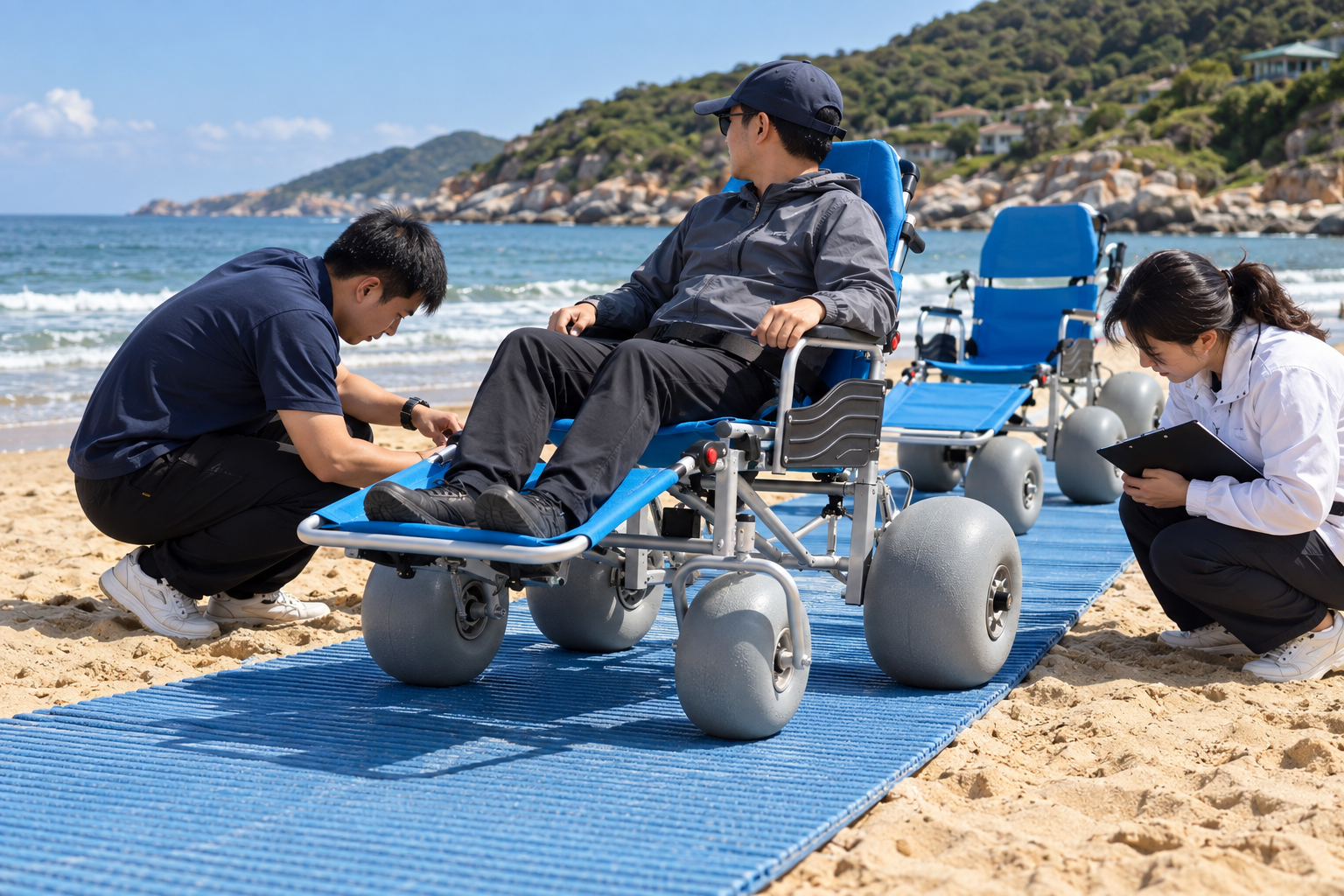
Multi-site beach accessibility should choose pilots that answer unresolved questions about equipment, site conditions, and support before wider purchasing. Write those questions into the pilot brief and supplier discussion. Explain which future sites share the conditions being examined and which remain outside the evidence collected.
What decision will the pilot change?
Give the trial a purchasing consequence. Test a defined service within documented equipment instructions and approved local conditions. Include the staff who would operate it and appropriate user input through the site's review process. A pilot that relies on additional temporary support should record that difference before its findings inform routine operations.
- State the uncertainty and the observation needed to resolve it.
- Identify equipment configuration and participating roles.
- Record interruptions, workarounds, and unresolved findings.
- Name the decision owner and conditions for repeating the review.
Limit how far a finding travels
After review, label each finding as relevant to specified sites, requiring local confirmation, or unresolved. Carry that classification into the next purchasing brief.
| Finding | Next step |
|---|---|
| Supported under comparable conditions | Apply to named sites after local review |
| Dependent on temporary staff or facilities | Resolve the permanent support arrangement |
| Configuration or route mismatch | Revise the proposal and repeat affected checks |
| Condition absent from the pilot | Gather evidence before wider approval |
Key Takeaway: Pilot value depends on the decisions it resolves and the boundaries of what was observed.
4. How can multi-site beach accessibility vary equipment?
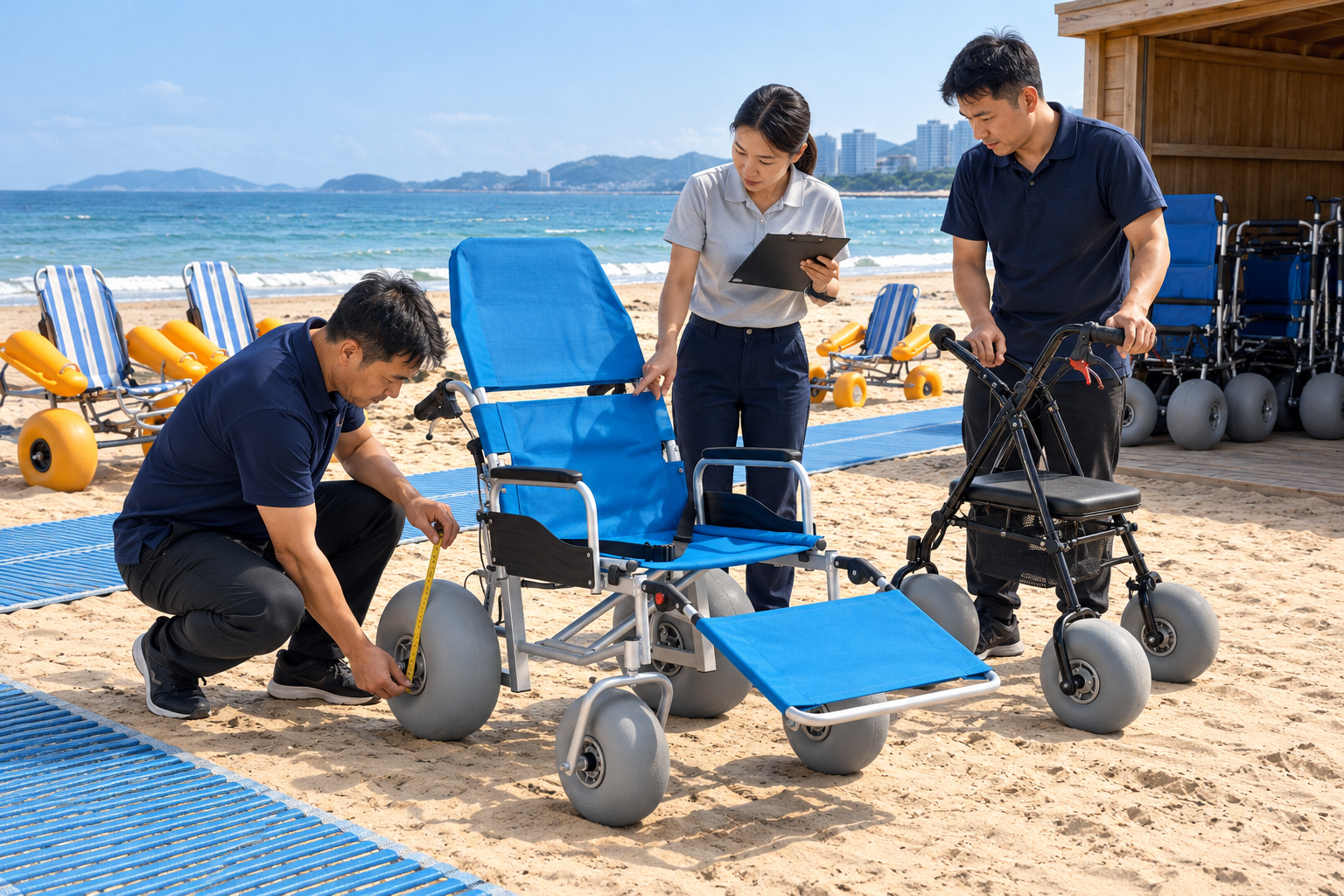
Multi-site beach accessibility can vary equipment through a controlled configuration schedule linked to each site's approved activities. Define the equipment role before selecting the model, options, and quantity basis. Record differences that affect instruction, handling, care, parts, or local support.
Specify each approved configuration
Make differences visible at ordering. Pair every configuration with the applicable beach wheelchair user manual and request clarification where the documentation does not identify the supplied version. Shared appearance does not establish interchangeable components or identical operating limits. Retain the supplier's written answer with the affected order lines.
- Assign a configuration reference to each approved combination.
- List the sites and activities for which it was reviewed.
- Record options, instructions, parts references, and exclusions.
- Require review before a substitution enters a later wave.
Separate common items from local variations
Keep quantity decisions in each site's demand assessment and record their basis in the schedule. Avoid turning a pilot's equipment list into an automatic allocation for every location.
| Schedule entry | Purpose |
|---|---|
| Common configuration | Identify the approved shared combination |
| Local variation | Explain the site condition requiring a difference |
| Quantity basis | Connect the order to a local service assessment |
| Proposed substitution | Trigger review of affected evidence and instructions |
Key Takeaway: Standardizing configuration records makes variation manageable without assuming every site needs identical equipment.
5. How should multi-site beach accessibility phase purchases?
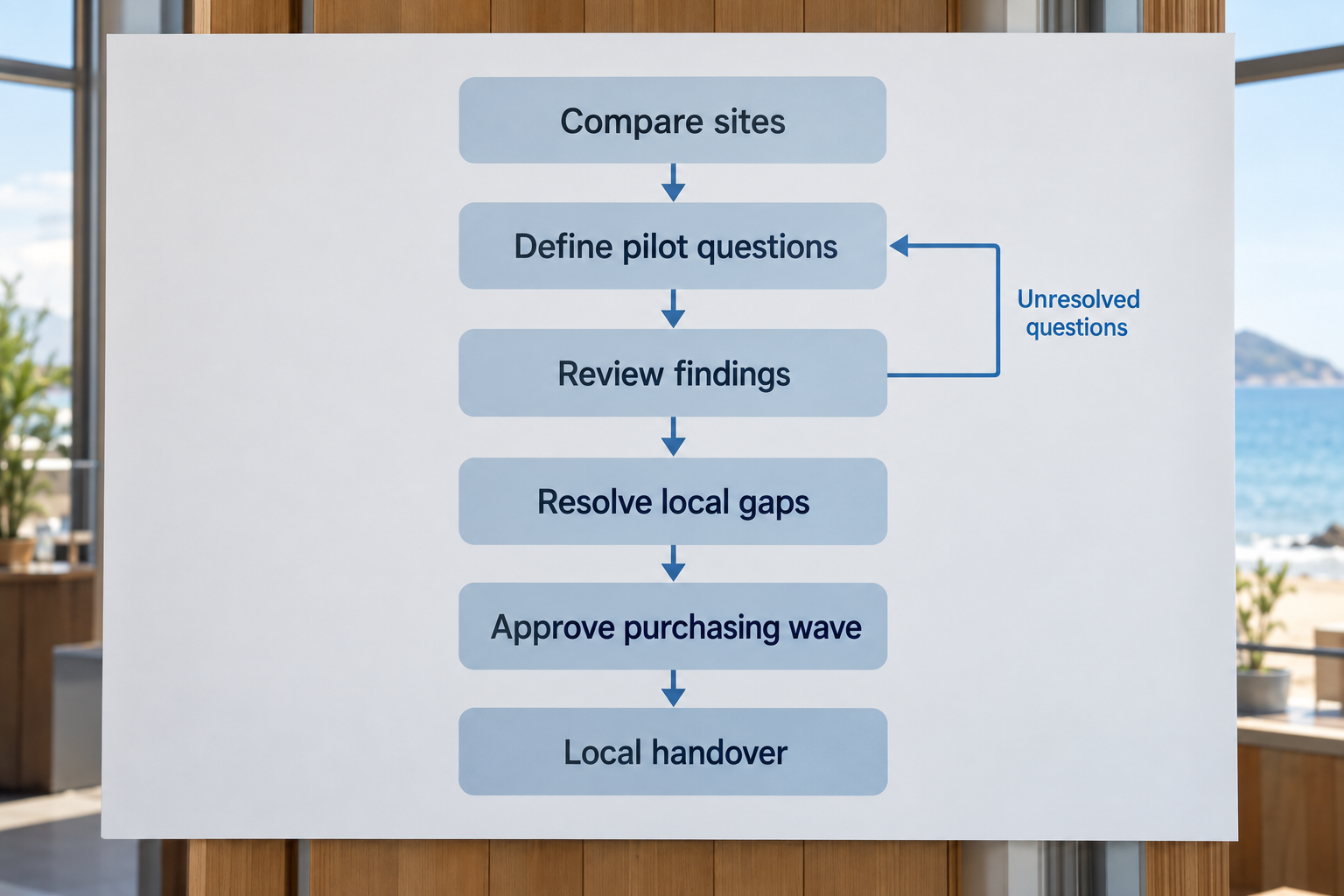
Multi-site beach accessibility should phase purchases around approved configurations and local readiness. Define a wave as the sites and order lines released through the same review. Confirm commercial terms for phased delivery, changes, and unresolved items in writing before committing to that purchasing arrangement.
Release only the scope supported by evidence
Connect the order to the receiving site. Bring pilot corrections, site works, support arrangements, and delivery readiness into the release discussion. Separate equipment that can be accepted from items still dependent on an unresolved configuration. Include time and budget for corrections without inventing a standard allowance.
- Confirm the configuration revision on every released line.
- Assign receiving, storage, and discrepancy-review roles.
- Check supplier responses against the current site brief.
- Retain the reason for each deferred item.
Keep a complete wave-release record
Use the following fields together in the approval record. A date on the purchasing calendar does not close an unresolved entry.
| Field | Required entry |
|---|---|
| Site and wave | Locations, order lines, and release scope |
| Entry evidence | Relevant pilot findings and approved revisions |
| Local dependency | Work, staffing, storage, or approval still required |
| Approver | Person authorized to release this scope |
| Unresolved item | Specific gap and affected sites or equipment |
| Corrective action | Owner and evidence needed to close the gap |
| Next decision | Review date and proceed, revise, or hold outcome |
Key Takeaway: A phased order should preserve a clear decision boundary between approved purchases and unresolved requirements.
6. Who supports multi-site beach accessibility locally?

Multi-site beach accessibility needs a named local operating owner supported by clearly assigned central purchasing, technical, and logistics roles. Specify who can release equipment, pause an activity, request repairs, and update availability. Check that a backup can act when the usual contact is absent.
Test the support arrangement across locations
Follow a fault through the whole support path. Ask the local team to explain how it would identify, report, isolate, and resolve an equipment problem. If shared stock is part of the response, review the beach wheelchair transport workflow and confirm the receiving site's acceptance responsibility. Central availability alone does not establish that a suitable unit can reach service.
- Name the local decision-maker and backup.
- Identify repair approval and supplier escalation contacts.
- Confirm access to required care and storage facilities.
- Record how another site accepts transferred equipment.
Assign support by action
Retain the agreed contact path in the site pack. Escalate a gap to the portfolio owner when the proposed service depends on support that no team has accepted.
| Action | Responsibility to assign |
|---|---|
| Pause or resume the local activity | Local operating authority |
| Review equipment faults or substitutions | Designated equipment reviewer |
| Arrange transfer or repair support | Regional support owner |
| Resolve an unassigned dependency | Portfolio decision owner |
Key Takeaway: Shared support becomes usable when the local team knows who will act and how the response returns equipment to service.
7. How is multi-site beach accessibility handed over?

Multi-site beach accessibility is handed over by confirming that local staff can operate the agreed booking-to-return service with the delivered equipment and current records. Separate delivery acceptance from permission to open the service. Assign a receiving operator who can identify missing documents, unfinished training, and unresolved local dependencies.
Rehearse the site-specific service
Check what the next shift will need. Combine common program instruction with the exact configuration, local route, and assistance boundaries. Observe the tasks assigned to each role and record anything requiring further instruction. Attendance records alone leave the reviewer without evidence of how the task was performed.
- Locate current instructions and the approved service boundary.
- Demonstrate assigned checks and the equipment-status process.
- Explain escalation, closure, return, and care responsibilities.
- Confirm the public description matches the handed-over service.
Record what the operator accepts
List accepted scope and outstanding items separately, including any activity kept closed. Give the local operator access to the records used to authorize opening.
| Handover element | Evidence to retain |
|---|---|
| Delivered equipment | Configuration and receiving result |
| Staff readiness | Observed tasks and outstanding instruction |
| Local operation | Route, responsibilities, and support contacts |
| Opening decision | Accepted scope, holds, and named authority |
Key Takeaway: Handover is complete for an activity when its equipment, people, records, and local opening decision agree.
8. How does multi-site beach accessibility control changes?

Multi-site beach accessibility controls changes through linked document revisions and an impact review for affected locations. Identify the site, configuration, procedure, and public information touched by each change. Give local staff a direct way to report when the approved record no longer describes operating conditions.
Trace the effect before issuing a revision
Follow the change to its users. A supplier substitution may affect instructions and parts, while a route change may alter briefing and visitor information. Decide which sites need further checks and who must acknowledge the update. Keep previous versions identifiable so staff can trace decisions without mistaking an old instruction for the current one.
- Record the change, reason, owner, and effective date.
- Identify affected sites, assets, documents, and activities.
- Set any temporary holds and required repeat checks.
- Confirm staff receipt and public-information updates.
Use findings to revise the next wave
Review recurring issues before releasing another wave. Record whether the finding changes a shared requirement, one site's arrangement, or the evidence still needed.
| Change source | Review question |
|---|---|
| Pilot finding | Which planned sites share the same condition? |
| Equipment revision | What instructions or acceptance checks change? |
| Local route or staffing change | Which activities need a new decision? |
| Visitor information mismatch | Who corrects the description and confirms it? |
Key Takeaway: Revision control should show both what changed and which operating decisions must be reconsidered.
9. What should multi-site beach accessibility deliver next?

Multi-site beach accessibility should deliver a site-by-site purchasing brief with approved equipment roles, local dependencies, and a controlled expansion sequence. Bring the comparison, pilot findings, configuration schedule, and support decisions into the same review. Each site should leave that review with a defined next action.
Turn the review into a bounded commitment
Close the gaps that affect the next order. Identify the evidence still needed before requesting or accepting a revised quotation. ARY's beach mobility range can support equipment discussions against that brief, with model-specific documentation requested for the proposed configuration.
- Confirm which sites and activities the next wave includes.
- Carry unresolved findings into named corrective actions.
- Review local handover and support readiness.
- Issue the approved brief with its revision and owner.
Approve the next step for each site
Keep the rollout decision short enough for purchasing and local operators to use together. Review deferred sites when their controlling dependency changes.
| Site decision | Next action |
|---|---|
| Ready for quotation | Send the approved configuration and scope |
| Evidence incomplete | Resolve the named question before release |
| Local dependency open | Complete the work or revise the service |
| Ready for local handover | Verify the delivered scope and operating records |
Key Takeaway: A useful rollout leaves every site with an evidence-based next step. Keep your ARY purchasing brief centered on equipment your local team can support; contact us to discuss the proposed configurations and phased requirements.
10. What do buyers ask about multi-site beach accessibility?

Buyers ask whether multi-site beach accessibility requires identical equipment, how to select a useful pilot, and when expansion should pause. These decisions depend on the approved service and evidence available at each location.
Can I use the same equipment package at every site?
Yes, where each site review supports the same configuration. Check the conditions behind the match. Differences in activities, routes, staff, or storage may require a local variation.
- Confirm the task and applicable instructions.
- Record the reason and approval for any variation.
What's the best way to select a pilot site?
Choose a site that can resolve an important rollout question under controlled conditions. Explain which other sites may use the findings and what still needs local confirmation. Include permanent operating staff in the review so temporary pilot support remains visible.
How do I know if expansion should pause?
Pause the affected scope when required evidence or local readiness remains unresolved. Identify the gap, assign the corrective action, and state who can reconsider the decision. Continue unaffected preparation where its approval remains valid.