
Write the standard operating procedure for the shift that will use it. A receptionist needs to know when a request becomes a confirmed booking. An attendant needs the correct model instructions, the released unit and the route approved that day. A supervisor needs to know who can pause the service and who can authorise reuse after a repair.
Start the document with its site, entrance, destination, operating hours, applicable equipment and named owner. State how staff find the current version, its effective date and the local emergency procedure. A land-only outing and a separately authorised water activity need clearly identifiable scopes. Do not copy instructions for one device or environment into the other.
Build each step around an action and its result
Use the following sequence as a starting structure for a local procedure. Complete it with the site’s actual roles, contacts, forms and model-specific instructions before staff rely on it.
| Stage | Assigned action | Leave the next team with |
|---|---|---|
| Request and allocation | Booking staff establish the desired outing, time, contact route and assistance questions, then confirm available resources. | A booking reference with either confirmed allocation or the specific decision still pending. |
| Before issue | Equipment staff identify the asset, current instructions and release state, complete its pre-use check and verify the route and cover. | An identified unit and destination cleared for the agreed handover, or a hold with an owner. |
| Visitor handover | The trained attendant discusses fit and support within their role, demonstrates permitted use, checks understanding and agrees the return. | Actual issue time, custodian, route limits, return arrangements and working contact. |
| During the visit | Staff receive requests for assistance, changes or late return and follow the local emergency procedure when urgent help is needed. | Clear responsibility for the individual and the affected route or equipment. |
| Return and preparation | Receive the unit and its accessories, record any difficulty, then complete approved cleaning, drying and inspection. | An accurate physical and system state, with faults directed to the responsible service contact. |
Remove every field without a defined decision purpose. The equipment lead may need to know which side of a wheel rubbed. A general maintenance log seldom needs the visitor’s diagnosis. Keep restricted personal or incident information in the appropriate system and link only the operational reference where necessary.
Reference the exact instructions at the point of use
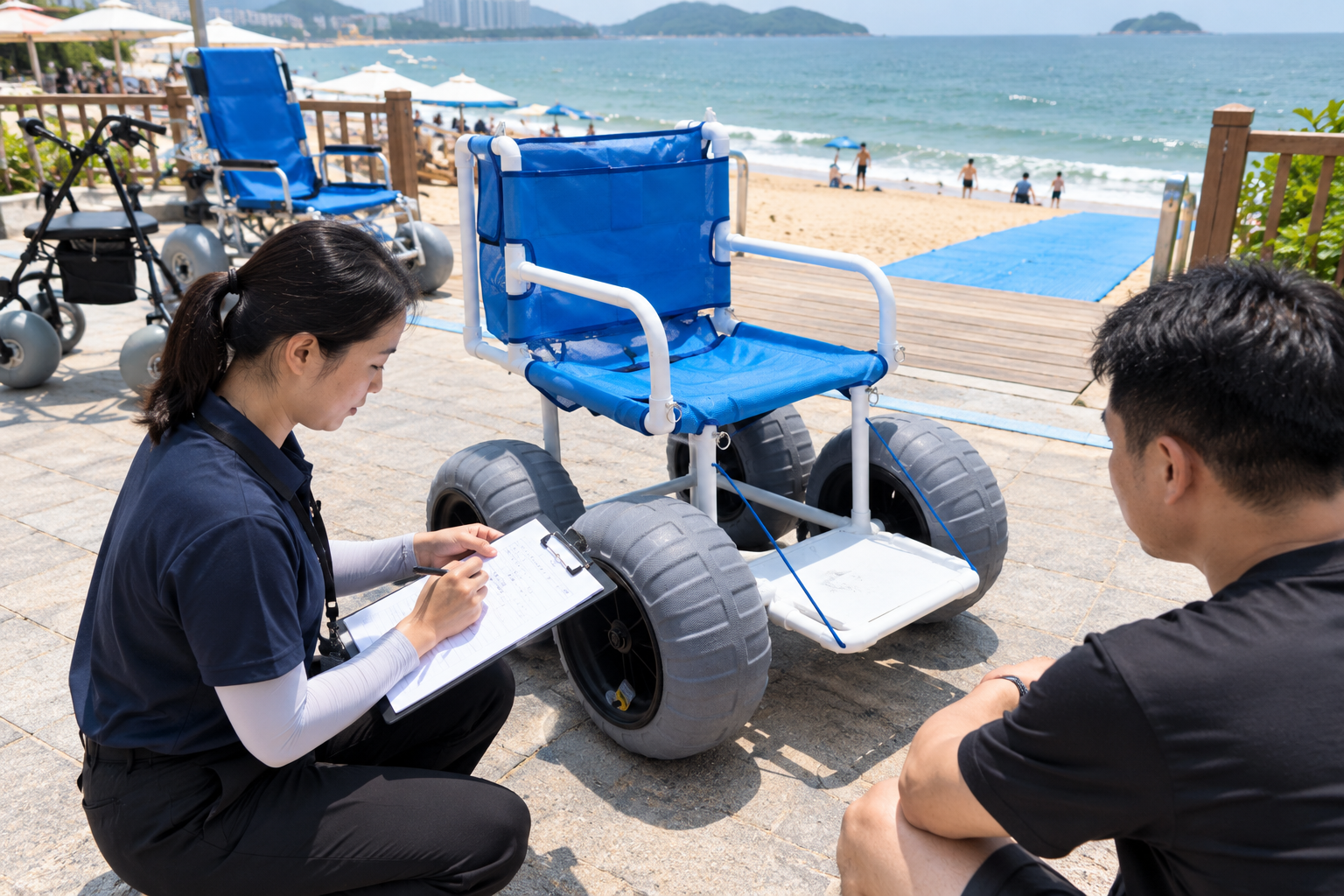
List each model, revision, manual and the staff roles trained for its tasks. For example, a procedure covering the AY-STZ1.0 walking aid can direct staff to the supplied wheel, handle, brake, folding and rest-seat checks. A procedure for the AY-ST-V1.0 floating chair needs its own component instructions, trained supervision and controlled calm-water operating arrangements. Make it easy to locate those separate documents when an asset is issued. Beach walker manual · Floating chair manual · Floating chair operating conditions
Record what the staff member must observe, where they mark the result and what stops the next step. For visitor handover, include the collection point, equipment ID, planned destination and how the visitor can ask to stop or return early. The operator should define who handles an unresolved suitability question and what alternative assistance can actually be offered. Staff training for beach walker handover
Write the exception before calling the procedure complete
Suppose a returned chair has a loose wheel attachment and another guest is due shortly. The receiver first follows the site’s immediate assistance arrangements, identifies the chair and records the observed fault. The unit is marked held at its physical location and in the booking list. The supervisor checks whether a suitable released alternative and trained staff are available. Reception communicates only the arrangement that can be confirmed.
Make release authority narrower than hold authority where appropriate to the operation. Anyone assigned to identify a dangerous condition must know how to stop issue and obtain help. Only the authorised person should close the technical hold after the required work and recheck. A purchase order for a replacement fitting leaves the chair unavailable until that fitting is installed and checked.
Test the document with a relief shift
Give a colleague who did not write the SOP a normal booking and the loose-wheel scenario. Ask them to locate the correct unit, manual, route status and receiver. Have them show which fields they would complete and identify who tells the waiting guest. Use a tabletop scenario or clearly marked training equipment. Avoid introducing a real fault into public equipment.
Fix the instruction wherever the relief shift had to guess. Issue the approved revision to each desk, store and supervisor, withdraw superseded copies and rehearse affected tasks after a model, route, contact or staffing change. The document is ready when a new shift can carry out its assigned tasks, identify where its authority ends and leave the following shift a reliable service state. Accessible beach service operations