
A floating beach wheelchair program supports safer water access when a team connects equipment choice, route planning, trained assistance, guest communication, and daily checks in one written operating plan. A resort or public beach may own suitable equipment yet still face gaps between parking, sand, transfer points, shallow water, cleaning, and storage. Those gaps create uncertainty for staff and visitors. A practical solution starts with the full service route rather than the chair alone.
This article explains how a B2B operator can plan a floating beach wheelchair program around clear roles, repeatable checks, respectful guest support, and site-specific limits. It offers operating questions for procurement teams, accessibility managers, recreation leaders, and rental supervisors without replacing manufacturer instructions, local rules, or professional site review.
For procurement context, use all-terrain beach wheelchair together with beach mat route planning.
For broader destination-level context, consult the UN Tourism accessibility publications and guidelines. Apply local requirements and current product documents to the specific project.
What should a floating beach wheelchair program achieve?
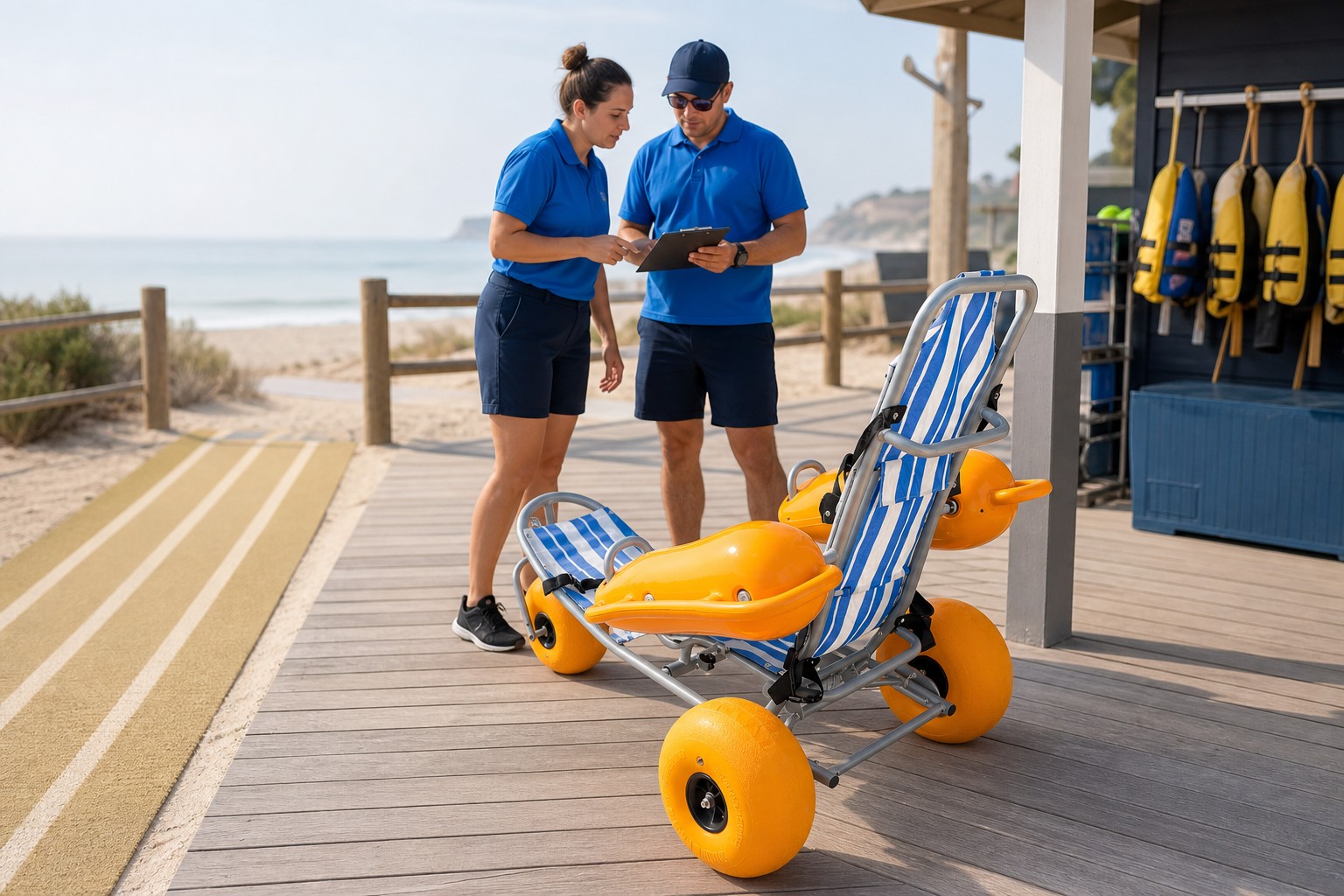
A floating beach wheelchair program should create a repeatable path from arrival through water access and back to a clean, stored chair. That goal is broader than moving a guest across sand. Managers need a service that staff can explain, operate, pause, and document with consistent judgment. A written scope also helps buyers separate equipment needs from staffing, route, storage, and booking needs.
Turn service goals into operating criteria
Here’s the practical point: define what the program will offer before comparing chairs or drafting promotional copy. State whether service covers sand travel only, shallow-water entry, supported floating in a designated zone, or a mix approved by local policy. Match each activity with a responsible staff role.
- Name each approved activity and operating area.
- Record who opens, pauses, and closes service.
- Describe how guests request support and receive instructions.
- List the checks that must pass before equipment leaves storage.
Key Takeaway: A narrow, written service scope gives staff a stable basis for daily decisions.
| Program question | Working decision |
|---|---|
| Where does service begin? | Named arrival or booking point |
| Where may the chair travel? | Mapped land and water zones |
| Who controls operation? | Assigned trained staff roles |
Use this table as a short briefing prompt before a site walk.
How should teams map the route from parking to water?
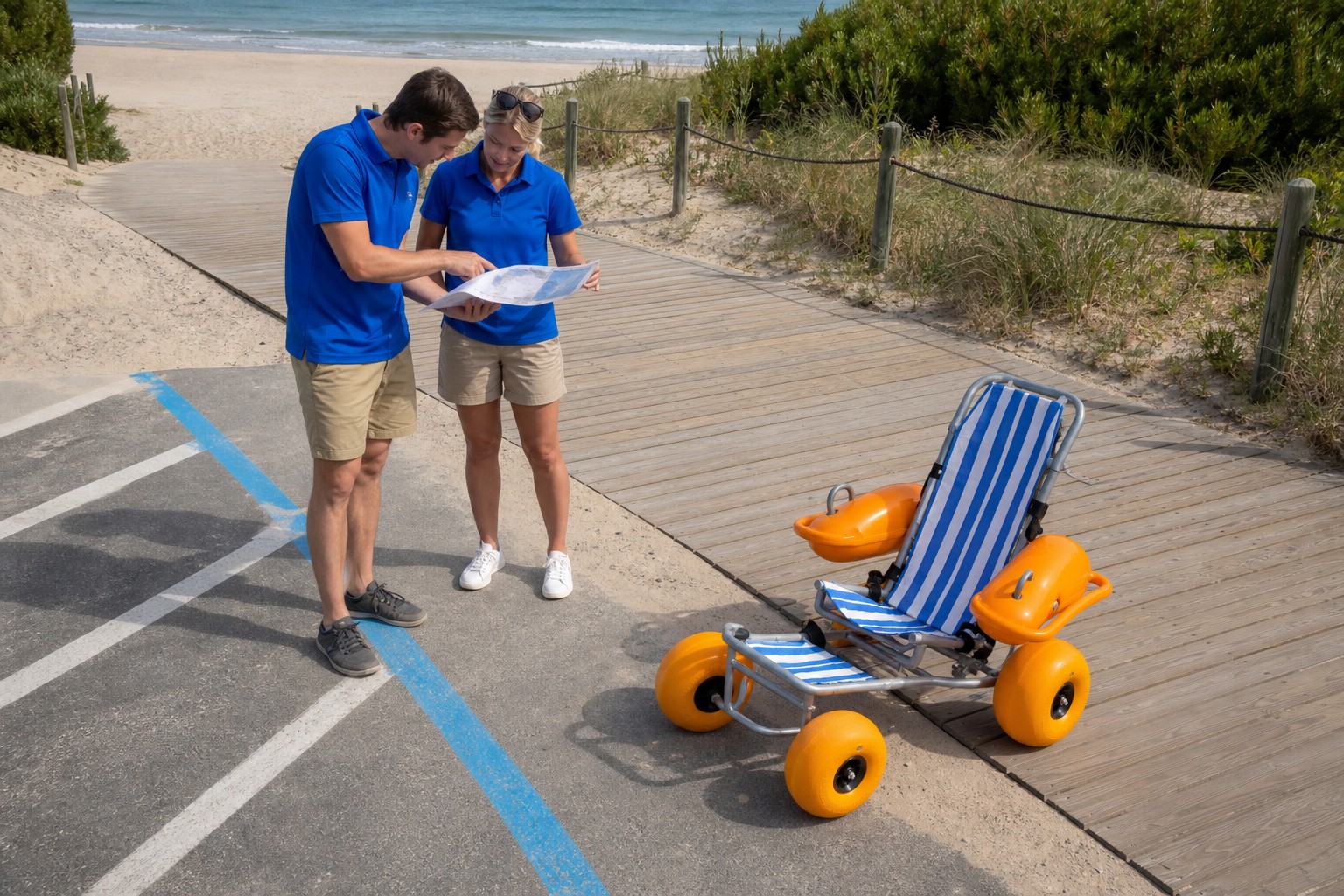
Teams should map a floating beach wheelchair route as a chain of connected handoffs from parking or reception to sand, water, rinse area, and storage. A chair that performs well on soft sand still needs workable approaches, turning areas, and a clear return path. Route planning should also cover queues, shade, changing shoreline conditions, and points where another mobility device may be present.
Walk every surface and handoff
A useful checkpoint: follow the route at the same time of day when service will operate. Staff can note tight corners, loose sand, steep changes, drainage channels, crowded zones, and places where communication becomes hard. The floating wheelchair water-park application page can help teams frame route discussions for managed aquatic settings.
- Mark arrival, transfer, launch, exit, rinse, and storage points.
- Note surfaces that change after wind, rain, or tide movement.
- Keep emergency and public circulation routes clear.
- Assign a backup route or closure point.
Key Takeaway: A route map should show operational handoffs rather than one line from boardwalk to surf.
| Route segment | Review focus |
|---|---|
| Arrival to transfer | Space, privacy, communication |
| Transfer to water | Surface, turns, assistance |
| Exit to storage | Rinse access, drainage, drying |
The route is workable only when every segment supports the next one.
What site conditions should staff check before opening?

Staff should check weather, water, shoreline, route surfaces, crowding, visibility, and equipment condition before opening a floating beach wheelchair service. A checklist helps teams notice change rather than relying on memory. Local beach rules, lifeguard direction, manufacturer instructions, and the operator’s own risk controls should set the final go or no-go decision.
Use a site-specific opening checklist
The working rule is simple: if a condition falls outside the written operating range, pause service and escalate the decision. Staff should never feel pressured by a booking or queue to ignore a closure rule. The checklist must use plain language that a trained operator can apply during a busy shift.
- Confirm that the approved route remains open and visible.
- Check water boundaries and local staff instructions.
- Review crowd levels around transfer and launch points.
- Inspect the chair before it reaches the guest.
Key Takeaway: A clear pause rule protects consistent judgment when coastal conditions change.
| Check area | Pass question |
|---|---|
| Route | Is the mapped path usable now? |
| Water zone | Is the approved area open? |
| Staffing | Are assigned roles present? |
A short checklist is useful only when staff may act on its result.
How should an operating plan assign staff roles?
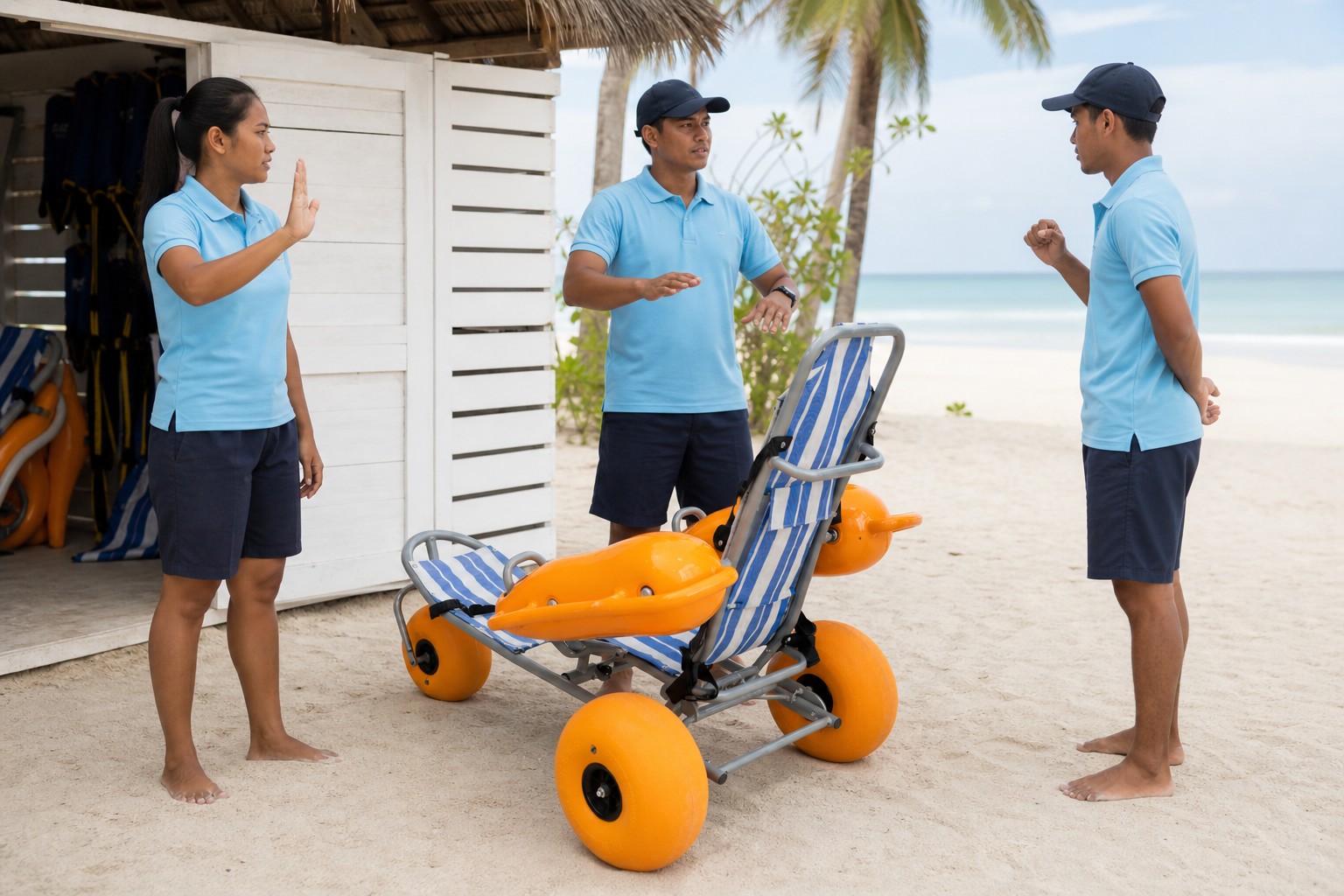
An operating plan should assign enough trained staff to follow product instructions, local rules, and site controls for each floating beach wheelchair activity. A fixed staffing number may not fit every chair, guest, route, or water setting. The plan should instead name roles, decision authority, communication signals, and conditions that require more support or a paused session.
Define control, support, and communication
Here’s what operators can act on: give one person clear control of movement and one person clear authority to stop the activity when the written plan calls for it. Other roles may cover guest communication, route clearance, equipment handling, or shore observation. Teams can compare their draft with the operational topics in this attendant-use article.
- Name the lead operator for each session.
- Set short verbal signals for start, stop, and return.
- Record who checks route and equipment status.
- Keep role changes visible in the daily log.
Key Takeaway: Named roles reduce hesitation when a session needs a quick change.
| Role | Core duty |
|---|---|
| Lead operator | Controls chair movement |
| Support operator | Assists route and guest communication |
| Shift lead | Opens, pauses, or closes service |
Role clarity matters more than an informal assumption that someone will help.
What guest information should teams collect before a session?
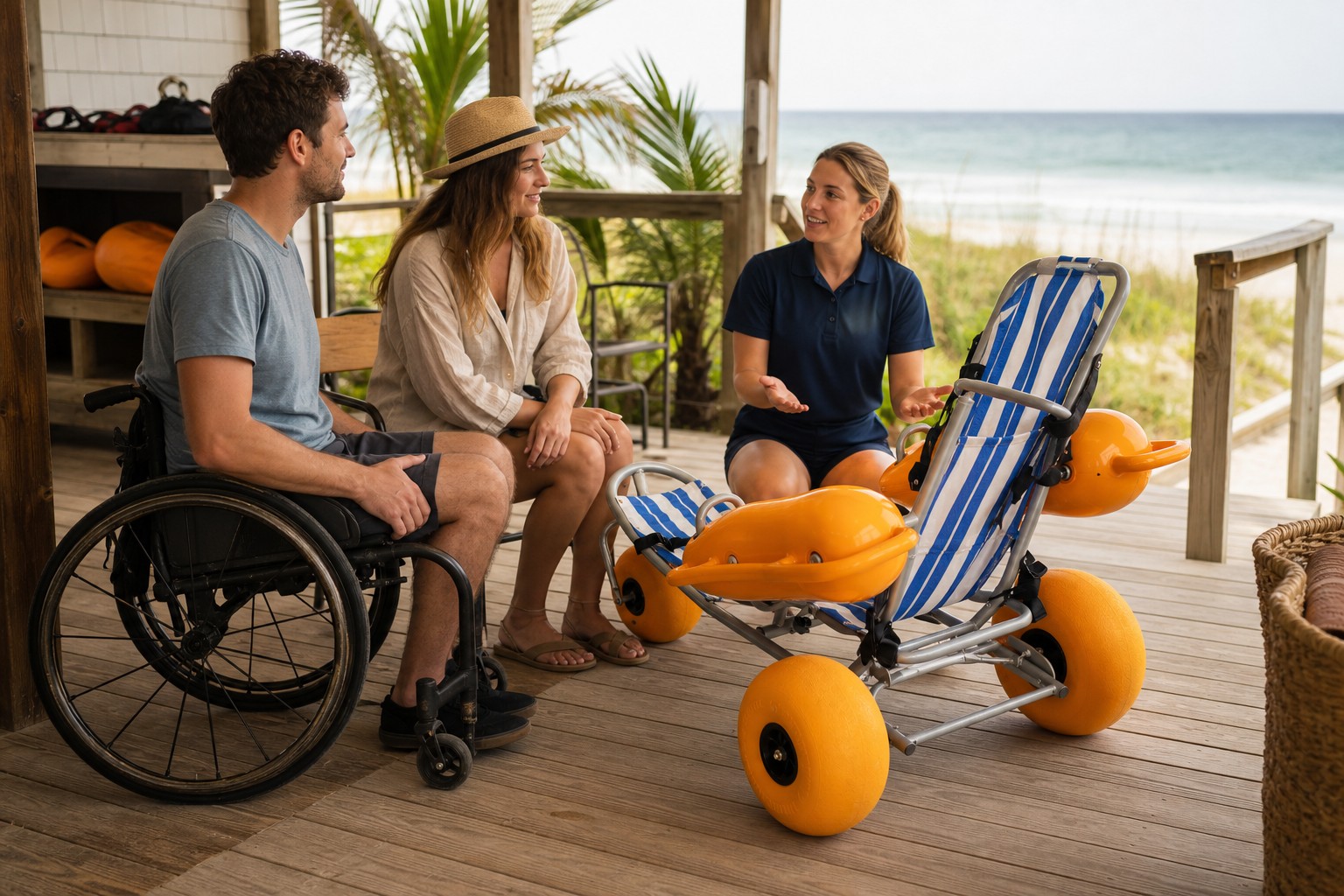
Teams should collect only the practical information needed to match a floating beach wheelchair session with product limits, site rules, transfer preferences, and available assistance. The process should remain respectful and avoid promises about suitability or outcomes. Guests also need a plain description of what the service includes, what it does not include, and when staff may stop.
Build a short booking and briefing script
The key question: can staff explain the service in the same clear way on the phone, at reception, and beside the beach? Use open questions about preferred assistance, companion involvement, communication, and the route. Refer any suitability question beyond staff scope to the guest and their chosen qualified adviser.
- Confirm booking time, meeting point, and contact method.
- Ask about preferred transfer and communication support.
- Explain approved land and water activities.
- Share cancellation or pause conditions before arrival.
Key Takeaway: A concise briefing supports informed participation without turning staff into clinical decision-makers.
| Briefing topic | Plain-language message |
|---|---|
| Service scope | Activities staff can support |
| Guest preferences | Assistance and communication choices |
| Pause conditions | Situations that stop or shorten a session |
Good communication starts before the chair reaches the sand.
How should teams prepare a consistent transfer area?
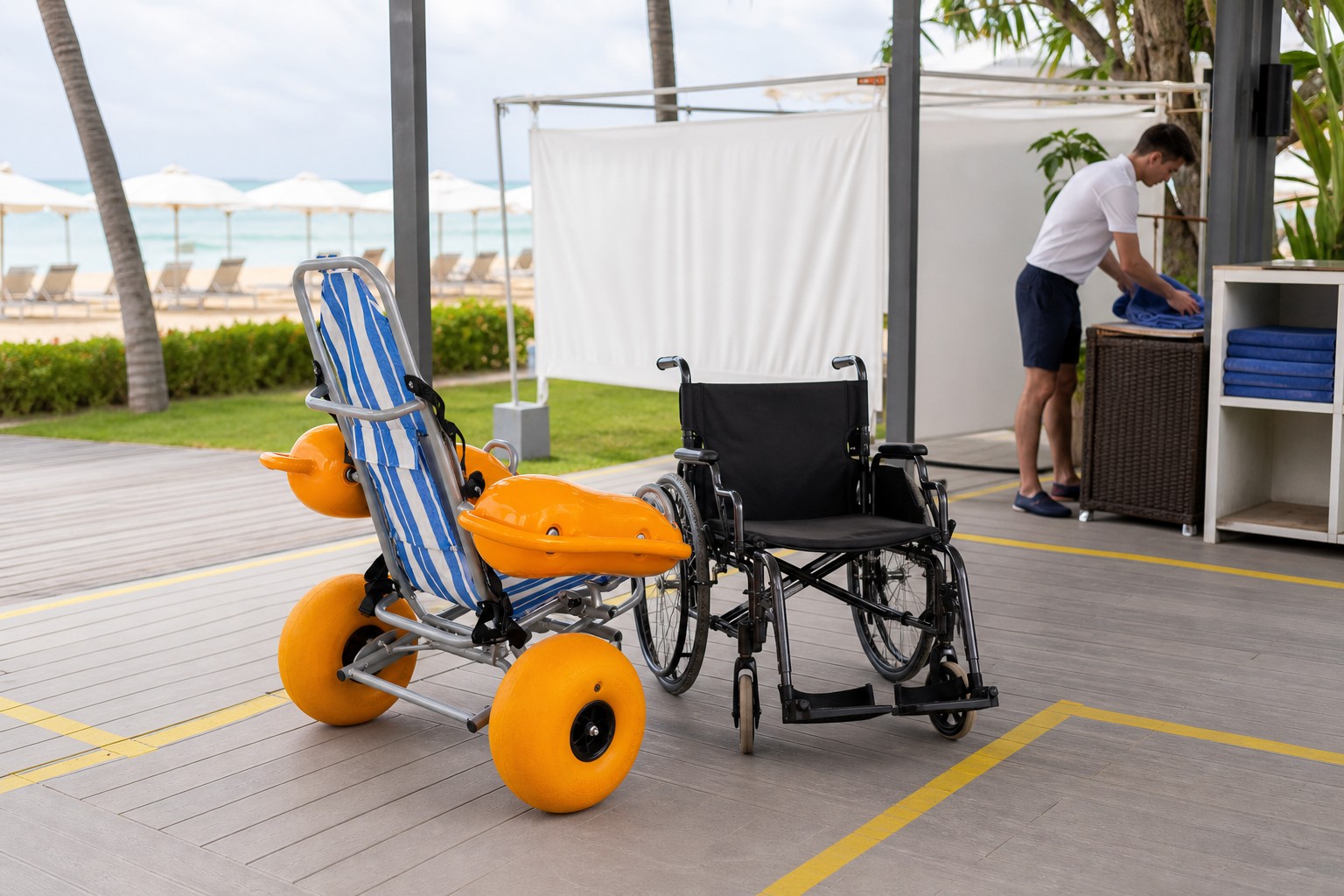
Teams should prepare a floating beach wheelchair transfer area with stable access, adequate working space, privacy options, clear staff positions, and the chair set according to its instructions. The location should keep the public route open while giving the guest and staff time to communicate. A rushed transfer beside moving traffic or unstable sand creates avoidable confusion.
Stage the area before the guest arrives
A practical detail matters here: place every needed item within reach before beginning. Confirm brakes or stabilizing features as directed by the product manual. Staff should discuss the sequence with the guest and never pull on pontoons, arm supports, or frame points that are not approved handling areas.
- Clear loose gear and trip hazards from the working zone.
- Position the chair and other mobility device for the agreed method.
- Confirm staff roles and verbal signals.
- Recheck supports, straps, foot position, and comfort before movement.
Key Takeaway: A staged transfer area replaces improvisation with a calm, repeatable sequence.
| Setup element | Staff check |
|---|---|
| Space | Clear and private enough for the task |
| Chair position | Stable under product instructions |
| Communication | Sequence agreed with the guest |
The area is ready when people and equipment have defined positions.
How should staff manage shallow-water entry and exit?
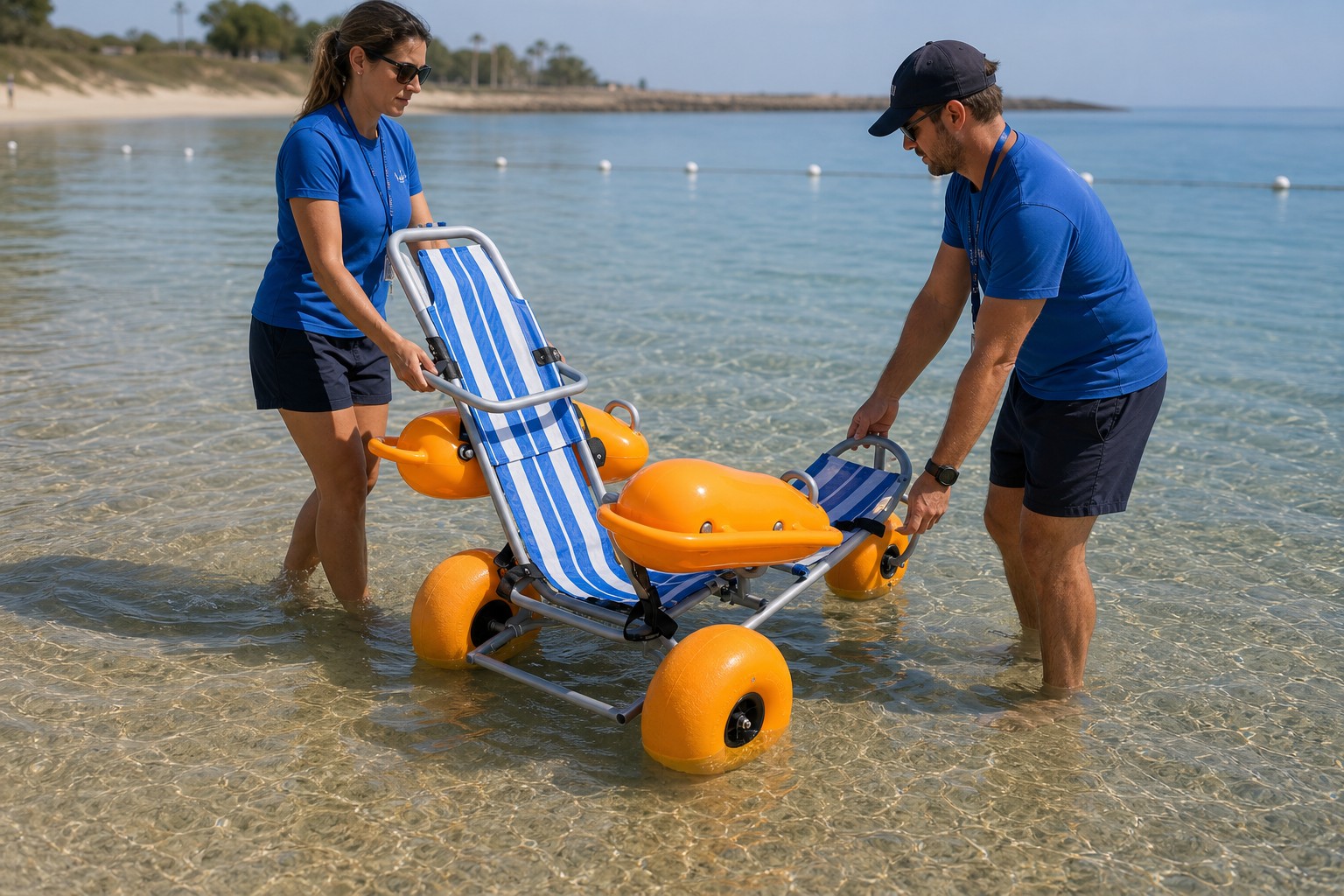
Staff should manage floating beach wheelchair entry and exit within the approved water zone, product guidance, local conditions, and the team’s written stop rules. Entry should be deliberate, with continuous communication and control of chair orientation. Exit planning begins before entry because shoreline shape, waves, crowds, and guest comfort may change during a session.
Use boundaries and simple signals
The operational anchor: everyone involved should know where the session may go and what signal starts the return. Staff should keep hands on approved control points and maintain the staffing arrangement stated in the plan. A guest request never overrides a boundary or closure rule.
- Confirm the entry and exit path immediately before movement.
- Use agreed words for pause, return, and stop.
- Keep the chair oriented according to manufacturer guidance.
- Return early when conditions approach a written limit.
Key Takeaway: Clear boundaries and signals help staff act before a changing condition becomes urgent.
| Water-stage prompt | Team response |
|---|---|
| Route changes | Pause and select the approved alternative |
| Guest requests return | Begin the planned exit |
| Staff loses clear control | Stop and return under the plan |
Entry and exit should follow one coordinated operating sequence.
What cleaning and inspection steps belong after each use?
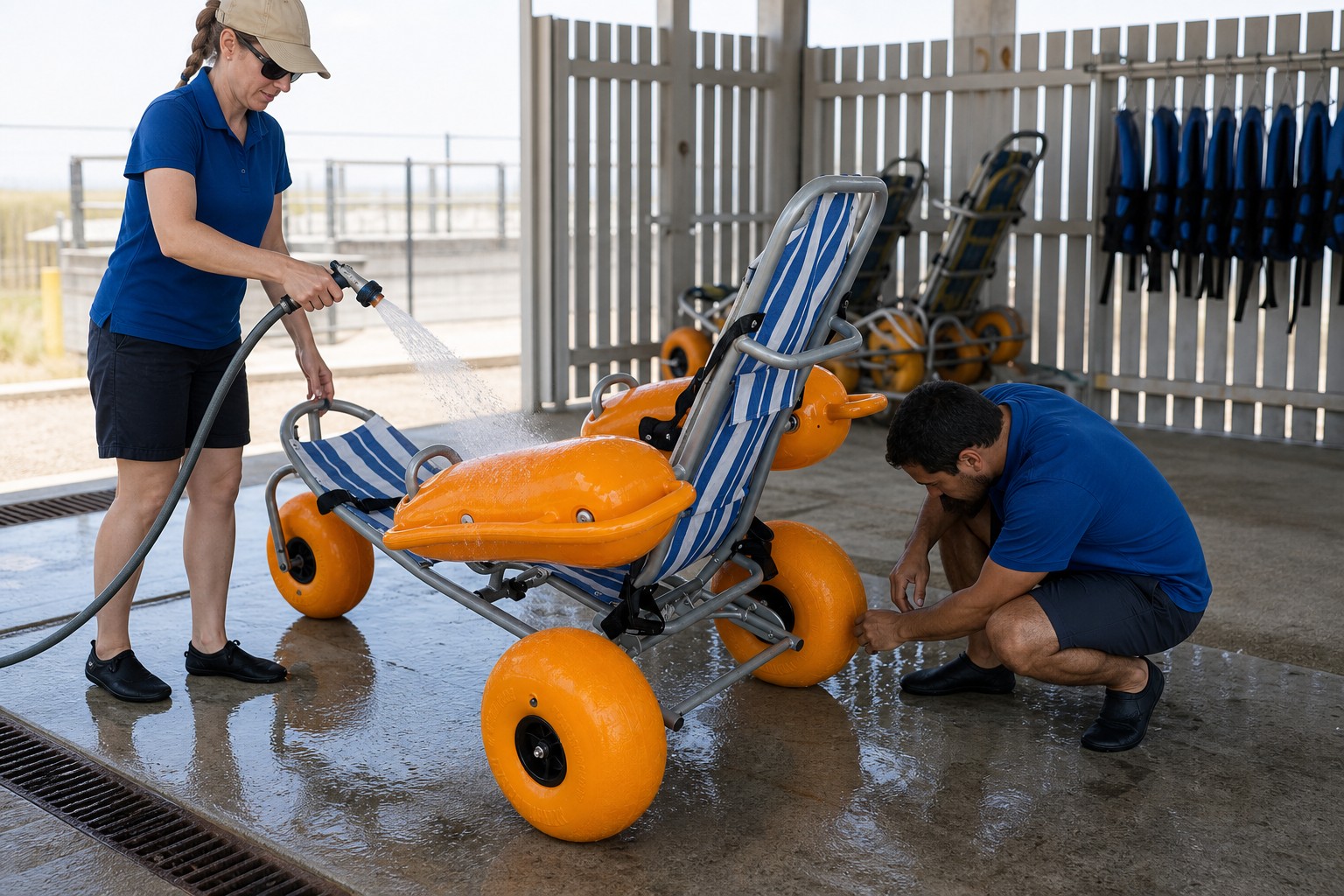
Post-use care for a floating beach wheelchair should cover fresh-water rinsing where directed, removal of sand and debris, drying, visual inspection, fault recording, and correct storage. Product instructions govern the exact method and materials. Staff should avoid harsh chemicals, high-pressure spray, or disassembly unless the manufacturer permits them.
Create a close-down sequence
Here’s the reliable rhythm: move from dirty areas toward clean inspection points so sand and salt are not carried into storage. Pay close attention to wheel hubs, frame joints, fasteners, fabric, straps, handles, and flotation parts. This saltwater maintenance resource offers related topics for a local checklist.
- Rinse and clean according to product instructions.
- Dry surfaces and places where water may collect.
- Check for looseness, wear, cuts, corrosion, or damage.
- Tag and separate equipment that needs review.
Key Takeaway: Cleaning and inspection work best as one documented close-down task.
| Care stage | Record |
|---|---|
| Clean | Method and staff initials |
| Inspect | Condition found |
| Store or hold | Ready status or fault tag |
A clean chair is not automatically a service-ready chair.
How should managers train staff and record operations?
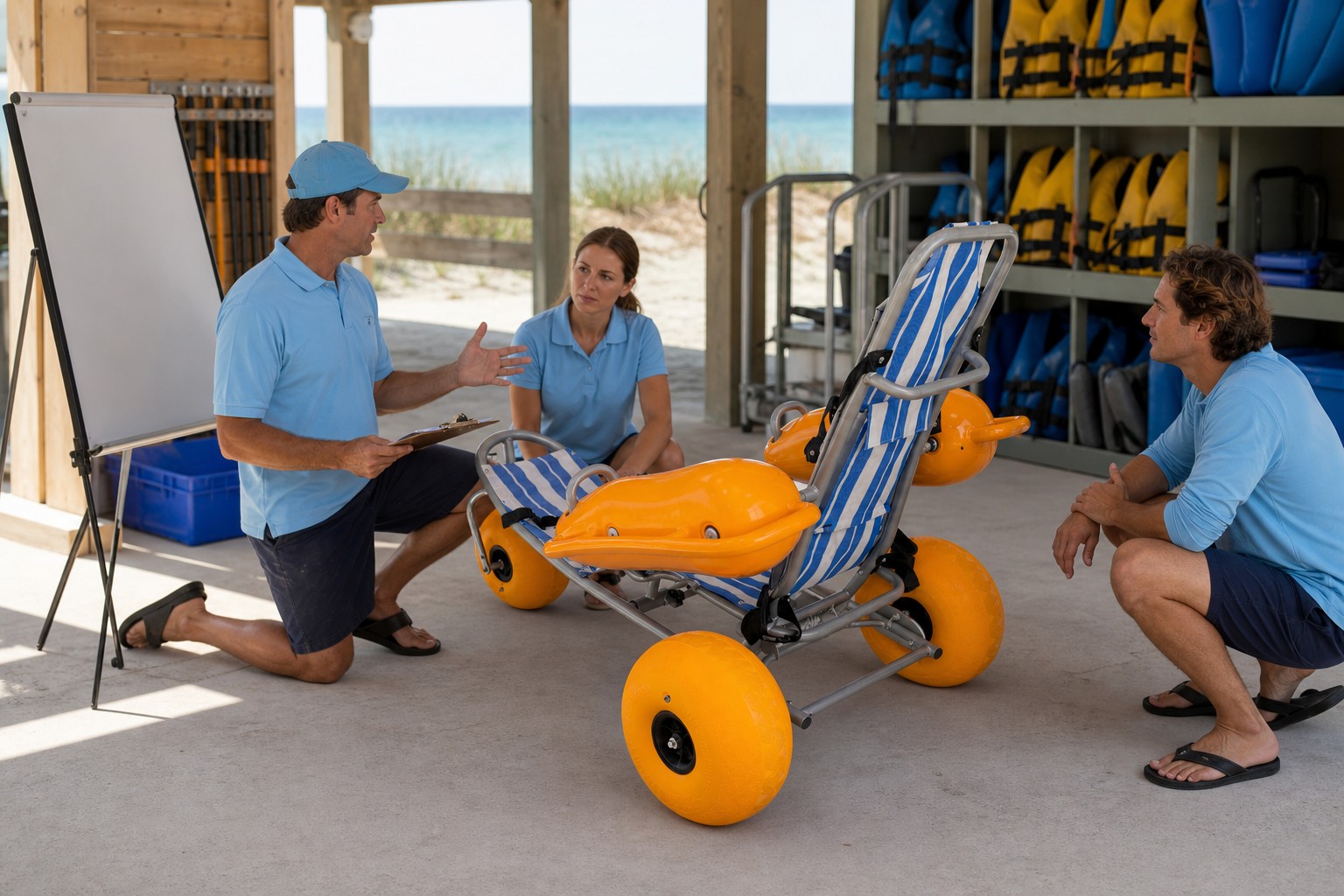
Managers should train floating beach wheelchair staff through product instruction, route practice, role drills, guest communication, cleaning tasks, and documented competency review. A single demonstration may not prepare a team for changing conditions or role swaps. Records should show who trained, what they practised, and which duties they may perform.
Connect drills with daily records
The useful shift in thinking: treat logs as operating tools rather than paperwork stored after the season. Booking notes, opening checks, session records, cleaning entries, faults, and service actions can reveal repeated friction at one route point or task. Managers can then revise training and site setup.
- Run dry-route and water-zone practice under approved conditions.
- Practise pause, return, and equipment-hold decisions.
- Record staff authorization by role.
- Review recurring faults and near misses at set intervals.
Key Takeaway: Training records help managers confirm that written procedures appear in daily practice.
| Record | Management use |
|---|---|
| Training log | Role authorization |
| Daily checklist | Opening and closing status |
| Fault log | Repair and purchasing decisions |
Patterns in records can guide the next operational review.
What should buyers compare before purchasing equipment?
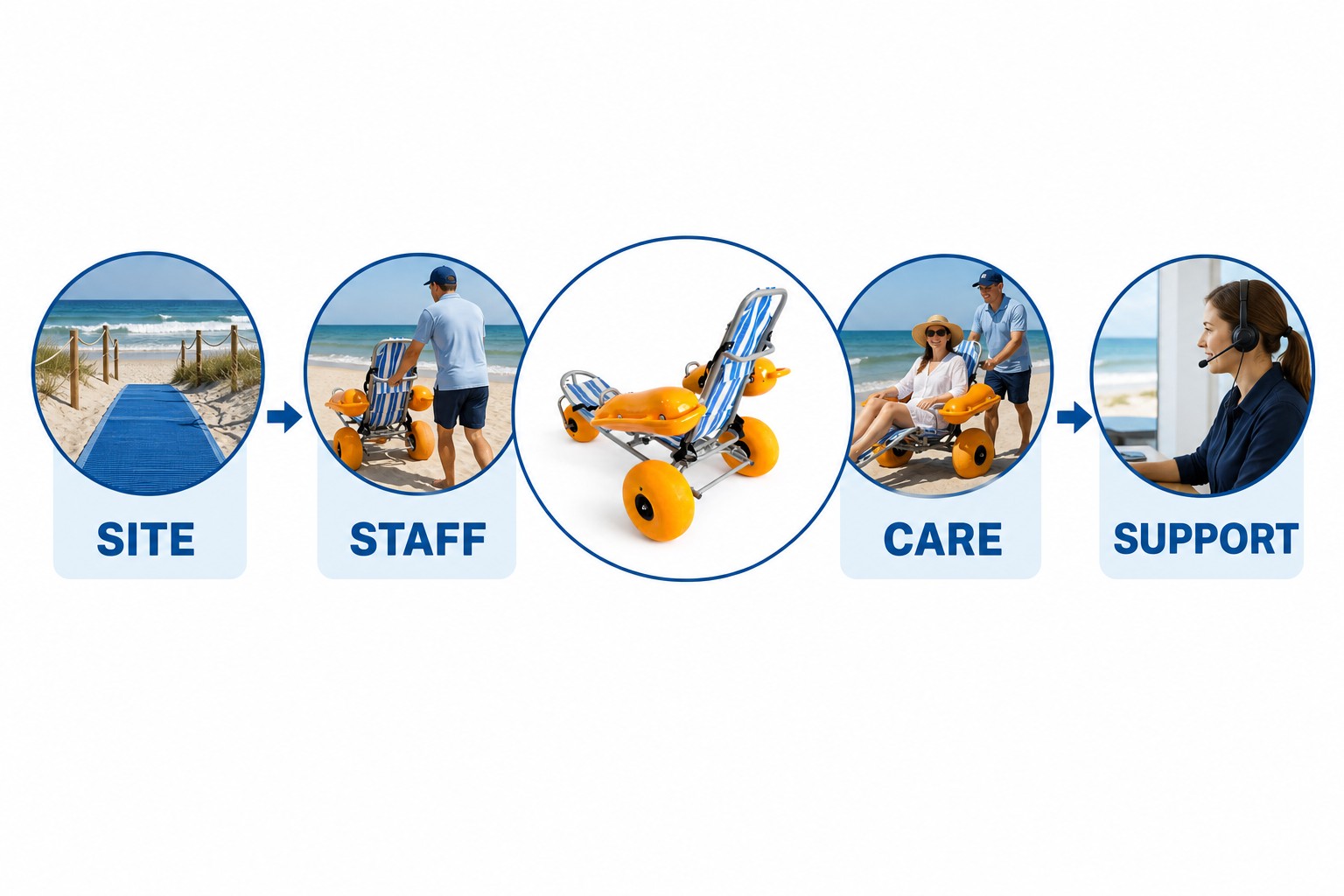
Buyers should compare a floating beach wheelchair against the planned route, approved activities, operator capacity, cleaning setup, storage space, parts access, documentation, and supplier support. A visual product comparison alone cannot show how the chair will fit a complete service. Procurement teams should give suppliers a written use case and ask for clear, verifiable documentation.
Build a use-case comparison sheet
A strong buying question: which option fits the operating plan with the fewest unresolved gaps? Ask each supplier for product instructions, limits, care guidance, packing details, parts information, warranty terms, and operator training materials. Do not fill missing fields with assumptions.
- Compare dimensions and handling needs with the mapped route.
- Review approved land and water use stated by the supplier.
- Check cleaning, drying, storage, and transport requirements.
- Record parts lead times and support contacts in writing.
Key Takeaway: The best procurement choice fits a verified service plan rather than a photo or isolated feature.
| Comparison area | Evidence to request |
|---|---|
| Site fit | Dimensions and handling guidance |
| Operations | Instructions and stated limits |
| Ownership | Care, parts, warranty, support |
This comparison turns procurement into a documented operating decision.
Closing note: A floating beach wheelchair program works through connected decisions: service scope, route, opening checks, staff roles, guest communication, transfer setup, water boundaries, care, training, and procurement evidence. Teams can use these ten questions as a workshop agenda, then align every answer with supplier instructions and local rules. For product or program questions, contact us today and share the route, operating setting, storage plan, and service goals you need to review.
FAQ
Can I run a floating beach wheelchair service without trained attendants?
No. Follow the product instructions, local rules, and your written operating controls. A managed program normally needs trained people assigned to movement, communication, checks, and stop decisions.
Daily operating checks
What’s the best route for a floating beach wheelchair?
The best route is the one verified for the specific chair and current site. It connects arrival, transfer, sand, approved water access, rinse, and storage without unresolved handoffs.
How do I know if water conditions are suitable?
Use your site-specific opening checklist. Lifeguard direction, local closures, product guidance, weather, water, visibility, and shoreline conditions should inform the decision.
Can I use one operating plan at every beach?
No. Reuse the framework, then rebuild route limits, staff roles, water boundaries, and closure rules for each site.
What’s the best procurement document for comparing chairs?
A use-case comparison sheet works well. It links each supplier response with route fit, approved use, handling, care, storage, parts, and support evidence.