
When a supplier calls a beach walker durable, ask which parts your technician can inspect, which can be replaced, and what would put the walker out of service. A demonstration on a showroom floor gives the buyer a first look at assembly and steering. A sample returned from the proposed route lets the maintenance team see where sand collects, whether the brakes still operate as instructed and how much preparation the next user will need.
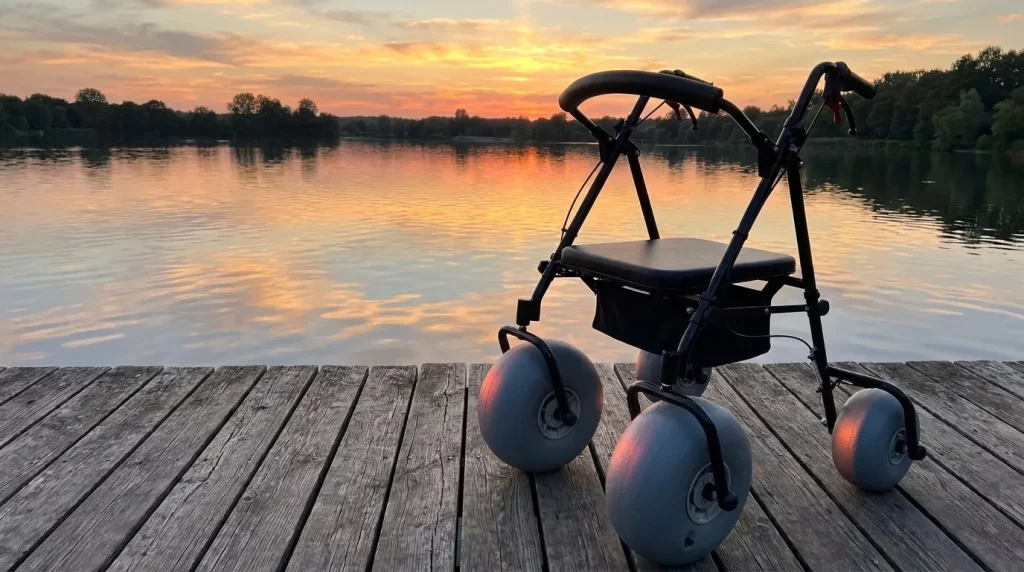
The AY-STZ1.0 provides a specific example for a fleet buyer. It is a walking aid with four wheels, adjustable handles with brakes, a folding frame, a rest seat and a storage bag. Commission it for the walking-support service your site can offer. A prospective user’s fit and ability to operate its controls need individual attention. AY-STZ1.0 walking-aid manual
Match the delivered sample to its specification
Check the model label against the order before accepting a sample. Page 2 of the manual lists an epoxy-painted carbon-steel frame and a stainless-steel front fork. Inspect the finish where frame members meet and where parts touch during folding or storage. Photograph any damaged coating, edges or displaced fittings as delivered so that later marks can be distinguished from arrival damage.
The manual lists 9-inch front wheels and 12-inch rear wheels. Record which assembly belongs at each end. When ordering a spare, identify the wheel part, its mounting interface and its retention hardware. Similar-looking wheels with the same outer diameter may use different hubs. Keep a photograph of each fitted interface alongside the supplier’s parts reference. Beach walker replacement wheel fit

Let the receiving team do the setup
Give the supplied instructions to the people who will prepare and store the fleet. Have them set up the empty walker on firm, level ground. They should be able to identify the intended folding mechanism, confirm its operating position and adjust the handles according to the manual. A handle that shifts after adjustment or an uncertain frame connection needs investigation before a visitor uses the unit.
Inspect both brake controls, their connections and any visible cable routing, then perform the supplier’s prescribed function check. Fold and reopen the empty frame as directed. Check whether a cable or the bag catches on another part during that movement. Ask the supplier to show how staff should verify correct reassembly. For the seat, inspect its attachments and request the instructions that govern stationary rest use.
| Sample feature | Record at receipt | Reason to pause acceptance |
|---|---|---|
| Coated frame and front fork | Model, overall condition and photographs of contact points | Distortion or damage needing a supplier disposition |
| Front and rear wheels | Size, position, attachment and replacement reference | Wrong component, rubbing or uncertain retention |
| Adjustable handles and brakes | Selected setting and result of each instructed check | A setting moves or a control fails to operate as specified |
| Folding frame, seat and bag | Complete fitted parts and the setup needed for storage | Unresolved engagement or interference after reopening |
The listed net weight is 13.5 kg and the stated capacity is 100 kg. The former helps staff plan their own handling assessment. The latter is a manufacturer limit. Have the service lead review the intended user and setup before a trial. If the walker must travel in a vehicle, measure the approved folded configuration and the actual loading opening. The carton dimensions describe shipping.
Take the sample from the boardwalk onto the intended sand route
Can the walker cross your boardwalk-to-sand transition with the planned assistance? Start the trial at that point. Examine the lip at the boardwalk or mat end and the sand immediately beyond it. Note the surface, direction of travel and room to turn. Staff can first examine clearance and ordinary movement using the supplier’s approved checks. Any trial with a visitor should follow an approved, supported plan suited to that person.
Separate the results for each stretch. Record whether a front wheel caught at the transition, whether the operator could maintain direction and where assistance was needed on the return. An otherwise suitable model may require a different collection point or a shorter route. Use the observation to identify a specific change and repeat the affected part of the trial. Beach walker soft-sand route planning
Check the sample again after seaside use
At the return station, make room to check the brakes and wheels and let the fabric dry before storage. Remove sand and salt using the method supplied for the walker, allow the seat and bag to dry, and recheck the moving parts. A gritty sound at one wheel, a frayed cable or a rub mark that reappears after cleaning gives the supplier a specific problem to assess. Record its location and keep the affected unit unavailable until resolved. Beach walker maintenance checklist
Finish the purchasing review with the sample’s part references, route conditions, before-and-after observations and outstanding faults. Request written warranty terms for the frame and wheels, compatible service parts and the proposed repair route. If the supplier changes a wheel or brake assembly before production, repeat the affected fit and function checks on the revised configuration.