
One route stays in view throughout this rewrite: sand under attendant control, calm water at a managed edge, and a return along the same line. Every figure below is an illustrative planning example, and no number here approves a site.
Route and model choice come before specification
Walk the path a guest will travel before you open a specification sheet. Storage bay, service corridor, gate line, dry sand, wet sand, waterline, calm water. Each segment gives you something to measure, and the measurements narrow the model choice. The floating water beach wheelchair overview explains the platform concept for sand and water access, and the guide to choosing a floating beach wheelchair for resorts and beaches sets out the site questions to answer first. Two approvals sit above the model decision. The operator writes a statement of intended application, and the venue approves a site plan for the beach itself. A flat, matted resort frontage and a dune-backed public access point produce different constraints from the same chair.
Redesigned flotation armrests within a single frame layout
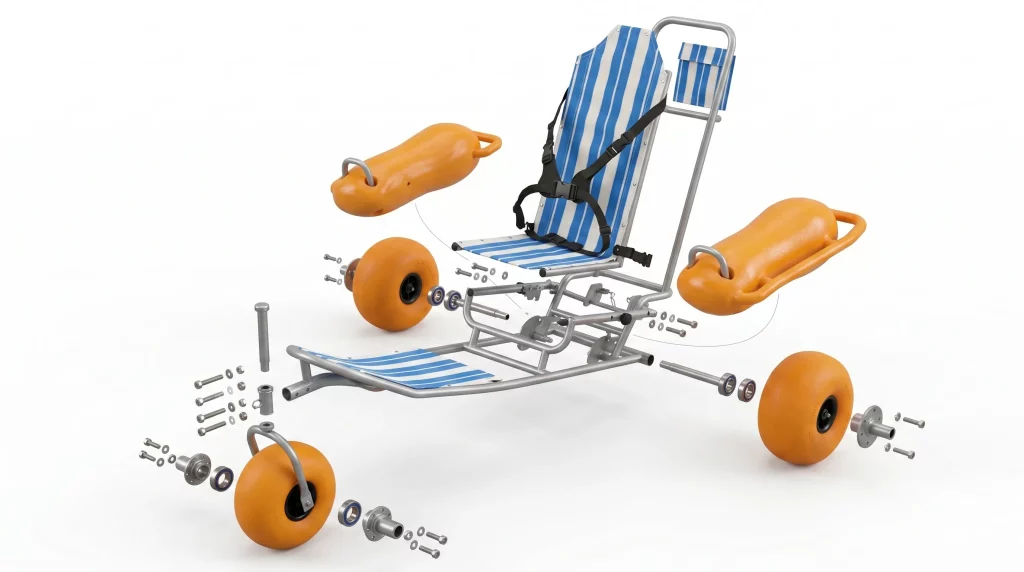
The Premium Edition is built on one frame with one layout. Two flotation armrests sit at the sides, one wheel runs at the front and two at the rear. The armrests are the redesigned element, and the product page presents them as the flotation armrests of the advertised build. Plan around that geometry. A trained attendant stays with the chair throughout approved water use. Record the wheel arrangement as part of the delivered configuration. For a site assessment, mark where the attendant stands to turn the chair, and confirm on the delivered unit that the frame, armrests, and wheels match the layout before you write it into a procedure.
Premium planning figures and build verification
Two figures from the Premium product page drive early planning. Overall width is 110 cm across the armrests. Chair weight is 24 kg for the advertised build. Both appear on the Premium Edition amphibious floating beach wheelchair page. Treat them as planning figures. They describe the advertised build, and they are not a measurement of the unit in your store room. Verify the exact delivered build before you commit a route, a vehicle, a storage bay, or a written procedure to either number.
The user and load rating needs its own document. Public sources carry conflicting rating references, so no capacity figure appears in this article. Request the Premium-specific user and load rating and the Premium-specific instructions through the Ary contact page, and file both with the site plan. A purchase order and a release to service both wait on that paperwork.
| Planning item | Figure or status | Evidence to hold |
|---|---|---|
| Overall width | 110 cm across the armrests, as advertised | Reading taken on the delivered unit |
| Chair weight | 24 kg, advertised build | Weight taken on the delivered unit where a scale is available |
| Wheel layout | One front, two rear | Visual check at receiving |
| User and load rating | Premium-specific document to be obtained | Signed document on file |
| Operating instructions | Premium-specific document to be obtained | Signed document on file |
| Site approval | Venue-approved plan required | Dated approved plan on file |
The exact use limit for this build
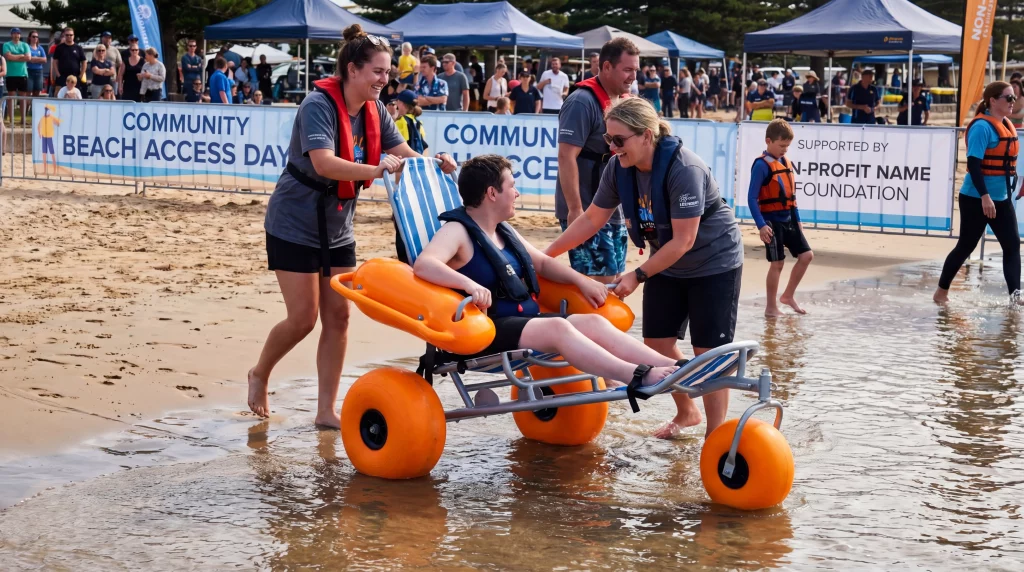
Intended application runs from sand to calm water, under continuous trained attendant supervision, with an approved site plan in force. Hold water use when the site has surf, an active wave pool, moving water or a gap in continuous trained supervision. Each is an exclusion, and a booking request that lands in one is declined before a date is offered. The safety and stability guidance for a floating beach wheelchair in water covers attendant positioning and balance checks that belong in the pre-use briefing. Put the limit on the booking form and in the attendant briefing so a guest party cannot reserve a session the site is not set up to run. Both the application statement and the site plan stay live during use, and a lapsed plan suspends the session.
Gates, thresholds and the turned path
Width planning starts at the narrowest fixed point on the route. Take a hypothetical gate opening of 114 cm and a confirmed chair width of 110 cm. The subtraction gives 4 cm of total difference across the opening, roughly 2 cm a side with the chair centred. That is arithmetic on paper. It is not a fit approval and it is not a margin to reuse at the next gate. Hinges, latch hardware, a raised threshold, sand build-up, and attendant footing all sit outside the subtraction. Measure clear width at the narrowest point with a tape, record the reading, and photograph the opening. Then plan the turn. A turned path needs room for the attendant and the full swept width of the chair. The beach wheelchair dimensions verification record shows the discipline to copy: name the point, state the tool, date the reading. Repeat it at the storage door, the mat edge, and the waterline entry.
Standard model and Premium Edition held as separate configurations
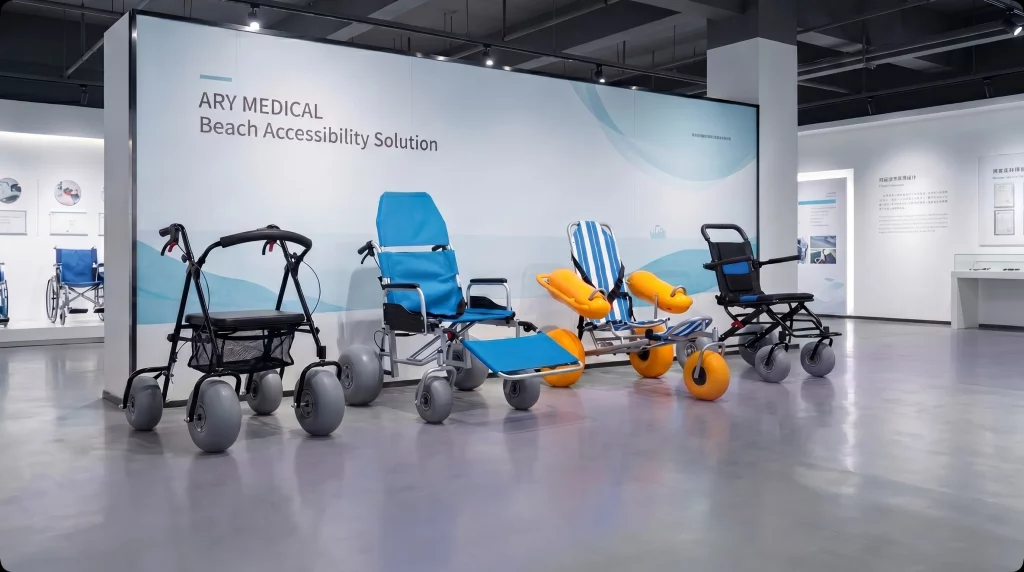
Both models serve the same sand-to-calm-water application, and each has its own document set. The Premium Edition carries the redesigned flotation armrests, the 110 cm overall width across them, and the 24 kg chair weight for the advertised build. The Standard model is described in its own sheet, and that sheet governs its figures. Keep the two sets apart in the procurement file, because a quote line, a manual page, or a parts entry from one model does not carry across to the other and no component interchangeability is claimed here. Parts planning for either build follows the beach wheelchair parts management record, which ties a spares list and an inspection log to a serial number. Where a site holds both models, label storage bays and log sheets by model so an inspection entry cannot land on the wrong unit.
| Attribute | Standard model | Premium Edition |
|---|---|---|
| Governing document | Standard model document | Current Premium-specific manual and specification |
| Flotation armrests | As stated in the Standard document | Redesigned flotation armrests |
| Wheel arrangement | As stated in the Standard document | One front, two rear |
| Overall width | As stated in the Standard document | 110 cm across armrests, planning figure |
| Chair weight | As stated in the Standard document | 24 kg for the advertised build, planning figure |
| Rating and instructions | As stated in the Standard document | Premium-specific documents to be obtained |
What a usable quote contains
A quote you can act on names the model and build, the delivered width and weight, and the documents supplied with the unit. Ask for the Premium-specific user and load rating and the Premium-specific instructions as line items. Ask for the serial number range, the spares list with part references, and the inspection points from the manufacturer’s manual. Ask what the figure covers and what it leaves out, and get the commercial terms in writing, since no price is stated in this article. A quote that shows a model name and a total gives the receiving check nothing to test against. File it with the site plan and the risk assessment so the release decision has a document trail behind it.
Receiving inspection on the day of delivery
Inspect before the chair goes near sand. Check the frame, both flotation armrests, the front wheel, both rear wheels, and the fixings at each attachment point. Match the serial number to the quote and the delivery note. Measure overall width across the armrests and weigh the chair where a scale is available, then record both readings beside the planning figures. Push the empty unit through the storage door and the narrowest gate on the route with a tape in hand. The Ary beach wheelchair user manual holds the inspection and care routine to follow from day one, including the post-use rinse that marine conditions require. A shortfall against the quote, a loose fixing, or a reading outside the planning figure goes into a written note, and the unit stays out of service until the note is closed. Photograph the unit and the readings on receipt and keep the file against the serial number.
Attendant plan and exit plan
The attendant plan names who may run a session, what the briefing covers, and how the chair returns to shore. Continuous trained supervision is a condition of use, and the plan shows how the site meets it for every session it books. Cover the entry line, the turn at the waterline, the calm-water position, and the exit line, with the same attendant in control throughout. The exit plan covers the return to sand, the rinse point, the drying position, and the storage bay, and it names the person who signs the chair back in. Build the briefing from the safety and stability guidance and from the Premium-specific instructions once they arrive. A dry run on sand, with the route walked and the turn practised, exposes gaps faster than a document review. Record any route change on the site plan and re-approve it before the next session.
Approve the chair for use or hold it
Release the chair when every checklist item has a document behind it. Hold it when any item is open, with the reason and the owner written down. The hold covers purchase as well as use, since an order placed before the Premium-specific rating and instructions arrive carries a risk the site cannot measure. A manager signs the release, dates it, and files it with the quote, the site plan, the inspection record, and the training log. Review the release when the route changes, when a mat or gate is replaced, when the site plan is revised, and when a document revision arrives from the manufacturer. A release left unreviewed drifts away from the site it was written for.
| Criterion | Evidence | Position while missing |
|---|---|---|
| Intended application | Written statement naming sand-to-calm-water use | Hold |
| Site plan | Dated venue-approved plan | Hold |
| User and load rating | Premium-specific document | Hold purchase and release |
| Operating instructions | Premium-specific document | Hold purchase and release |
| Delivered width | Measured reading against the 110 cm planning figure | Hold |
| Delivered weight | Measured reading against the 24 kg planning figure | Hold |
| Route clearance | Tape record for each narrow point | Hold |
| Staff briefing | Attendee log and dry-run note | Hold |
| Receiving inspection | Signed inspection record | Hold |
| Spares and logs | Parts list and log keyed to serial number | Hold |
Frequently asked questions
Is the Premium Edition suitable for surf or an active wave pool?
No. The application is sand to calm water under continuous trained attendant supervision and an approved site plan. Surf, active wave pools, moving water, and unsupervised sessions stay outside it.
Does a 114 cm gate approve a 110 cm chair?
No. The subtraction gives 4 cm of total difference on paper, which is arithmetic and not a fit decision. Measure clear width at the narrowest point and record it.
Where does the user and load rating come from?
From the Premium-specific document obtained through the Ary contact page. No capacity figure is quoted here, and purchase waits until that document is on file.
Do Standard model parts fit the Premium Edition?
No interchangeability is claimed, and the two models use separate documents. Order by model and build, and check the parts record against the serial number.
Who signs the chair into service?
A manager signs the dated release against the checklist, with the approved site plan, the inspection record, and the training log filed alongside.