
A bin containing two balloon wheels and one retainer does not necessarily hold two usable wheel kits. A resort stores team needs to know which carts the wheels fit, what hardware a repair consumes and whether any parts are already reserved. Start with the assembly the technician can install and return to service, then count the stock.
Build the list against the order drawing
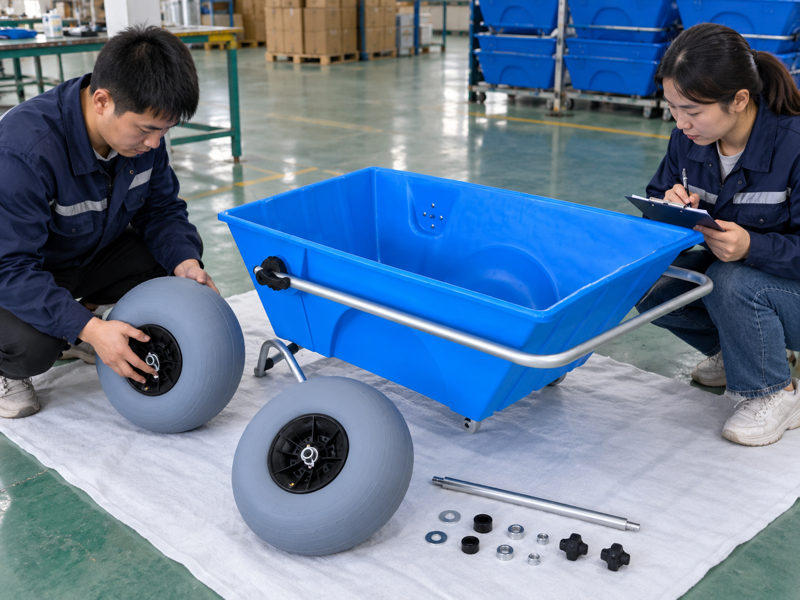
Take one current cart from each purchased configuration and identify it by asset number, supplier and order or drawing revision. On the standard two-wheel molded cargo cart, list the wheels, axle hardware, tub attachments, handle fixings and support stand as the supplier supplies them. Ask whether a damaged fitting is issued on its own, in a kit, or only as part of a larger assembly. A folding platform cart may also have casters, frame locks or a fabric basket. Give it its own parts list. Two-wheel tub cart configuration
| Field for each stock line | What to enter |
|---|---|
| Identity | Supplier part number, drawing revision, applicable cart IDs and any superseded reference confirmed in writing. |
| Contents of one issue | Identify whether the pack contains one wheel, a pair, a hub or bushing, spacers and the required retainer. State the unit used for counting. |
| Fit and supply | Verified interface, source of confirmation, current lead time and whether the supplier accepts an order for individual components. |
| Availability | Shelf location, physical count, quantity committed to open jobs, held or unidentified stock and incoming purchase orders. |
The molded cart’s published 12-inch wheel size is only the starting point for identification. Axle diameter, usable length, hub width and retention determine whether the assembly can be fitted as supplied. Use the manufacturer’s wheel matching guide before accepting a substitute or relabelling uncertain stock.
Calculate what can actually be issued
Suppose the supplier’s confirmed repair kit for one wheel position requires one wheel and one particular retainer, and the site already has the correct reusable spacers for this job. The store holds three matching wheels and two new retainers. One wheel and one retainer are reserved for an open repair. The free balance is two wheels and one retainer, which will support one more complete repair. A separate unlabelled wheel stays outside that count.
If two more matching repairs must be completed before the next delivery, the shortfall is one retainer under these assumptions. Confirm the work orders and current lead time. Then decide whether to order retainers individually or price the supplier’s minimum pack. Revise the calculation if another component turns out to be required. A fixed “two of everything” rule can leave the fleet short of a small part while tying up money in wheels.
Keep the shelf count honest after a repair
Issue the parts to a named cart and work order. Record what was installed, returned unopened or quarantined. Set aside any removed component the supplier needs to examine. Ask the technician whether the repair required a revision different from the one expected, and update the list only after confirmation.
Before the busy period, compare actual usage, booked service days and replenishment lead times. A frequently used, inexpensive retainer can justify shelf stock while a bulky replacement tub may be more practical to order when needed. Local downtime and supplier availability determine that choice.