
Open a beach access mat procurement brief by marking two points on a drawing. Show where a visitor first reaches the mat and where they should be able to stop, turn or transfer at the other end. State who expects to use the route and when it will be available. Bidders can then price the same usable path, including its connections, end treatments and removal requirements.
Give each bidder the same site and operating conditions
Attach a dated plan, photographs and measurements. Mark changes from paving or boardwalk to sand, corners, crossfalls, any required passing or stopping area and the proposed destination. Identify the narrowest usable approach outside the mat itself. A continuous mat cannot remedy a locked entrance or a missing connection between parking and the start of the route.
Give each entrance its own operating season and removal trigger. Identify actual sand and drainage conditions, exposure to storms or moving sand, and the space available for staging and storage. Say which dimensions have been measured and which the bidder must confirm in a site visit. Name the land manager and operator responsible for deciding whether the proposed alignment and anchoring are permitted at that site.
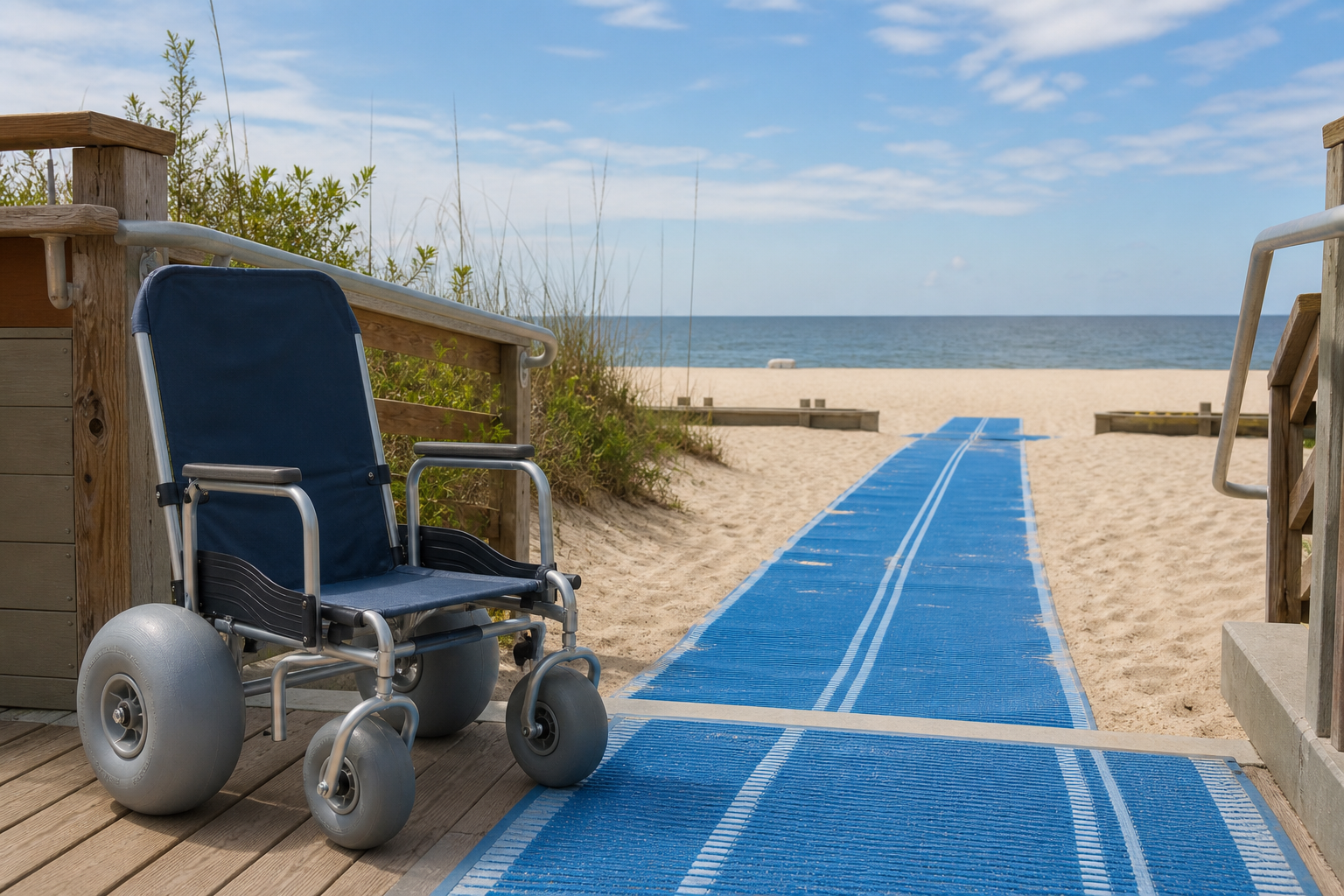
Specify finished coverage, then ask how the system achieves it
Request clear usable width and installed coverage along the defined alignment. A quotation in square metres can hide a narrow section, unused cut length or a missing turn. Ask bidders to mark the quantity, width and length of each offered roll or modular section directly on the layout, together with the effective length of any overlap or connection.
For example, a straight 30 m run could appear on a bid sheet as three nominal 10 m pieces. Before comparing that bid with two nominal 15 m pieces, ask what length each joint consumes and whether the transition at either end is included. On a simple straight run these layouts have two intermediate joints and one intermediate joint respectively. Their coverage, removal effort and replacement options can differ even when the listed linear metres agree.
The manufacturer describes an interlocking modular beach mat whose route length can be configured through section quantity and whose offered width must be confirmed. Ask for documentation tied to the selected product. Material, care instructions, warranty and service life vary by product. Manufacturer’s beach access mat description
Put the requirement and the offer side by side
| Buyer’s requirement | Bidder supplies | How the buyer will check it |
|---|---|---|
| A continuous route between the stated endpoints | Layout with pieces, effective coverage, clear width and end transitions | Compare the marked layout with the site survey and inspect the installed interfaces. |
| A surface suitable for the intended users and local conditions | Exact material and surface description, relevant test evidence, limitations and applicable care instructions | Match documents and sample to the offered model. Agree any representative site trial before award. |
| Joints, edges and anchoring suited to the site | Connection detail, edge treatment, proposed anchors, tools and assumptions about the substrate | Review against the land manager’s restrictions and the supplier’s installation instructions. |
| Removal and storage with the available crew and equipment | Individual piece dimensions, weight, rolled or stacked footprint, handling method and storage conditions | Demonstrate the proposed handling sequence and compare the packed pieces with the available storage space. |
| Replacement and continuing support | Component identifiers, whether spares are included, ordering units, availability and written warranty terms | Separate initial supply, optional spares and ongoing service costs in the price schedule. |
Require an explicit exception against a requirement the offer does not meet. For an example of the format, the Mauritius Beach Authority tender specified a particular polyester roll mat and asked bidders to identify their offer, compliance and deviations in separate columns. That material was a requirement of that particular tender. A buyer considering modular systems should specify the construction or performance evidence appropriate to its own route. Mauritius Beach Authority, technical specifications, PDF page 61
For site-designed anchors, request a method for the actual substrate and the relevant permissions before agreeing the fixing detail. A photograph of another installation does not supply allowable anchor spacing for this one. Make the material and surface comparison and any dealer demonstration address the same written requirements.
An Australian example of seasonal scope
In its 2024 Accessible Beaches brochure, Central Coast Council in New South Wales described matting deployed at four beaches during patrol season. The brochure also described retaining matting at protected Toowoon Bay outside that season, with possible removal during storms. One council therefore described different operating conditions for different sites. This dated example does not establish a current opening schedule or an Australia-wide procurement rule. Central Coast Council, Accessible Beaches brochure
A purchaser with comparable seasonal obligations can ask bidders to price initial deployment and later removal separately. State which site can retain its matting longer, who decides on storm removal, where the removed pieces will dry and be stored, how damaged connectors will be replaced and who will confirm the route is ready to reopen. Ask how changes in access will reach visitors before they travel. Obtain current local requirements from the responsible site authority. Australian beach access mat project guide
Compare delivered cost at the site named in the tender
Name the delivery point and identify who is responsible for the last leg to the site. A quote to a port, depot or council store can exclude inland freight, unloading or transport across the beach approach. Ask for package count, gross dimensions and weight, unloading needs, delivery basis, items priced separately, and the documents needed by the receiver. Where importing is involved, have the appointed importer or adviser confirm the requirements for that shipment and destination.
Separate the price of the mat itself from connectors, anchors, transitions, spares, packing, freight, training and site work. If either bidder excludes installation, compare both offers on the same installation basis. For a seasonal route, include the cost of collection, storage and redeployment in the period being evaluated. Beach access mat cost and budget planning
Decide in advance what counts as acceptance
Ask for the site layout, offered-product drawing, component list, installation and removal instructions, care guidance and agreed deviations before authorizing production. Name the delivery items that need a count and condition check, then distinguish those checks from accepting the completed route. A full pallet at the depot can still leave an unplanned step where matting meets the boardwalk.
At handover, compare the installed path with the agreed layout. Inspect transitions, exposed edges, connection condition, effective clear width, turning space and access to the endpoint. Ask the operator to demonstrate the agreed removal and storage arrangement with the equipment available on site. Define how a defect will be corrected, which work remains held and what must be checked again before public opening. Mat delivery and receiving inspection · Seasonal setup and opening
Give the evaluation team the same requirement-and-deviation schedule used by the bidders. Record unresolved items beside their price or technical consequences. A missing connector kit, excluded inland leg or unsupported surface claim can then be resolved while the offers are still comparable.