
Let the buyer choose the question before the dealer chooses the demonstration site. A parks buyer might ask whether the proposed joint can be inspected and replaced by its seasonal crew. A resort operator might want to know whether the offered sections fit its storage access and how a wheelchair crosses the first connection. Either question gives the people attending a task they can watch from beginning to end.
Write the question on the invitation along with the offered section reference, the intended setup and the evidence the buyer wants to take away. If the decision concerns a connection, bring the mating sections and the actual connection kit. A tabletop swatch helps the buyer examine surface finish. A joined pair also shows how the adjoining edges meet. For the modular configuration shown by Ary, request the drawing for the section width and interlocking detail being offered. Beach access mat product information
Put the offer and the sample side by side
Ask the dealer to identify the product, width, finished section length, mating edges and all hardware included in the sample. Show the matching drawing or assembly instruction. Explain any difference between the demonstration set and the quoted production set before anyone observes it. A sample with a different connector may still help discuss the face material. Keep the connection decision open until the offered version is available. Beach access mat material and surface comparison
Choose a place the site owner has approved for the demonstration. Describe the substrate, the approach and the weather at setup. If the buyer’s beach has a boardwalk landing or a tight turn, mark which part of that arrangement the trial reproduces. Record any conditions the venue cannot represent. Bring the person who will handle the sections, a site reviewer and someone empowered to decide whether the sample advances to procurement. Participants who use mobility devices should choose whether and how to participate within the agreed supervised plan.
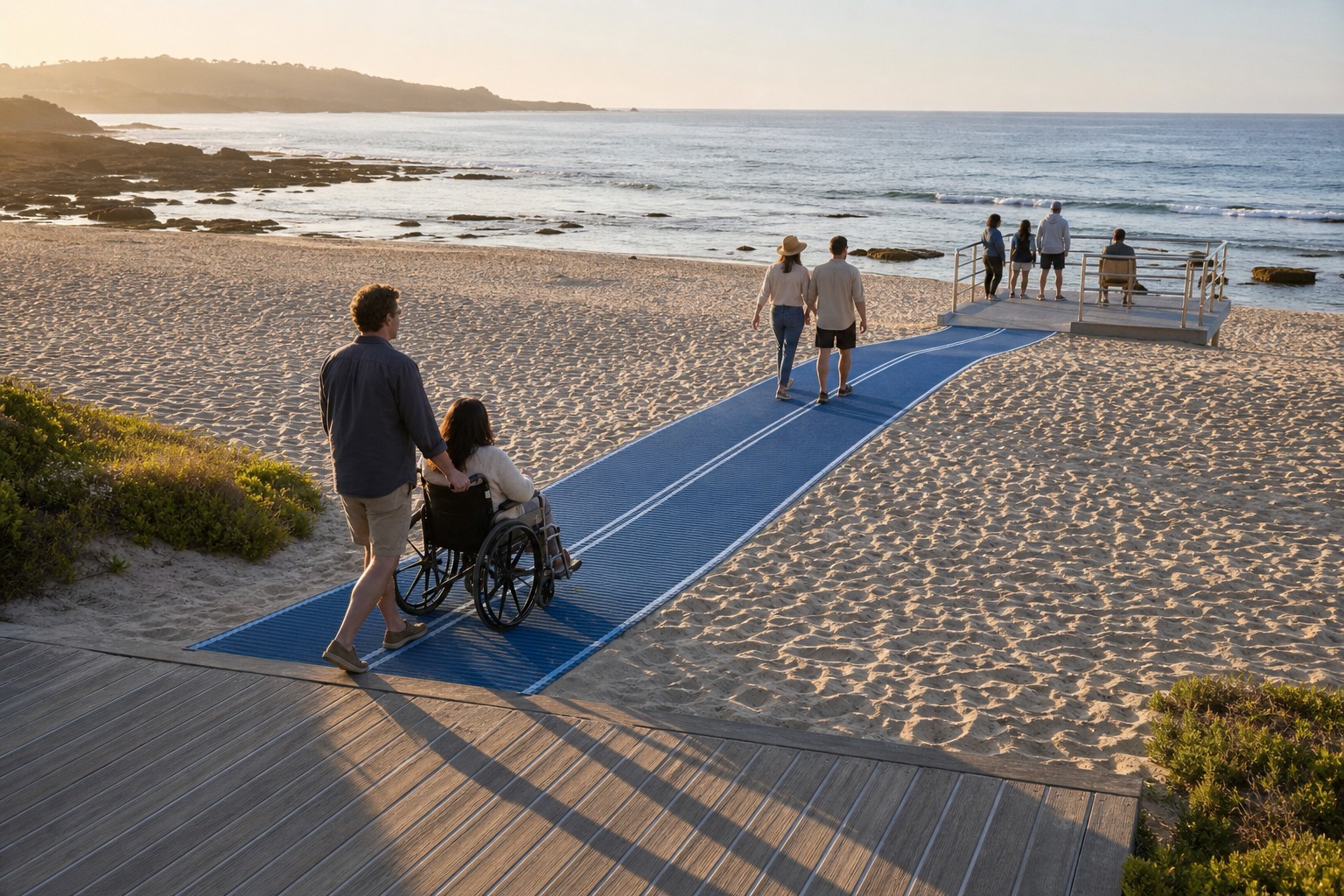
Give the buyer a task to observe
Have the dealer demonstrate the instructed setup with the permitted tools and fixing arrangement. Keep the work area under control until the site reviewer has checked the approach, section support, joint engagement, edges and endpoint. A buyer can inspect those functions while the sample is empty. Proceed to a movement trial only within the agreed method and after any unresolved physical defect is addressed.
| Buyer’s question | Demonstration task | Observation to record |
|---|---|---|
| Can our team identify the correct connector? | Match the loose parts with the drawing and assemble the prescribed joint. | Part references, instructions needed and any ambiguity the crew encountered |
| What happens at this join? | Observe the intended movement across the accepted joint in each relevant direction. | Where a wheel interacted with the join, whether an edge lifted, and the surface condition during the pass |
| Could we replace a damaged section? | Ask the dealer to show the permitted removal and refitting sequence. | Which neighbouring pieces must be disturbed, which tools are needed and what must be checked afterward |
| Can we return the sample to storage? | Prepare and pack the set as instructed, then move it through the proposed handling route. | Package size, actual handling assistance and the space needed at the doorway |
For an A/B comparison, use the same agreed task, substrate preparation, route segment and mobility device where practical. Keep each product within its own instructions and record any necessary difference in fixing method or setup. A result from a wider section on firm sand compared with a narrower section on loose sand tells the buyer about two different installations. It cannot establish that one surface material rolls more easily.
Keep the observation separate from the sales claim
Suppose an observer sees a wheel catch at the second joint during the return pass. Record the direction, the wheel involved, the joint ID and its condition. “I needed help turning here” is a participant’s experience and should be recorded in their words. “The edge lifted because the material is too flexible” is a possible explanation that needs investigation. Ask the observer to separate direct observations, participant comments and unresolved assumptions in the buyer’s copy.
If the installer corrects the joint under the approved instructions, identify what changed and repeat the affected task. Retain the first observation beside the retest. Stop when the setup changes beyond the agreed scope, the route becomes unsuitable or the team cannot maintain the participant’s planned support. The next useful demonstration may be a shorter, unoccupied equipment check rather than another user pass.
Hand over a result the purchasing team can use
Return a short note with the sample identity, quoted configuration, conditions, tasks observed and open questions. Link photos to the particular joint or handling step. Request permission before recording people and use a component-only view when it answers the technical question.
The buyer can now decide whether to request a revised connector, trial a full offered section at the intended beach, or advance the identified configuration to quotation. A demonstration result should name the sample, site and task it covered. Claims about long-term wear, accessibility compliance or installation at another property require their own evidence. If the offer advances, include the agreed component list in the receiving pack. Receiving a mat shipment against the order