
Ask the supplier to identify the material in each beach access mat section and the way two finished sections join. A material declaration can identify the polymer. A drawing and sample show the edge construction, contact surface, underside and connection that the beach crew will actually install.
Begin with the intended service. A seasonal route that staff remove from storage and lay again each year raises different handling questions from a short-term event installation. Tell the supplier where the mat will meet the firm approach, what ground lies underneath it, which mobility devices are expected and where the crew can clean and store the sections.
What does a documented material requirement look like?
One public procurement gives a concrete example. The Mauritius Beach Authority specified a 100% polyester roll mat and identified UV-stabilised polyester in the material field. The same table required end connectors, galvanised spikes, pre-installed grommets and a transport strap. Bidders had fields for the specification offered, compliance and any deviation. Those details belong to that particular tender. Mauritius Beach Authority technical specifications, PDF page 61
Ary’s product page describes a modular mat with interlocking sections. The selected width and section count define the proposed route layout. It also says material, environmental resistance, warranty and service life vary by product. Obtain the exact material statement, connection detail and care instructions for the part number quoted. Ary Beach access mat product information
“Roll” describes how a section can be handled or supplied. “Interlocking” describes a connection. A roll can form part of a modular route, so putting these terms in opposite columns of a material comparison produces a misleading choice. Compare the declared composition of each offered section in one row and the finished construction in another.
Inspect a joined sample from the top and underneath
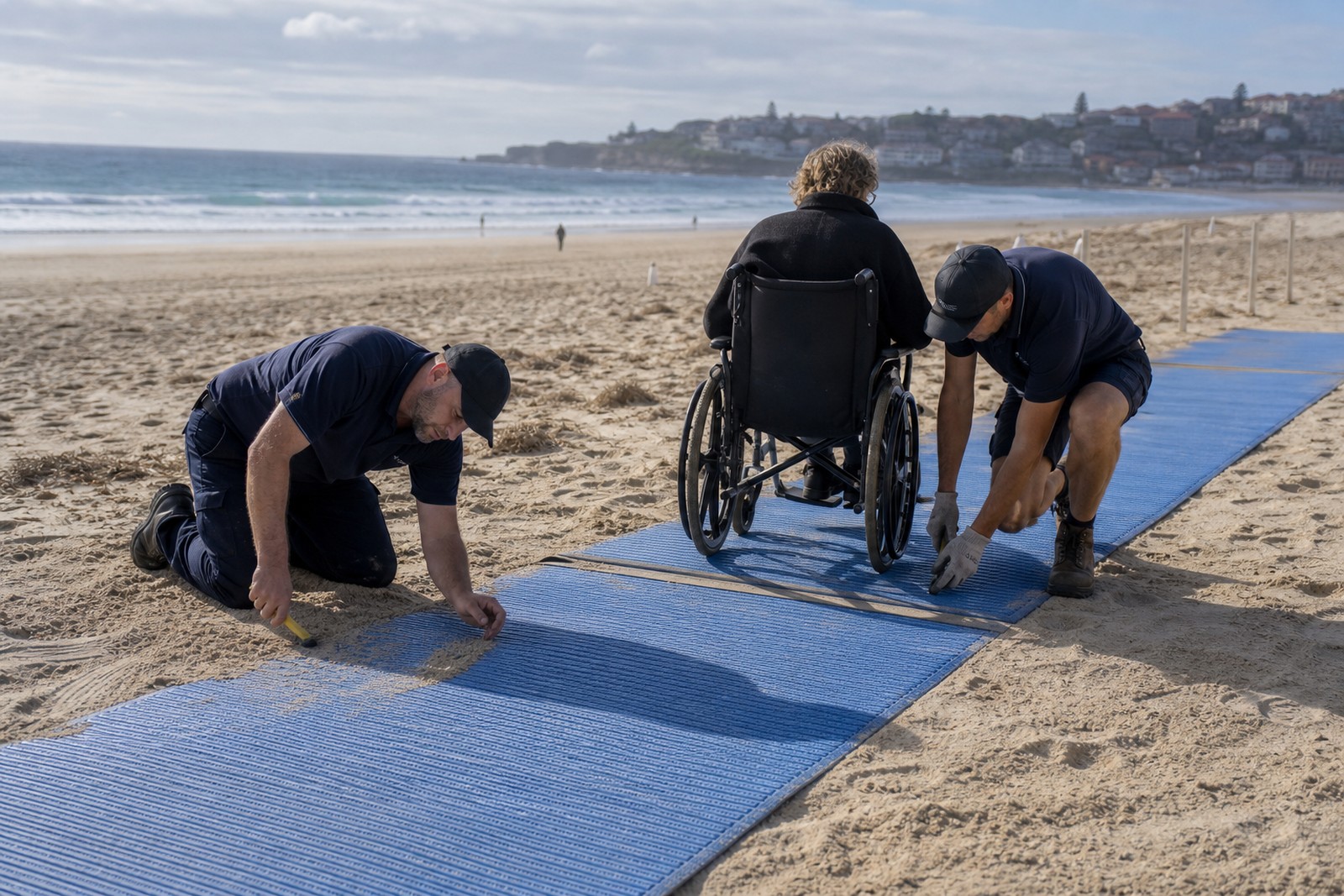
Ask for two compatible sample ends or a representative section pair, complete with the connectors and edge treatment named in the quote. Look at the contact surface under the intended conditions and at the point where the joint meets the user’s path. A small swatch helps identify texture and colour. It cannot show how the assembled join sits on sand.
| Feature | What the sample can show | What still needs documentation or a site trial |
|---|---|---|
| Running surface | Pattern, visible openings and the finish at each edge | How the installed surface behaves on the site’s substrate under the proposed use |
| Underside | Shape and contact points | Whether preparation and the specified fixing arrangement suit that location |
| Joint | Engagement, finished profile and access for replacement | Compatibility of production sections, allowed wear and the inspection procedure |
| Complete section | Flexibility during permitted handling and how the edges are finished | Actual section mass, packed dimensions and approved storage method |
A showroom surface may behave differently on loose sand. Set up the sample where the buyer can see the transition from firm ground to the representative substrate. Observe behaviour from both directions where crossing is authorised. Record whether a wheel catches at the joint, an edge lifts, sand accumulates at an opening or the section shifts relative to a fixed reference point. Record the setup and conditions with the finding. These observations describe that specimen at that location. Planning a dealer sample demonstration
Ask what the supplier tested
For an abrasion or tear claim, request the report and identify the specimen, test method and result. Was the specimen the field material, a finished edge, or an assembled joint? A worn connection can make a section unavailable while much of its visible running surface remains intact. For UV or salt exposure claims, ask which material grade and production finish the report covers, and which exposures were actually evaluated.
For a U.S. route subject to the ADA Accessibility Standards, the Access Board discusses firmness, stability and slip resistance of floor and ground surfaces. The finished surface and its installation need project-specific review. Neither a named polymer nor the colour of a sample settles that determination. U.S. Access Board guide to floor and ground surfaces
Choose the system the site can maintain
Let the people who will handle the mat inspect its supplied care method and move a representative section under an approved plan. Compare access to the storage doorway, cleaning space, drying arrangements and ease of replacing a damaged end or connector. Ask which repairs the site may make and which require an authorised replacement or return. Price the replacement part, its fittings and delivery on the same basis across offers.
Retain the accepted sample identification with the purchase order. A concise approval line should name the section, declared material, width, edge and connector version, accepted documents and any open trial condition. If the supplier later proposes another composition or joint, the buyer can identify exactly which evidence and checks must be repeated before accepting the substitution.