
Build the training roster around one complete booking. Someone must take the enquiry, prepare the correct beach wheelchair, support the agreed outing, receive the chair back and deal with any fault. Write each task on the roster alongside the person who teaches it, the person who will practise it and the person authorised to verify it. This exposes gaps that a list of staff names can hide.
Begin before the first booking. The route lead needs time to check the approach and return. The equipment lead needs a released unit at the collection point. The desk needs to know what it can offer that morning. Schedule preparation and the final return inside paid, covered shifts.
Assign the teaching and the practical work
Use named local roles and fill in the people who hold them. Operators should choose instructors qualified for the actual task and model. A supplier can explain its construction and instructions. Individual fitting, user training and follow-up require the appropriate trained personnel under the service’s provision arrangements. WHO training in priority assistive products
| Practical task | Who should lead the session | What the learner should demonstrate |
|---|---|---|
| Receive a visitor or booking enquiry | Service-desk lead who knows current availability and assistance arrangements | Locate the booking, identify the entrance, describe the equipment and give an accurate answer when the requested service is unavailable. |
| Prepare a manual land chair | Instructor authorised to teach the supplied model and its inspection procedure | Identify the asset, set up and check the empty chair, describe any unresolved fault and withhold that unit from issue. |
| Support the visitor and land route | Staff responsible for fitting, transfers or route support, each within their assigned duties | Show where the handover takes place, confirm agreed assistance and demonstrate how to summon the appropriate person if needs change. |
| Supervise an approved water service | The site’s qualified water-service instructor working with its equipment lead | Identify the approved zone, current water restrictions, trained cover and usable return before accepting an assignment. Practise a closure decision under the site procedure. |
| Receive and prepare a returned chair | Returns lead and authorised service technician | Match removable components to the unit, record a reported fault, isolate it when needed and tell booking staff which assets remain available. |
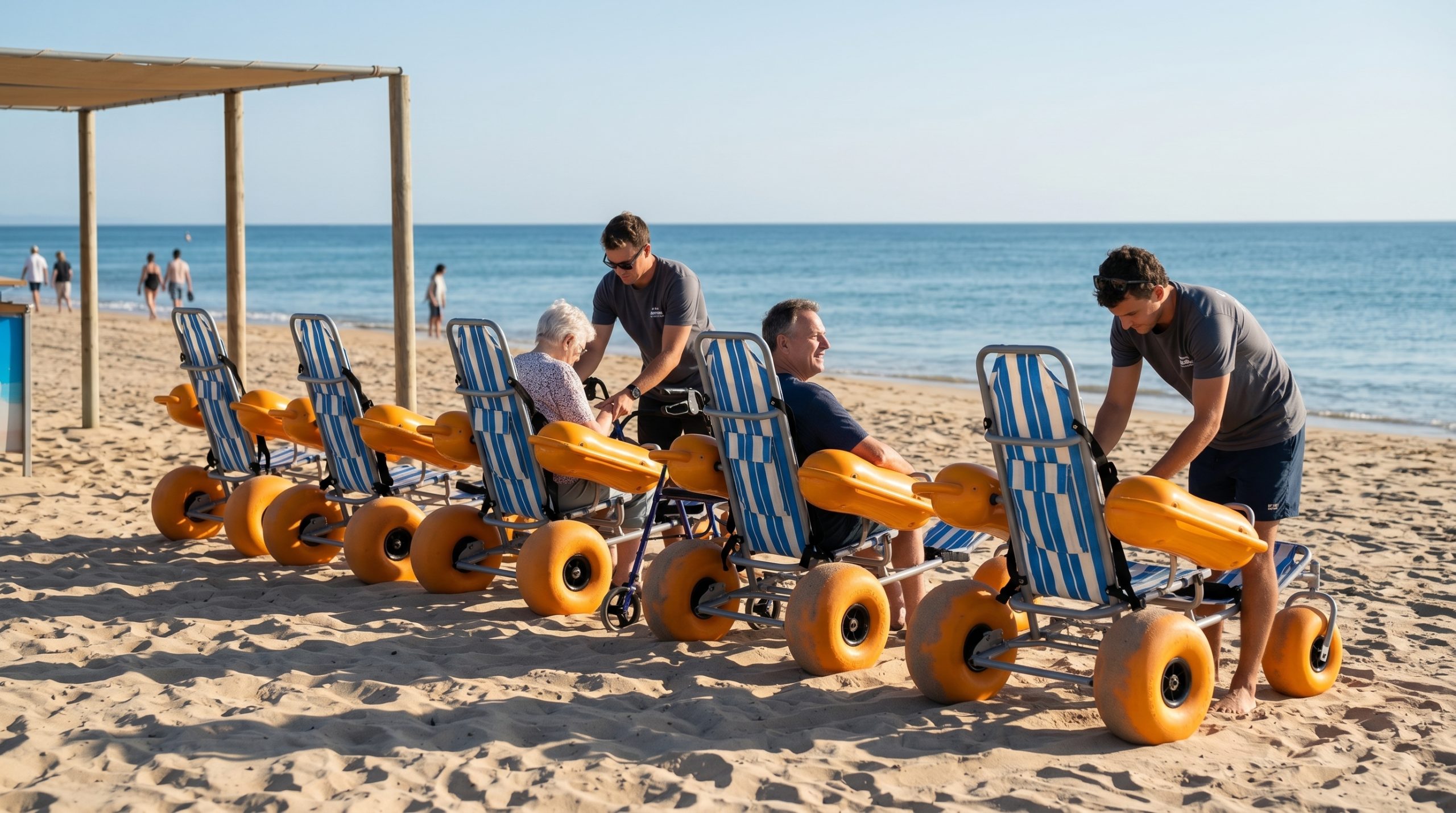
Where a learner has practised a dry-land task with the AY-ST-V2.0, use the supplied folding, high-back and adjustable leg-support configuration for the demonstration. For the AY-ST-V1.0, include recognition of its three wheels, detachable inflatable PVC armrests and model-specific attachments. Before assigning anyone to the water service, verify the additional local training for supervised calm-water operation and the return procedure. AY-ST-V2.0 manual and AY-ST-V1.0 manual
Let each learner complete a handover
Give the trainee the same model instructions, asset labels, booking details and communication tools that staff use on shift. The instructor demonstrates the task, then the trainee repeats it under observation. Use an empty chair for setup and equipment-fault exercises. Any practice involving a person must use the site’s approved arrangements for that activity, including their agreement and appropriately qualified support.
Introduce one change during the rehearsal. For example, suppose the desk has confirmed a land outing and the equipment checker finds that the leg support will not hold its selected position. Ask the trainee to find the relevant instruction, stop the chair being issued and contact both the service lead and the desk. Have the desk trainee explain the change to the visitor and offer only alternatives the team can deliver. The program delivery and rehearsal guide describes the complete visit to rehearse.
Record the task and model alongside the observation. Useful entries include “can complete the return and component count independently” or “needs supervised practice on the backrest engagement check.” The verifier records which duties the learner may take on and where another observed practice is needed.
Put the busiest overlap onto the shift plan
Consider a hypothetical morning when a visitor is returning a chair just as the next booking arrives. The only staff member authorised to check returned units is also listed to accompany the next outing. During that absence, who receives the chair, hears the visitor’s report and completes the required checks? If there is no suitably trained relief, change the appointment spacing or assign qualified cover before the desk confirms both visits.
Plan breaks and the handoff between early and late shifts the same way. Give the incoming person the current route status, equipment on hold, open bookings and the name of the person covering the next return. A change of model, a revised route, a long absence or a recurring fault report is a reason to revisit the relevant task under observation. The booking guide for beach operators shows how staffed capacity affects available appointments.
Before issuing the rota, run a role-by-role coverage check rather than counting names. Verify who teaches new arrivals, who may work independently on each model, who can cover a break and who can pause the affected service.