
“Permanent” can mean three different things in a project meeting: a route visitors expect to use year-round, a mat normally left in place, or a physical installation designed to remain there. Write down which meaning the site operator intends. An all-season service may use removable sections because staff need to move them after storms. A summer-only service may leave its mat in place between opening days if that is permitted for the actual system and site.
Choose a deployment pattern the operator can sustain
| Pattern under consideration | What makes it worth testing | What must be settled before choosing it |
|---|---|---|
| Put out for an attended session or event, then remove | The destination or allowed operating period changes often, or the site requires an otherwise clear beach. | Time, crew, means of transport and storage for every deployment, plus a proper check before each use. |
| Leave installed for a defined season | A stable alignment serves visitors repeatedly during staffed months. | Permission for the period, inspection and sand maintenance, criteria for early removal, and the seasonal closeout team. |
| Leave installed over a longer period | There is a sustained service need and the proposed system, substrate and approvals support that arrangement. | Ongoing checks during quiet months, arrangements for storms or sand loss, access for replacement and an agreed plan for eventual removal. |
Obtain the exact product construction, connection details and permitted deployment conditions. The manufacturer describes modular interlocking sections whose length is configured through section quantity. It also says that material, environmental resistance, warranty and service life vary by product. Do not turn the term “modular” into a promise that any staff member can lift, repeatedly remove or leave a particular system in place indefinitely. Manufacturer’s beach mat information
Look at the same route in different conditions
Identify which sections are exposed to sand movement, wind, runoff, tides or frequent service crossings. Ask what happens to the first hard-to-sand transition and the far edge when the supporting sand moves. A mat left in position still needs attention when a return edge becomes unsupported. A mat collected each evening needs a handling route that still works after visitors, bins or service vehicles occupy the area.
A dated local example illustrates why a single policy may be a poor fit for several beaches. In its 2024 Accessible Beaches brochure, Central Coast Council in New South Wales described patrol-season deployment at four beaches and retention outside that season at protected Toowoon Bay, with possible storm removal. The account concerns those council locations and that published period. Confirm the present site instructions locally. Central Coast Council accessible beaches brochure
Put removal work on the programme
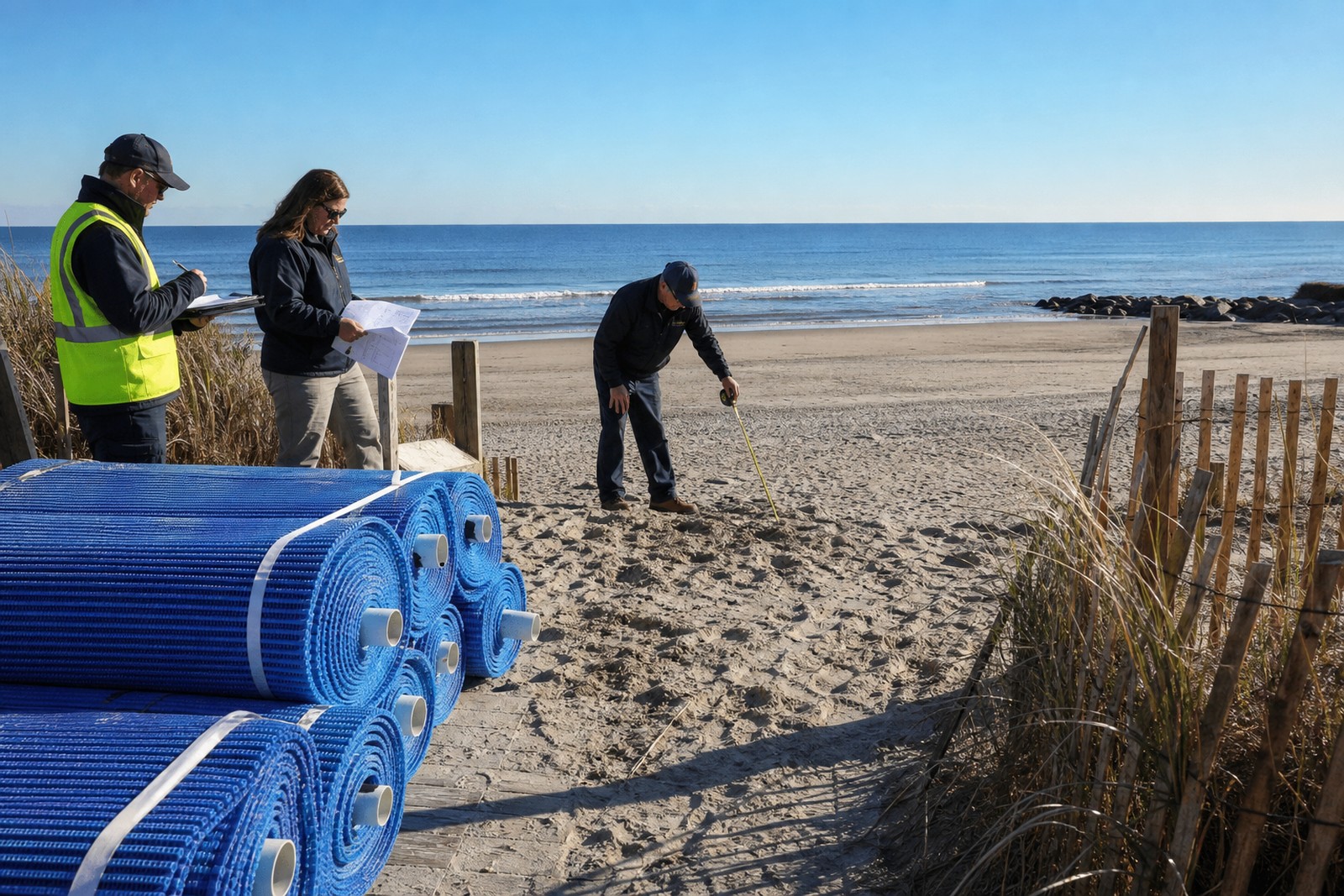
Ask the proposed crew to show how they would move the approved sample from the store to the entry and back. Measure pieces in their packed state. Check the path to storage, the available handling aids, space to clean and dry the material, and how staff will keep connectors and end parts identified. Record assumptions separately if those tasks have not yet been tried with the offered system.
Estimate handling events as well as mat length. In a hypothetical 12-week season operating five days each week, daily placement followed by nightly collection means 60 deployments and 60 collections. A season-long installation could have one initial deployment and one planned collection, plus any triggered removals. Neither calculation includes inspections, cleaning or storm work. Multiply actual task times by the events expected for each option and include labour, transport, spare parts and storage in the comparison.
Agree what could change the choice
Name who can call for a temporary closure or early removal, which crew can act during the allowed window, and where the material will go. Agree how the operator verifies the base, connections and return after relocation. If longer-term installation is proposed, obtain the relevant landowner or site permissions and qualified design review where applicable. No fixed interval or anchor layout can be taken from the deployment label.
Record the intended service period, normal installed period, exception triggers and responsible operator separately in the decision. If the preferred pattern requires a crew that is only present at weekends or a store that cannot accept the full mat set, reopen the comparison before committing. The seasonal opening guide and seasonal removal guide cover the resulting operating tasks.