
Take the width measurement where the visitor will have the least room. That might be the gap beside an entrance rail, the inside of a bend, or the space left after a queue forms near the equipment desk. A nominal width can disappear at a bend or obstruction. Record the limiting point on the plan before asking a supplier to quote a mat.
Measure three different widths
Mark the product width, the available site width and the finished clear passage separately. A roll or modular section can have the stated product width while its installed edge, an adjacent post or an offset join reduces the usable passage. Sand beyond the edge counts only if it forms part of the accepted, usable route.
| Entry on the width sheet | What to measure | Decision it supports |
|---|---|---|
| Offered section | Overall width and the portion the supplier identifies as usable when joined or finished | Which ordered section and edge detail belong on the drawing |
| Site constraint | Clear opening between fixed objects, gate position, bend geometry and any change along the alignment | Whether there is room to install and approach the proposed section |
| Installed passage | Smallest usable clearance at the actual approach, joins, turns and endpoint, with obstructions in their operating positions | Whether the finished journey can accommodate its intended movement |
For example, suppose a gate has 1.30 m of usable opening and the offered mat is 1.50 m across. Those hypothetical measurements identify a 0.20 m difference. A wider mat on the sand cannot widen the gate. Ask the designer to resolve the gate, alignment or route choice and then check the finished approach. Neither figure establishes a required or acceptable minimum.
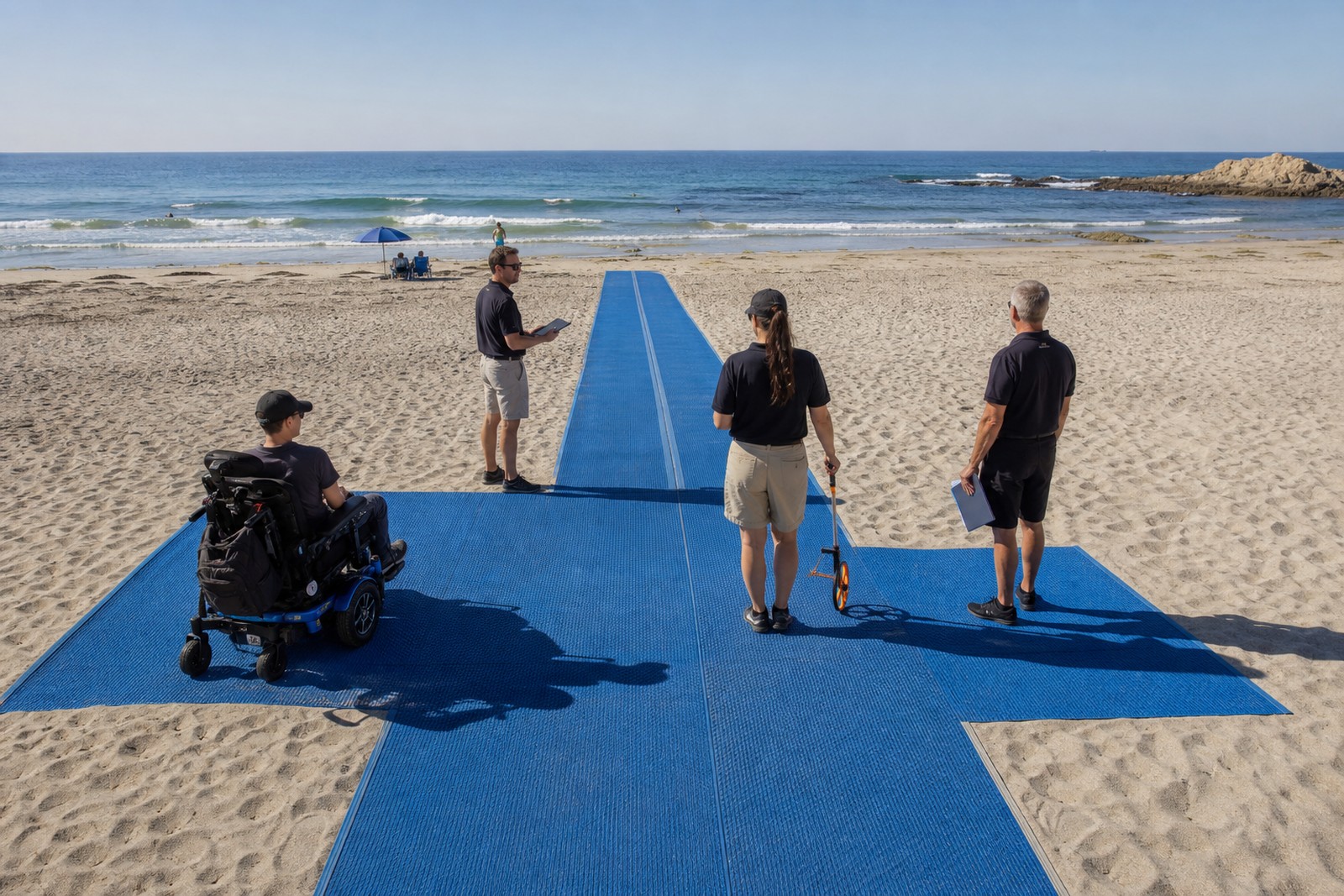
Give turns and passing their own space
List the devices the site intends to support and the assistance allowed along each segment. Use the assembled outside width and turning envelope. A wheelchair’s seat width is a poor substitute. For example, the AY-ST-V2.0 manual lists a 45 cm seat width and a 110 cm overall width. Its adjustable leg support also changes the practical turning envelope with position. Take measurements on the configured chair and observe the permitted movement under the site’s trial arrangements. AY-ST-V2.0 manual, page 2
Walk in both directions with the person who handles arrivals. Where could a visitor wait while someone returns? Could an attendant stand or turn at the endpoint without stepping onto an unsuitable surface? If two-way travel depends on a passing area, locate it and check that it stays clear during opening hours. A chair briefly fitting through a straight, empty section leaves these questions open.
Put the applicable width on the purchasing drawing
For U.S. projects covered by the federal outdoor provisions, the U.S. Access Board specifies a minimum clear width of 60 inches for beach access routes. Section 1018.4 allows a minimum of 48 inches at a dune crossing on a non-removable beach access route. Have the responsible project team establish applicability and any exceptions for each segment. Specify the governing requirement independently of the supplier’s available widths. U.S. Access Board, ABA §1018.4
Request a layout showing the offered width, section references, edge details and each change in direction. The manufacturer describes interlocking sections and configurable route length. Confirm the selected width and installed geometry for the quoted system. Mat configuration information
At acceptance, measure the narrowest passage again, photograph its location and record the direction and conditions of any agreed movement trial. If a gate, connector or endpoint still limits the trip, keep that segment pending until the responsible reviewer accepts a correction or a different layout. Reviewing mat and ramp connections