
At handover, ask the person receiving the beach walker to show or explain how they will stop, where they plan to turn back and whom they will contact if something changes. Give them time to answer in their preferred way. If a companion is present, agree with the user which tasks that person will handle. The user’s age alone tells staff little about their preferred support or ability to reach a particular control.
Start with a checked, correctly identified unit. A trained person should arrange individual assessment and fitting within the service’s provision process. The WHO training material places fitting, instruction and follow-up together. It does not prescribe one handle position or route for everyone. WHO training in priority assistive products
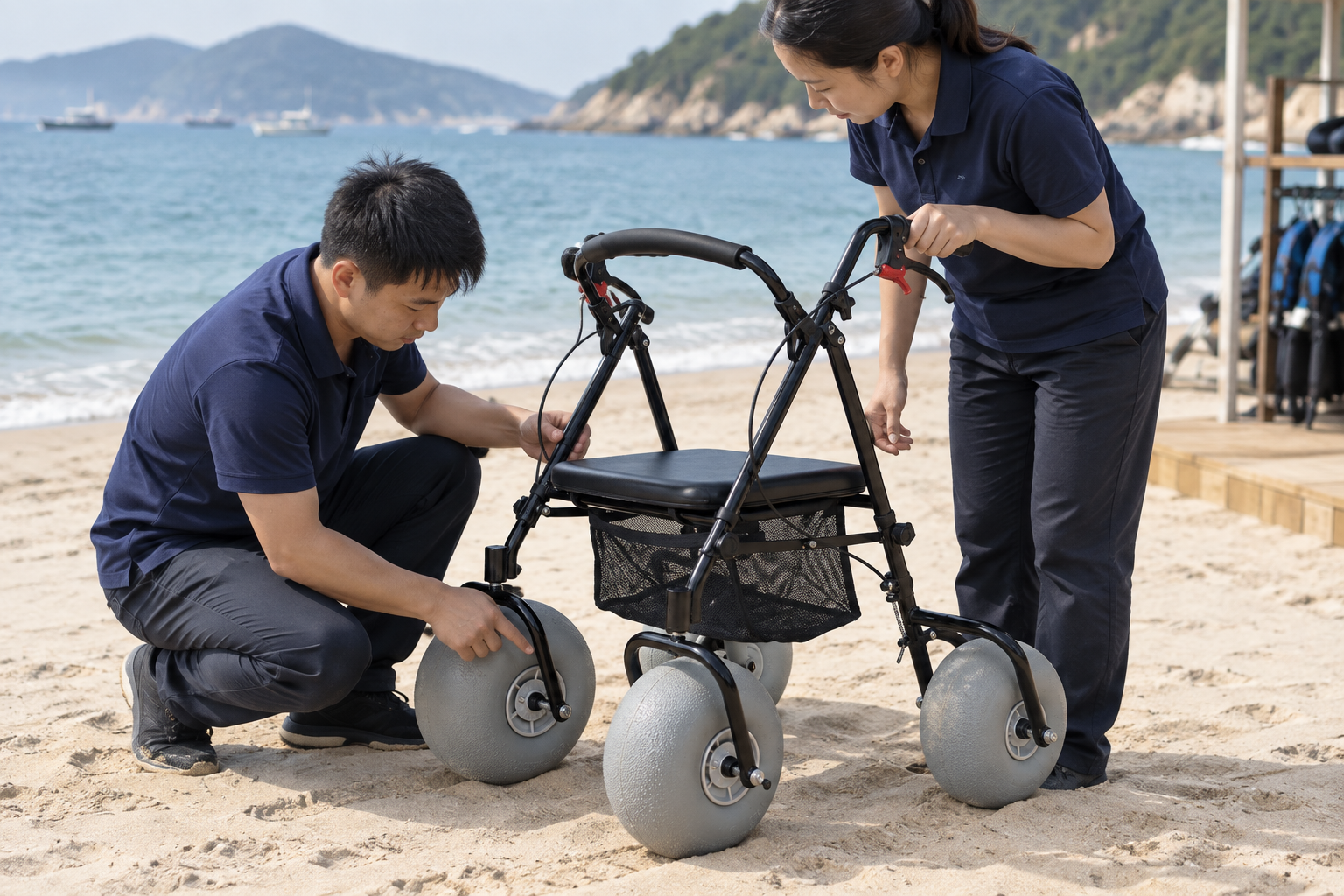
Show the controls on the walker being issued
The AY-STZ1.0 has a folding frame, adjustable handles with brakes, four wheels, a seat and an under-seat bag. Use the instructions for that unit and the settings agreed with the user. Demonstrate the permitted controls and how to recognise a change in their response on firm, level ground. The fitted seat and bag serve different functions. Obtain the approved stationary-rest instructions before including seat use in the handover. AY-STZ1.0 manual and component illustrations
Use a short prompt such as, “Please show me what you would do to stop here,” after the explanation. If a hand cannot reach the lever comfortably, pause and ask the appropriately qualified person to review fit and suitability. Avoid asking the user to compensate by leaning farther forward or to practise on loose sand while control is uncertain.
Ask about the actual outing
| Prompt for the user or companion | What staff are trying to establish |
|---|---|
| “Where are we going, and where would you like to turn back?” | The person knows the intended land destination, surface changes and supported return. |
| “What would you do if one wheel began pulling to the side?” | They can describe pausing safely and contacting the named helper or service point. |
| “If you want a rest, which spot have we agreed on?” | The rest location and equipment use match the individual arrangements and model instructions. |
| “If either of you wants to end the walk early, how will you tell each other?” | User and companion have a practical signal and a return arrangement both understand. |
Teach-back checks whether the explanation worked. It is not a competition or a substitute for an individual assessment. If the user prefers a demonstration, a picture, an interpreter or time to repeat a step, agree how to communicate before proceeding. Speak to the user directly and include the companion in the way the user prefers.
Where the companion’s help begins and ends
A companion may carry belongings, help identify the next rest point or contact the desk as agreed. They should know who will assist if the person needs more help than expected. The walker’s seat does not authorise pushing someone along while seated. Keep the outing within its documented walking-aid use and the service’s land-route plan.
Suppose the visitor can explain the controls but cannot identify the route back after the mat ends. Show the turning point on a map or walk out to a visible landmark with the agreed assistance. Ask them to describe the return again in their own words. If the route or available support still does not work for that person, offer a shorter appropriate outing or rearrange the service with them.
Leave the person with one contact
Give the user and companion the collection point, a working telephone number, the agreed return time and a clear way to report discomfort or a fault. At return, ask which part of the walk they would change. Link a reported equipment issue to the asset ID for follow-up. Collecting feedback from a beach walker trial
The staff supervisor can record which handover was completed, on what model, and any specific question still awaiting an answer. The separate staff training guide covers how the operator qualifies its own team to teach and support these tasks.