
Ask the person who tried the walker where they wanted to go, how far they got and where they would have liked different support. An illustrative comment such as “I could reach the bench, but I couldn’t turn back onto the mat” gives the operator a place to inspect. A satisfaction score alone would miss the turn, the direction of travel and the visitor’s intended destination.
Choose a question the team can act on before arranging the trial. A buyer comparing walkers needs to know whether the person can reach both brakes and control a turn. A beach operator reviewing the route needs to know which crossing, surface or handover interrupted the walk. Explain which decision the feedback will inform and let the person choose whether to take part.
Identify the walker and the walk
For a trial of the AY-STZ1.0, record the asset identifier, the fitted handles and brakes, the front and rear wheel assemblies, and the route from collection to return. Its manual shows four wheels, a folding frame, a seat and a storage bag. The technical table lists 9-inch front wheels and 12-inch rear wheels. Those details help staff identify the same setup when they investigate a comment about one wheel or one brake. AY-STZ1.0 manual, pages 2–5
A beach walker is a walking aid. Agree a land route, a supported place to pause, and how the person can ask to return. Before an individual trial, arrange fitting and familiarisation with their usual mobility professional or the service’s appropriately trained personnel. Reach, balance and assistance can differ between people of the same age. Choosing a beach walker for a senior
Ask at the point where the answer is still useful
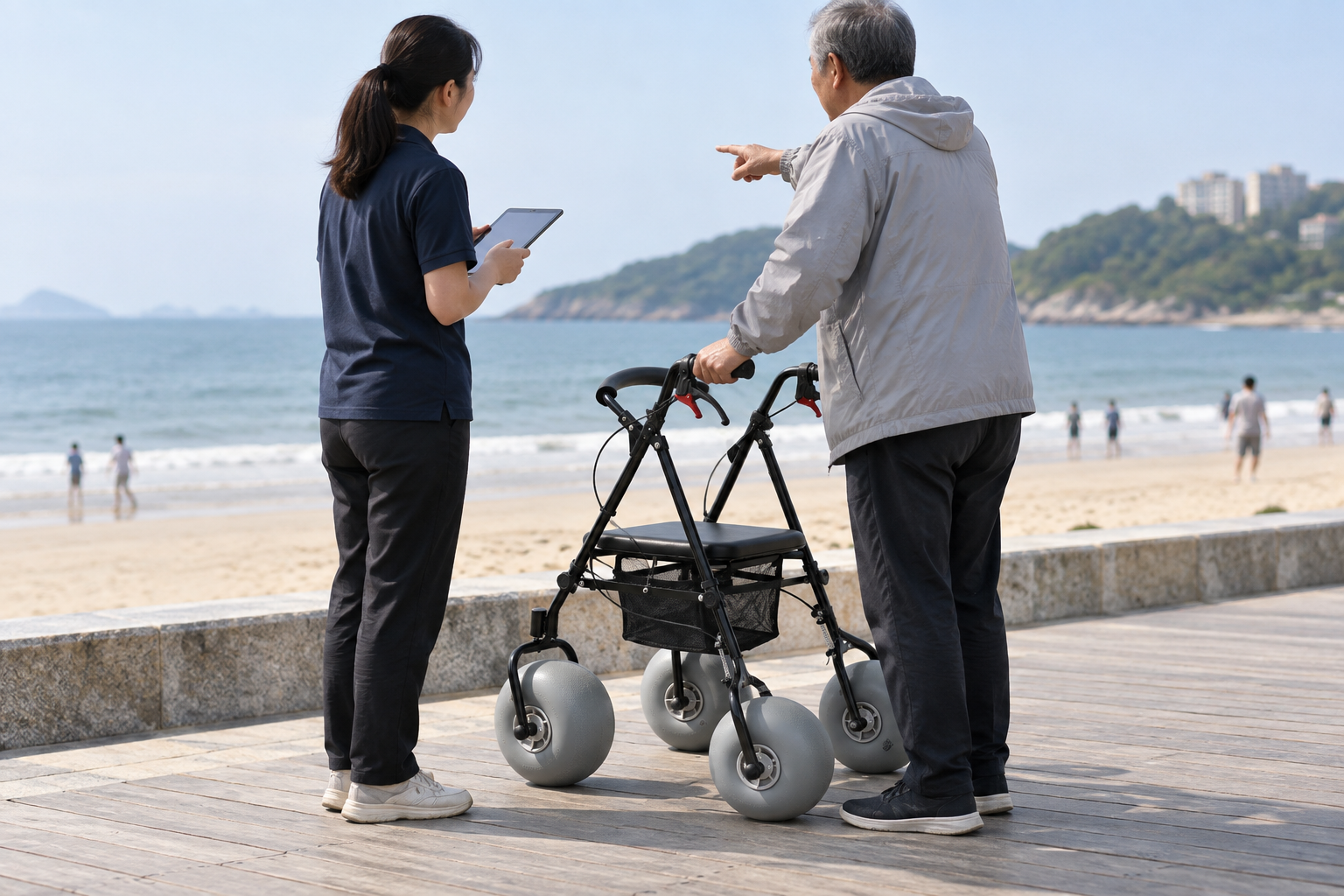
Ask about the booking or directions before setting out, because return-only surveys miss pre-trip barriers. During the walk, give the visitor time to concentrate on steering. Discuss the route from an agreed resting place or after the person is back on firm ground. Someone who stops early can still give valuable feedback about that part of the service.
| Moment | A question the visitor can answer | Detail worth keeping |
|---|---|---|
| Arrival | “Could you find the collection point from the entrance you used?” | Entrance, sign or direction that caused difficulty |
| Setup | “After the handles were adjusted, how did it feel to reach and operate each brake?” | The person’s words, affected side and chosen setup |
| Rest or return | “Where did the effort or steering change? What were you trying to do there?” | Named segment, turn direction, surface and assistance requested |
| After the outing | “Would you choose this route again? What would you change first?” | Preferred destination or alternative, including a shorter outing |
Offer a spoken conversation, a short written card, a phone follow-up or an accessible digital response as practical. A paper or spoken option matters because one QR code can exclude part of the audience. Ask the person how they want to respond. If they want a companion to contribute, identify whose words you record. Collect only information needed for the stated review under operator policy.
Keep the visitor’s comment and the technician’s observation together
Give each version its own field. For example, in a hypothetical trial the visitor says, “I had to pull left to stay on the mat.” The operator records that the right front wheel crossed a ridge of loose sand at the return edge. A technician can inspect that wheel and its retention and check the brake on firm ground. The site team can examine the edge. Each finding helps decide whether the walker needs service, the route needs attention or the team should repeat the trial with different assistance.
For a transport question, ask who handled the empty walker and where the handling difficulty occurred. AY-STZ1.0 has a manufacturer-listed net weight of 13.5 kg. Someone who can fold it in a store room may still find the vehicle sill too high for their agreed handling method. Keep the measured opening and the handler’s observation with that particular vehicle arrangement. Beach walker sample and durability checks
Show what the comment changed
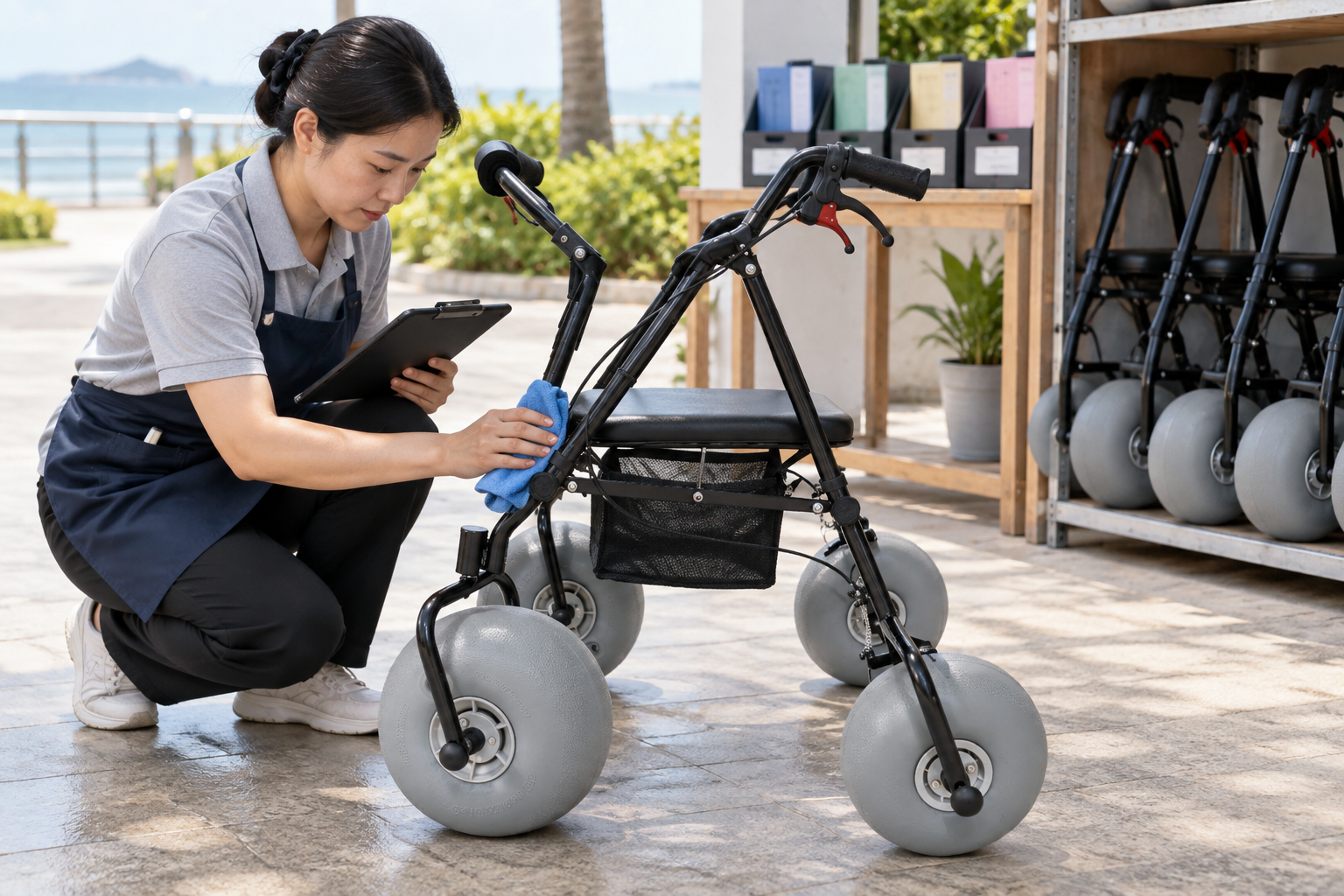
A loose handle, a brake fault or a wheel-retention concern requires an immediate equipment hold and technical review. A confusing pickup sign goes to visitor services. A difficult turn goes to the route lead with the location and direction of travel. Look at repeated comments alongside the consequence of a single access failure. A rarely reported barrier can still prevent an entire outing.
Tell the visitor about the action if they asked for a reply. If the operator changes the mat exit, ask a willing participant to try the revised turn under an approved plan, then record what that participant found. The buying or service decision can refer to a named walker, a specific route condition and a change the team actually checked.