
Put an empty AY-STZ1.0, its current manual and the service’s asset card at the actual collection point. Ask the trainee to prepare it for a colleague coming on shift. Watch which model they select, what they examine after opening the frame and how they explain an unresolved fault. Those observations show which tasks they can perform independently and which need supervised practice.
Divide training by the work people will do. Reception may confirm bookings and communicate a closure. An equipment attendant may inspect and prepare walkers. An authorised technician may diagnose or repair a brake. Give the incoming shift a named contact for tasks beyond its authority.
Exercise one: identify and prepare the empty unit
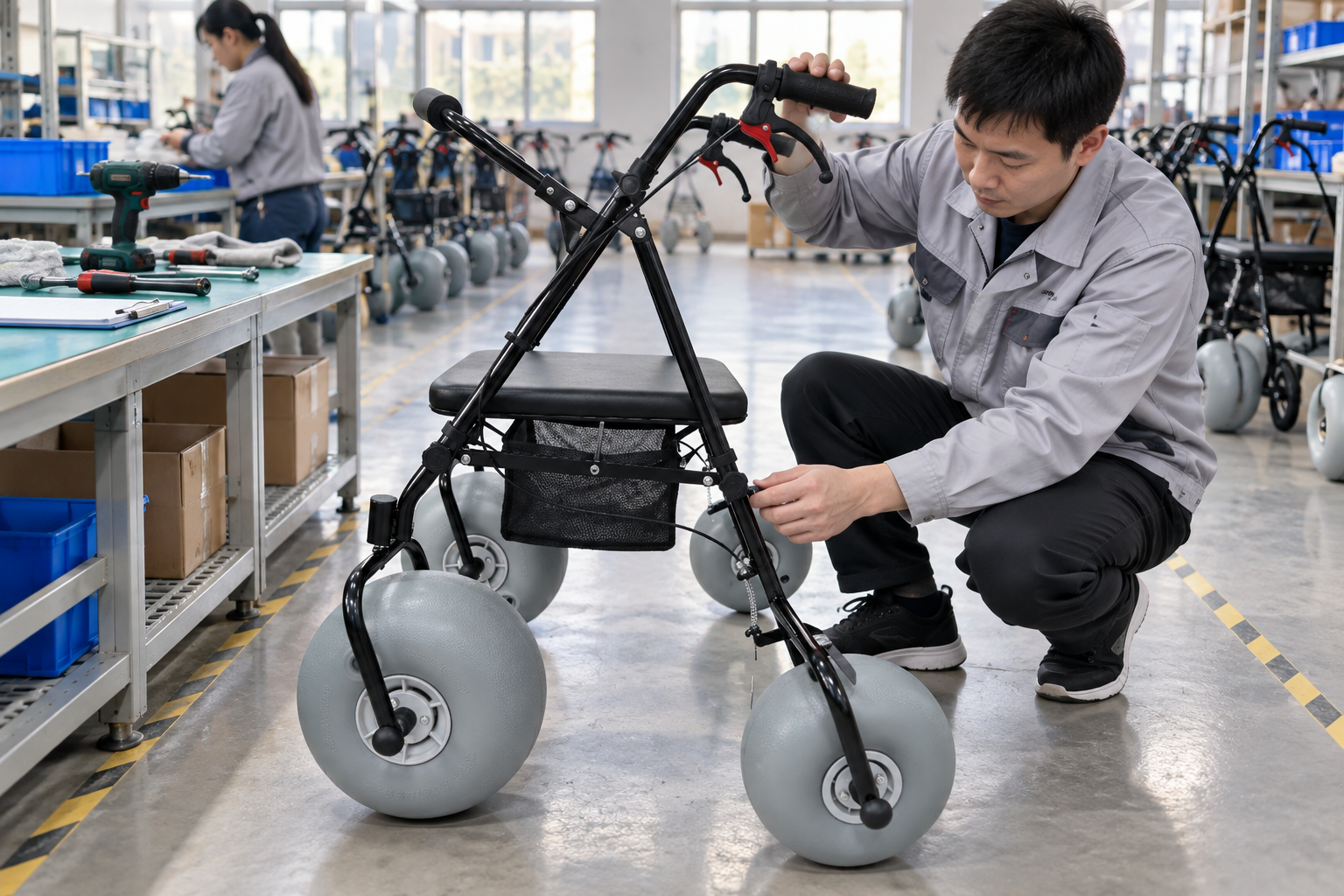
Have the trainee match the asset ID with its model and instruction set. The AY-STZ1.0 manual identifies a folding frame, four wheels, height-adjustable handles with brakes, a rest seat and storage bag. Its front wheels are listed as 9 inches and its rear wheels as 12 inches. Ask the trainee to point to the fitted assemblies, their retention points and the controls they use. AY-STZ1.0 manual, pages 2–5
On firm, level ground, observe the instructed setup and recheck after folding. The trainee should identify a handle setting that has not secured, wheel interference, cable obstruction or an uncertain frame connection during its prescribed check. Use photographs or a clearly labelled scenario to discuss defects. Do not deliberately disable an active loan unit for a surprise exercise.
Have the trainee describe the observation in the asset record. “The left handle moved during its prescribed check” gives the service lead something to investigate. “Bad walker” gives the next attendant little help. The trainee should identify where to place the unit on hold and how the desk will learn that it cannot be issued.
Exercise two: explain a real outing to a visitor
Walk the actual route with the trainee. Point out the collection desk, surface transitions, a suitable stopping point and the return. Then give a realistic change, such as a maintenance trolley blocking the usual gate. Ask the trainee to find out whether another approved entrance is open before offering it.
Practise an enquiry about brake reach or resting on the seat. Staff should demonstrate functions covered by their training and explain the model instructions. The visitor’s own fit, support and ability to use controls require appropriate assessment. A staff member can record a need and bring in the responsible trained person. The WHO identifies assessment, fitting, instruction and follow-up as elements of assistive-product provision. WHO training in priority assistive products
Exercise three: pass an exception to the next shift
Give the outgoing attendant this scenario: a returned walker has a reported brake fault and another visitor expects collection soon. The attendant receives the report, follows the site’s immediate assistance procedures as relevant, identifies the unit, marks it held and alerts the desk. The incoming attendant should be able to locate the same walker and tell the desk whether a suitable alternative is confirmed.
| Task observed | Evidence of competence | Scope to record |
|---|---|---|
| Prepare equipment | Trainee identifies the correct unit and demonstrates the instructed wheel, handle, brake and frame checks. | Model and configuration observed, with any task still requiring support. |
| Explain the route | Trainee gives accurate directions and identifies the change that would stop the outing. | Named route and current service boundaries. |
| Hand over a hold | Both shifts identify the same physical unit, fault status and next responsible person. | Role authorised to assess and release after service. |
Approve staff by task rather than attendance. If a person can correctly check the empty walker but still needs practice briefing a guest, record those as two different results. Reassess the relevant task after a configuration change, a new route, a long gap in practice or an incident revealing uncertainty. The rental desk can then assign duties with a realistic view of available competence. Rental asset and shift coverage