
Choose a park route by following the guest’s complete outing, from the transfer point to the destination and back. A paved path that ends at a narrow gate can be a worse choice for a wide beach wheelchair than a longer route with room to turn. Start with one destination the visitor wants to reach, such as a picnic table or lakeside viewpoint, and compare two plausible approaches using the chair that staff will supply.
Map the parts of the trip where the chair changes direction or surface
Walk both ways from the drop-off. Mark the gate or bollard with the least clear width, the sharpest corner, the transition off a boardwalk, and the available turning area near the destination. Identify the surface after rain or heavy use if those are conditions in which the park intends to offer the service. A loose gravel patch after an otherwise firm path may decide whether the party can return comfortably.
Record clear space between actual obstructions. A sign calling a path wide, or a measurement between fence posts with the gate fully removed, does not establish the opening available during visitor hours. Check the position of gates, bins, parked service vehicles and queues as they will appear during the outing. Beach access site assessment
Try the configured AY-ST-V2.0 at the limiting point
The manufacturer lists this four-wheel model at 120 cm long, 110 cm wide and 122 cm high overall. It has inflatable PU front and rear wheels, a removable high back and a five-position leg support. Measure the actual chair with the supports in the intended positions. Its full front projection matters when it turns at the end of a narrow path. AY-ST-V2.0 manual, pages 2–3
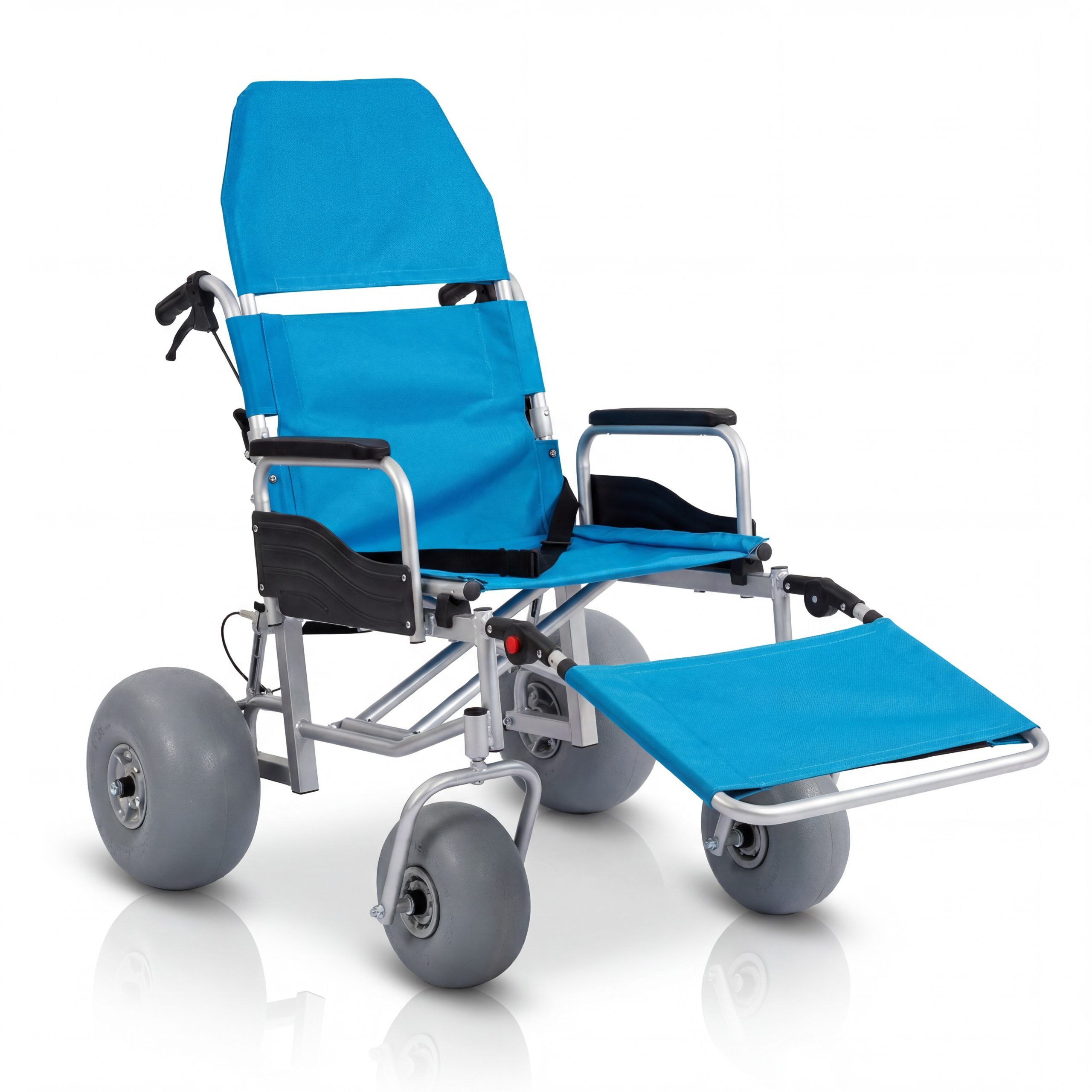
For example, suppose a picnic entrance leaves 105 cm clear, and the supplied chair measures 110 cm across in its normal travel configuration. That entrance fails the straight-through width comparison. Check the alternative gate before the guest arrives. A positive width difference at another entrance still leaves practical questions about hands at the push handles, the angle of approach and room beyond the gate. These example measurements are not public-path design standards.
| Park feature | What to observe on the outward and return legs | Possible route decision |
|---|---|---|
| Boardwalk exit to sand | Drop at the edge, accumulated sand and the space to turn back before leaving the surface | End the outing at the viewpoint or select another transition if the exit is unsuitable. |
| Gravel or damp grass | Loss of control, wheel drag, side slope or a change in assistance needed | Try the firmer alternative within the operator’s plan or shorten the route. |
| Picnic table, shelter or viewing rail | Clearance for the projected supports, companion access and a complete turn | Pick the bay where the party can turn and leave using the same agreed assistance. |
| Maintenance gate or shared path | Whether the gate will be open on return and pedestrians can pass | Use an entrance with confirmed access for the full booking. |
Rehearse a specific trip, then offer it with its limits
Begin with a mechanically checked empty chair. A member of staff pushes the proposed line while another observes the limiting points. Note where a wheel rubs, where the chair ruts the surface or where the attendant must change position. If any equipment fault appears, stop and address the chair separately. The V2.0 staff practice guide covers setup, adjustment and handover before a visitor stage.
An empty roll can establish whether the chair clears a fixed gate. A visitor’s seating needs, preferred destination, fatigue and agreed assistance still require their own assessment. Tell the guest where the firm path ends, whether the chosen loop crosses sand, where they can turn back and who will assist. Treat the V2.0 as a land chair in this service. A lakeside destination can end at the view. A supervised lake water-access session requires separate equipment and conditions.
Keep a shorter return available
Before starting, identify a place where the chair can turn around earlier if the visitor requests a shorter outing or the surface deteriorates. For a scheduled service, include enough time to get back through the gate and return the chair to storage before the next handover.
Recheck the affected stretch after a storm, path works or a change in gate furniture. A record that says “picnic bay via west gate, firm on the day checked, return by the same path” gives the next attendant something to verify. A general statement that the wheelchair handles the park gives the visitor little basis for choosing a trip.