
Put an empty, complete AY-ST-V2.0 beside its current manual and ask the trainee to prepare it for the next attendant. Watch what they check before anyone is invited to sit. Can they identify the front and rear wheel assemblies, show how the fitted high back and leg support are secured, and stop if something moves unexpectedly? Those actions tell a trainer more than a signature on the attendance sheet.
Walk around the chair with the trainee
Start on firm, level ground with a chair that has already passed receiving inspection. The AY-ST-V2.0 is a four-wheel, folding beach wheelchair with a high backrest and a five-position leg support. Its page 3 diagram identifies the removable upper backrest and brake control. Pages 4–5 illustrate wheel attachment, opening the frame, fitting the upper backrest and fitting the front support. Have each trainee find these items on the chair they will actually use. AY-ST-V2.0 manufacturer manual
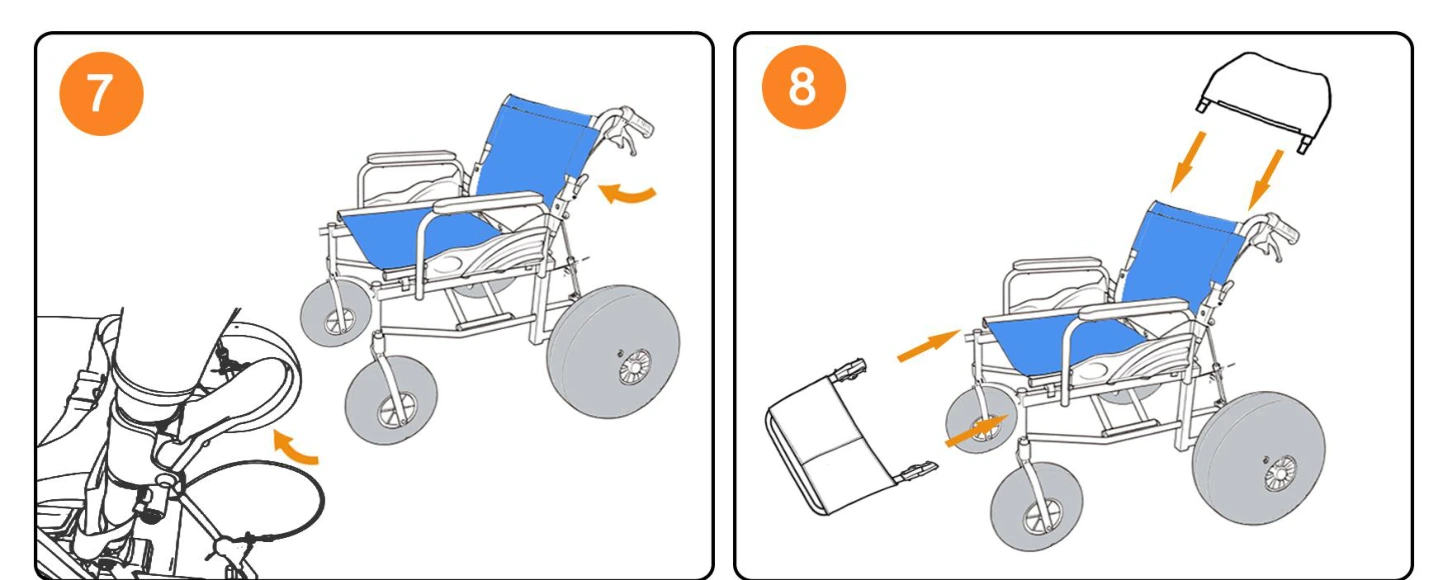
Component identification from the AY-ST-V2.0 manufacturer manual, page 5.
Ask the trainee to trace each part to its attachment. At the front, they should identify the wheel, fork and connection to the frame. At the rear, they should recognize the larger wheels and locate the points that retain them. An attendant returning from seasonal work may remember a similar chair with different attachments. If the supplied part and its drawing disagree, the trainee should put the chair aside and ask the equipment lead to resolve the difference.
Have staff demonstrate three tasks on the empty chair
- Prepare the seat and frame. The trainee follows the model’s illustrated opening and assembly sequence, then shows the trainer the engaged connections and the condition of the seating fabric. Ask them to indicate where they would stand and keep hands clear as moving parts come together.
- Set and check the supports. Have the trainee install or check the upper backrest, demonstrate the documented adjustment on the empty chair, and show how they confirm the chosen setting holds. Repeat this for the leg support. The available settings describe mechanical movement. A suitable position for a particular guest must come from that person’s needs, the relevant assessment and the operator’s instructions.
- Demonstrate movement and stopping. On the agreed firm-ground practice area, the trainee checks wheel retention, rolls the empty chair, turns in both directions and demonstrates the specified brake functions. Ask what they would do if a wheel rubs or the backrest slips. Keep the equipment out of service until the fault is addressed and the affected function has been checked again.
The trainer should be able to point to the component and the observed result. “Located the rear-wheel retention and checked it after reassembly” is a clearer training note than “knows wheelchair setup.” If the person cannot identify a release or locking point from the supplied instructions, obtain the manufacturer’s clarification before continuing with that task.
Practise a handover the next attendant can act on
Use the chair’s actual storage and transfer area for an empty-chair rehearsal. Ask one member of staff to retrieve the unit and another to receive it. The outgoing attendant identifies the chair, tells the incoming attendant which components were refitted, identifies the selected settings and reports any unresolved concern. If something is wrong, the incoming attendant should be able to locate that exact chair and prevent its use.
Then introduce a change in the route, such as a closed gate on the normal return. Ask the trainee to choose where to turn back and explain the alternative to a visitor. A supervisor can use the park route assessment to choose a realistic training segment without improvising an occupied test.
Introduce the visitor stage only when the arrangement is ready
Before a visitor transfers, the responsible team must have a suitable chair, an agreed transfer and assistance arrangement, a usable land route and a way for the visitor to pause or end the outing. Invite the guest to describe their preferred communication and intended destination. Staff should be able to explain where they plan to return and who will help there. The chair’s reclining capability does not supply a personal seating prescription.
Make the scope of each person’s training explicit. A person observed preparing an empty chair may still need supervised experience with guest handover or the specific route. Repeat affected tasks after a configuration change, a prolonged break or an incident that exposed uncertainty. Managers coordinating cover across shifts can use a separate staff training and roster plan.