
Take a visitor’s intended outing as the unit of assessment. A wheelchair may clear a ramp and still leave the person short of a shaded seating area. A transfer space may be usable, yet the equipment store opens after the visitor’s last return shuttle. Identify where the complete trip first fails before recommending additional mat sections, a beach chair or more staff.
Give the assessment a named entrance, destination, season and service period. Include the land manager, operating lead, people who use the route and the person responsible for the relevant design review. Explain which decisions the assessment can support. A site visit can produce a measured gap list, an operations change or a brief for further engineering work.
Walk from the actual arrival point and return the same way
Walk every normal arrival path with operations staff. Start at the parking or drop-off space people will actually use. Record how someone reaches the entrance, obtains directions, collects any equipment, travels to the destination and gets back to their usual device or vehicle. Check each gate in its normal position. Include furniture, queues and service traffic present during the proposed hours.
| Stop on the walk | Record a fact that another person can verify |
|---|---|
| Drop-off and reception | Location of the usable arrival space, gate, opening hours and distance to the assistance point. |
| Hard approach and sand transition | Clear width at real obstructions, change in level, support under the edge, surrounding sand and direction of travel. |
| Destination | Actual space to stop or turn, seating, shade or toilet if advertised, and any remaining loose surface. |
| Return and care point | Whether the same way back remains available, who receives the equipment, and where it can be inspected and prepared. |
Mark each finding on a plan and give it a reference, date, conditions and direction of view. Ask a visitor or companion where they would pause or need help. Keep that account alongside the physical measurements. A single participant’s experience can identify a decisive barrier without establishing the experience of every visitor. Gathering community input about the route
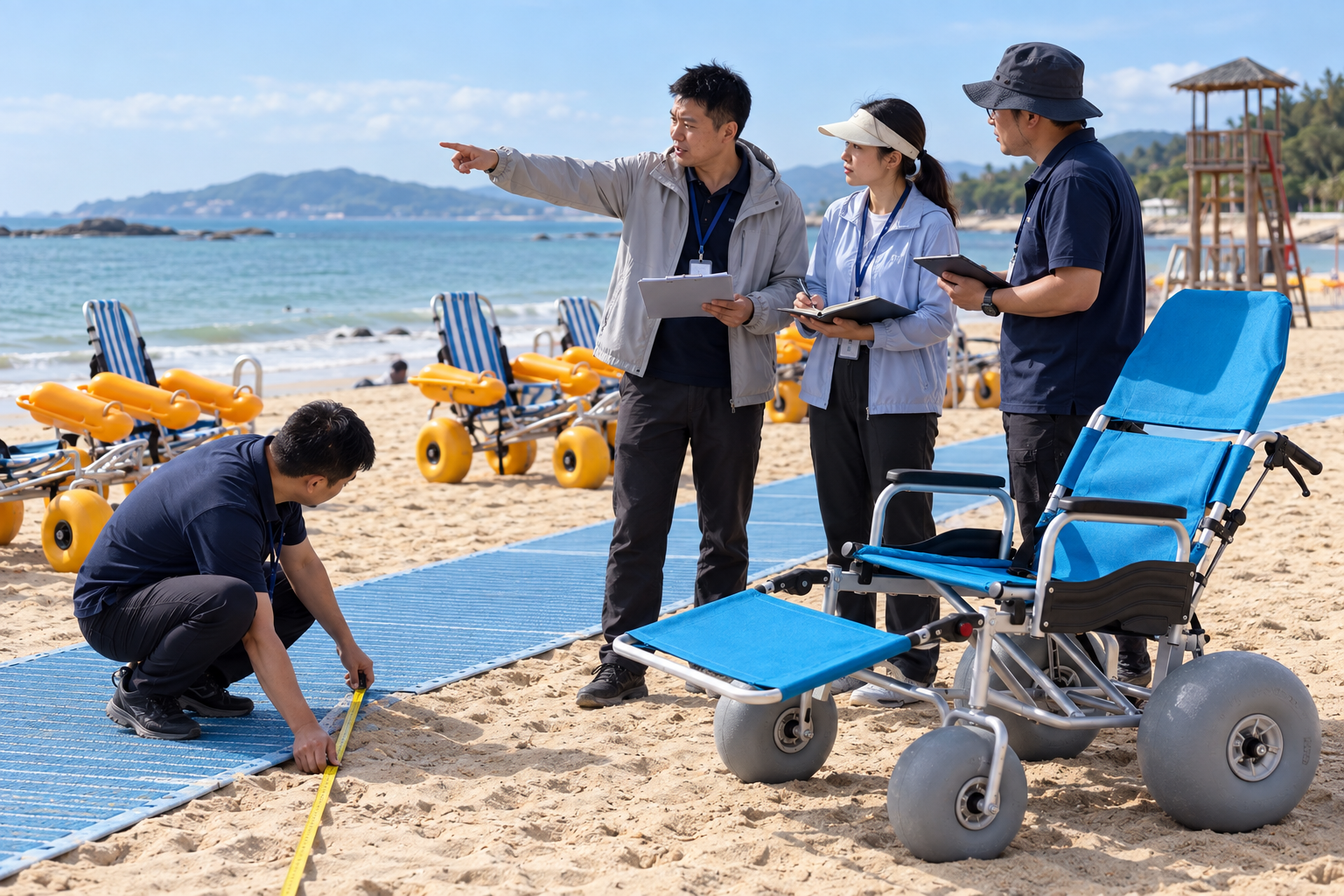
Check one real equipment and staffing constraint
Identify which assets are actually available, which are on hold and which have current instructions for the proposed role. Measure the complete configured equipment where it needs to pass or turn. For example, the AY-ST-V2.0 manual lists an overall width of 110 cm. An entrance measured at 105 cm clear cannot accommodate that listed assembled width in a straight pass. If a wider gate exists, verify that it opens during the outing and gives enough room for the attendant and the turn beyond. AY-ST-V2.0 manual, page 2
Ask the duty team to rehearse one booking through return, including retrieval, agreed assistance, cleaning, drying and a fault reported just before the next visitor arrives. Record which task stalled and why. A missing staff handover can prevent a service from running even where the chair and route are both physically usable. Keep any water activity in its own assessment with its own model, staff and permitted conditions.
Separate the field finding from the proposed remedy
Suppose a chair stops at the end of a mat because sand has washed away below the last section. The observed gap, section reference and photograph belong in the assessment. An extension, a different endpoint or restoration of support are proposals. Ask the responsible reviewer to compare them against site permissions, intended users, construction detail and maintenance capacity before specifying a purchase.
For U.S. projects, the Access Board’s outdoor guide explains the scope of federal outdoor developed-area provisions. Establish the requirements applicable to this particular site and project with its responsible accessibility and design team. Record a qualified review as outstanding where it is needed. Access Board guide to outdoor developed areas
Deliver a short list organised by consequence. Identify an immediate operating restriction, a correctable obstacle, a design question and any equipment or staffing purchase each would require. Give each finding a decision owner, what evidence closes it and the earliest realistic phase. A decision-maker can then see whether to move a bin, change a handover shift, investigate ground support or commission a new route design. Designing the accessible route to the beach