
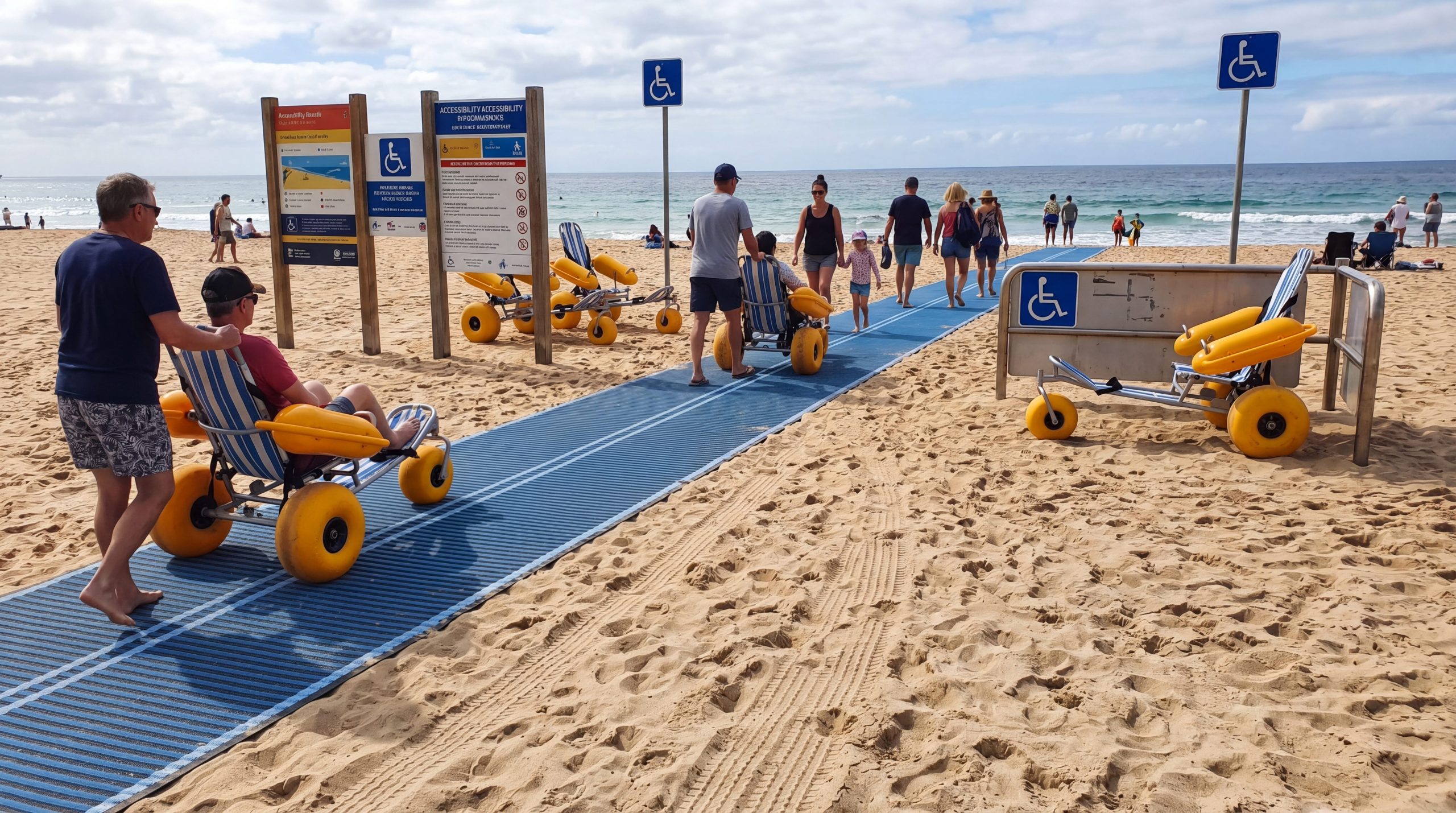
Illustrative equipment and route image from the Ary Beach collection.
A national park beach mat proposal should name the entrance, the visitor’s destination and the land the route would cross. A route proposed for a dune crossing, a view of the beach or access to a tidal shoreline can involve very different work. The park’s access, resource management and operations staff need to assess the same alignment before a product or opening date is announced.
Read a park guide entrance by entrance
The National Park Service’s 2026 Cape Cod National Seashore Visitor Guide listed seasonal matting at Coast Guard Beach in Eastham, Race Point Beach and Herring Cove Beach. It separately listed summer beach wheelchair availability at the seashore’s beaches except Marconi. Those are two different facility descriptions. Someone planning a visit should identify the particular entrance and ask the park which route and borrowing arrangements apply on their date. Cape Cod National Seashore 2026 visitor guide, page 1
For a park planning its own route, borrow the guide’s distinction rather than its facility schedule. Draw the path a visitor can use from parking or drop-off to the mat, then from its end to the stated destination. Show where the visitor can turn and return, and identify any additional equipment, transfer or assistance beyond the mat. A seasonal listing at another beach cannot establish those conditions locally.
Find the alignment the park can sustain
Walk the candidate lines with the people responsible for access and for the resources on the ground. Map the hard approach, dune or shore crossing, drainage, areas of erosion, established visitor movement and locations the resource team says must be avoided. Ask whether the proposed route is still usable on the return leg and whether a crew can reach the mat to inspect, remove and store it under the park’s operating plan.
Consider an illustrative choice between two entrances. At the shorter one, the proposed mat line would cross a sensitive area identified by the park. At the longer one, an existing visitor corridor reaches a firm approach but its junction with sand needs work. Compare what each alignment would require, including visitor travel, interface work, resource effects and seasonal removal. Ask the relevant park staff to decide whether either line can proceed. A new strip of matting cannot resolve the land-use question.
Establish which federal route requirements apply
The U.S. Access Board explains that its 2013 outdoor provisions address certain facilities constructed or altered by federal agencies, including qualifying work by others on federal land on an agency’s behalf. Its treatment of beach access routes covers the connection from a beach entry to the applicable shoreline level and distinguishes tidal, river and lake settings. Have the agency’s project and accessibility staff establish the required scope, current standards and any applicable exceptions for the actual project. U.S. Access Board guide to outdoor developed areas
For a covered route, the Board’s guide describes a 60-inch minimum clear width and a specific reduction to 48 inches for a non-removable route at a dune crossing. Record which segment and provision the design team is using. A mat catalogue width is not the installed clear width past an offset joint, gate or obstruction. The guide also distinguishes these federal outdoor provisions from the Department of Justice’s 2010 ADA Standards. Project teams elsewhere need the requirements applicable to their own sites. Board guidance on beach access routes
Put resource constraints into the physical proposal
Ask the supplier to identify the mat sections or rolls, connections, end treatments, anchoring assumptions, tools and removal method for the chosen route. Use the park’s actual substrate and restrictions for that request. Where anchoring, digging or seasonal work may disturb a protected feature, refer the proposed detail to the park’s responsible authority before installation. A manufacturer describes its product and installation needs. The park decides what work it can authorise. Beach access mat specification and procurement brief
At handover, check both ends and each surface change against the accepted route. A gate can be clear on the drawing but difficult to approach when a queue forms at the beach entrance. A crossing that worked at installation can change as sand moves. Agree who will check those points, what visitor activities depend on them and who can remove or restrict use of the affected segment. Seasonal mat setup and route opening
Describe the route that visitors can use
When the park announces an opening, identify the entrance, destination, season or service window, surface beyond the installed mat and the contact for current conditions. Describe wheelchair loans separately, with their own collection points, availability and operating conditions. If a resource restriction or erosion changes the alignment, update visitor centre directions and field signs together. A person already beyond a removed section needs a workable return before the next group is offered the shortened route.