
A straight boardwalk is usually the easy part of a four-wheel beach cart trial. At a tight gate, the front casters must change direction while the rear tires and the outside corner of the load follow different paths. Back at the store, the crew needs room to release and fold the empty frame. Passing through the gate and fitting on the shelf are two different tests.
Use the dimensions for the four-wheel deck model
Ary lists the four-wheel folding cart with two 12-inch balloon tires, front swivel casters, a 29.5 × 16 in deck with a mesh basket and a handle adjustable from 35 to 53 in. The published maximum cargo load is 220 lb for this configuration. The 30021-SIS quick-fold model also has casters, but carries different shelf and handle specifications. Confirm the order drawing and fit of the supplied model. Folding beach cart specifications
Measure the front opening with the gate fully in its normal working position. Note posts, bins or hinges at axle height and rails near the outside cargo corner. Then look past the entrance. Even if the wheels pass straight through, the operator may have nowhere to stand to complete a ninety-degree turn immediately beyond it.
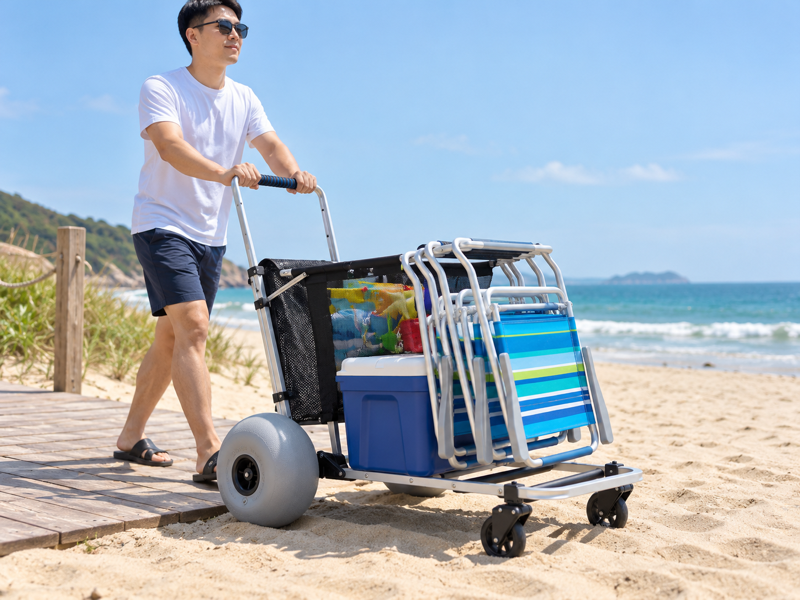
Watch both wheel pairs as the surface changes
| Where to observe | What can decide the route |
|---|---|
| A tight turn on the firm approach | Allow room for the casters to swivel, the rear of the load to sweep around and the operator to stay clear of the gate. |
| A seam or raised edge | Inspect the approach from both directions. Watch whether a small front caster catches before the larger tires arrive. |
| The start of loose sand | Check whether the casters can turn and the load remains controlled over the actual surface. Avoid relying on a clear track made earlier in the day. |
| The unloading place | Find a suitable stationary position and enough space to remove the goods without obstructing the return. |
Start the route check with an empty, released cart. Use only a permitted, secured representative load for a subsequent trial under the site’s handling arrangements. Keep people out of the cargo area and follow the instructed method of moving the cart. Avoid forcing a trapped caster across an edge or improvising a different operating position to finish the run. If the crew cannot control the change of surface, choose another route, stop on the firm side or use more suitable equipment.
A simple example is a folded beach chair strapped across the deck. Its end may clear the gate going straight and strike the post when the caster changes direction. Reposition it within the permitted support and restraint arrangement and repeat the actual turn. If the required clearance is still unavailable, the wide route or another load plan is the usable option.
Try the fold in the real storage bay
Unload the cart in its instructed position and account for loose accessories. Identify the release on the supplied model. The product sheet describes a folding frame with a red release button for this four-wheel version. Use the applicable instructions to close it, keeping hands and nearby equipment clear of moving parts. Record the clear working space needed before the folded cart can be parked.
Measure maximum length, width and height in that stored configuration, including any wheel or handle projection. Check the door, shelf lip and space occupied by adjacent carts. Can the closing crew put it away without blocking the corridor, and can the opening crew unfold it where the frame engagement can be checked? The open deck dimensions do not answer either question. The folded cart storage guide covers the bay and retrieval arrangement, while the departure inspection covers reopening the unit for work.