
The first useful test of a two-wheel folding beach cart is whether the goods have somewhere to sit. A soft bag can spread across a mesh sling. A narrow-footed cooler can put most of its weight on a few small points. A long chair bag may clear the ground while stationary and catch a wheel when the operator tilts the cart to move. The shape and support of the load matter before anyone compares weights.
Ary’s standard two-wheel folding model has two wide balloon wheels, a mesh sling deck and a folding handle. Its published comparison lists the cargo rating and included accessories on request. Ask for the order-specific rating, supported cargo positions, stand or parking arrangement and permitted restraints. Neither the rigid molded-tub cart nor the four-wheel deck cart can supply those answers. Manufacturer’s model comparison
Try the loaded shape on the actual sling
Measure the bottom of the largest rigid item, including feet, wheels or other points that concentrate its load. Inspect the sling and its attachment points under the model instructions. Place the proposed cargo only where the manufacturer allows. Look for unsupported corners, contact with wheels, or a strap that bears on the fold release. Weigh the packed goods, including ice or contents added at the last moment.
For an illustrative rental kit containing a cooler, two bagged chairs and a soft dry bag, ask three questions. Does the cooler base stay supported as the operator takes up the handle? Do the chairs project into the turning space? Will the dry bag stay accessible without undoing the restraint on the other items? A second run or a different carrier can be simpler than finding a way to wedge one more bag into the stack.
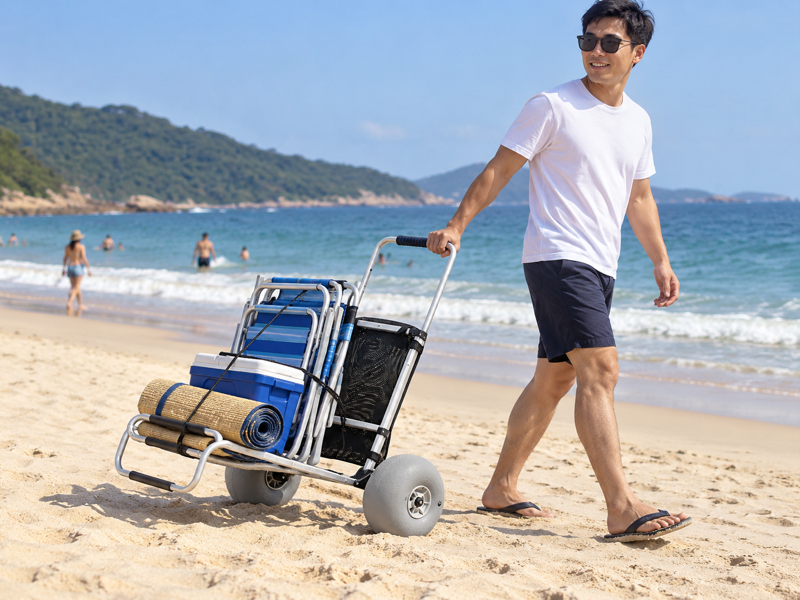
Account for the operator’s end of the cart
The two wheels provide one axle line. As the cart is moved at its working angle, the operator must be able to maintain control of the handle through starts, stops and turns. Avoid assuming that centering an item by eye establishes acceptable handling. A tall load near the handle can feel different from the same mass placed near the outer end of the deck.
Choose a level, clear place for the first controlled check and follow the supplier’s procedure. Observe whether the goods shift, the sling draws close to a wheel or the handle becomes difficult to control. Stop and change the arrangement if the operator cannot keep control. Have the person who will work the route identify the narrowest turn and the transition where the cart must change angle. A large balloon wheel does not make a loose or obstructive load suitable.
Decide how the last item comes off
At the destination, establish the permitted stationary position before unloading. Use the support arrangement supplied for that version and make sure the footing and working area are suitable. Never assume a two-wheel unit will remain upright unattended with an uneven load. Keep the operator’s hands clear of movement in the frame or sling.
Return to the cooler example. If staff remove the chairs first, the remaining cooler may change the way the cart rests. If the dry bag is underneath, trying to pull it out can disturb both. Set the cart in its instructed loading position and unload in the order checked at dispatch. When the drop point offers no suitable place to stop, agree another handoff before departure.
Empty the cart before folding, check for damage at the sling and attachments and store loose items with the correct asset. For a damaged sling or a folding mechanism that will not engage, take the cart out of issue and use the folding cart inspection procedure. A buyer comparing this wheel arrangement with a caster-equipped deck model can use the three-model purchasing guide.