
A folding cart can stand on its wheels with the deck level while its opening lock is only partly engaged. Keep the cart empty until the assigned operator has identified the locking mechanism for that model and checked it by the method in the supplied instructions. A carton placed on the deck is a poor way to discover that the frame can fold.
Identify what holds this model open
Ary Beach lists a red release button on its four-wheel deck model. Its quick-fold 30021-SIS and two-wheel mesh-sling cart are separate configurations. Do not use the position of a red button in a photograph as a sign that every cart has the same lock or releases in the same direction. Match the unit or order reference to its assembly instructions first. If those instructions fail to identify the lock on the delivered frame, ask the supplier to identify it before putting cargo on the cart. Folding cart model comparison
Set the empty unit in the instructed position on clear ground. Look at the hinge, pivot hardware, locking parts and the sections of frame that must meet. Check for sand, a loose strap or a folded edge of fabric in the working area. Follow the manufacturer’s opening sequence, keeping fingers outside the path of the moving members. Examine the final position from a place where the lock can be seen.
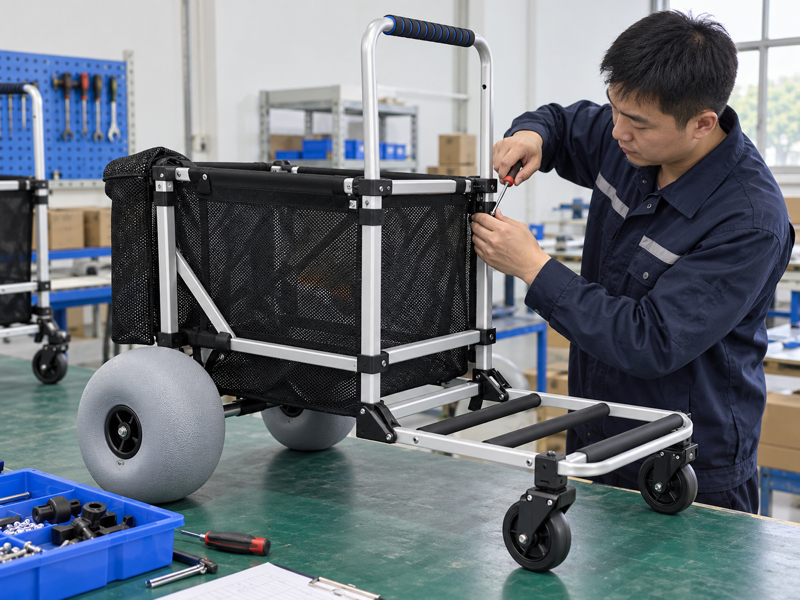
Decide what the observation permits
| Finding on the empty frame | Action |
|---|---|
| Fabric lies across a surface the lock must reach | With the frame safely positioned under its instructions, clear the obstruction and repeat the prescribed opening check. Inspect the fabric for damage. |
| The release control remains displaced or the mating pieces do not reach their documented position | Keep the cart empty and off dispatch. Record the location and take a clear photo without operating the cart under load. |
| A pivot fixing is absent, displaced or of uncertain identity | Refer the frame to the authorized service person with its asset ID. Obtain the prescribed hardware and installation instructions. |
| The frame opens and the lock meets its documented check | Continue with the other pre-use checks, including wheels, handle, deck and the equipment holding the cargo. |
A click can be a helpful observation if the instructions mention it. On its own, the sound says little about which surfaces met or whether a release control returned. Ask the supplier for the acceptance check if it is unclear. Leave any pull-test force, adjustment or replacement procedure to the version-specific instructions.
Keep a repeated folding fault traceable
Suppose an operator reports that the left side of cart F04 failed to reach its usual open position twice after a strap was moved clear. Photograph the open position and the affected side. Tell dispatch which cart is unavailable and what happened on the second attempt. A note saying only “stiff frame” loses the distinction between a first obstruction and a continuing hardware fault.
The person authorizing return to service should identify the correction, the fitted part if applicable and the empty-frame check that closed the original finding. If the cart was stored folded during repair, unfold and check it before making it available. Keep that result with the unit’s storage record. Staff can then see exactly which cart was cleared to carry goods.