
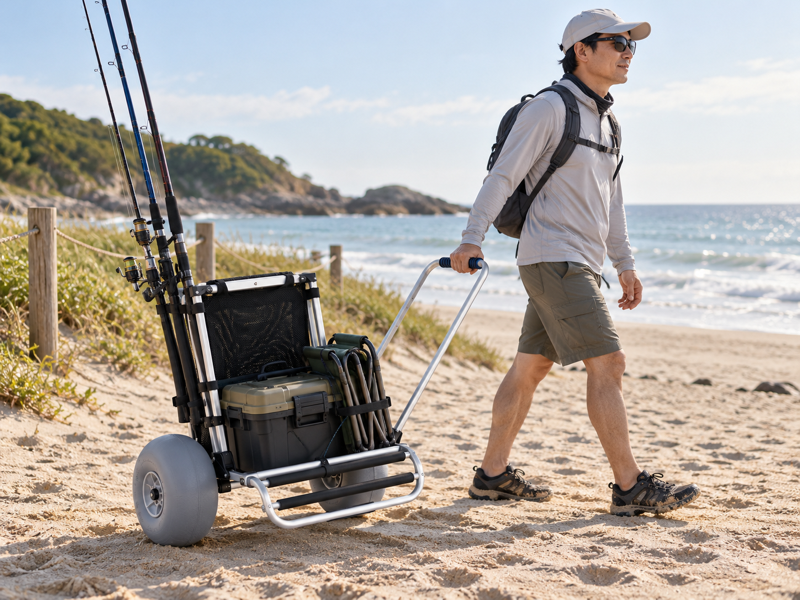
Start packing a fishing beach cart with the route from the parking area to the place you intend to fish. At the narrowest gate, a protruding rod can be a bigger problem than the width of the cart. On the return, a wet net, loose line and a cooler with different contents can make the outward packing arrangement unsuitable. Work out both loads before setting off.
Pack rods and tackle for a moving cart
Break down and protect rods in sleeves or cases where the equipment allows. Measure the longest packed length. Use confirmed attachment points for that cart and contain the ends so they cannot sweep into another person, catch a rail or strike overhead obstructions. Store tackle with hooks and lures enclosed. Loose line can reach a wheel even when the box it came from sits securely on the deck.
Put heavier gear on a supported part of the platform or sling in the position permitted by the manufacturer. Count the cooler’s actual packed weight, including ice and contents. Keep items needed first accessible without pulling a strap out from under the whole load. A holder supplied for an umbrella does not establish that it can secure a rod bundle during travel. Check included accessories and any proposed rod carrier against the specific order.
Ary lists different folding beach cart models. The standard four-wheel deck is 29.5 × 16 in, while the 30021-SIS lists a 20 × 14 in shelf plus bags and a chair rack. The two-wheel sling model requires its own confirmed cargo limit. Pick the support surface that fits the packed fishing gear. A fishing illustration does not identify accessories included with every cart.
Walk the actual fishing access
A public access gate may give way to steps, a tight turn or a narrow shared boardwalk. Find the last place the loaded cart can reach, stop and turn safely under the site’s arrangements. Look up as well as across the path. If the rods cannot be transported within the available clearance, shorten the packed arrangement, make a separate trip with the appropriate carrier or choose a different entrance.
The return deserves a separate look. Ask whether the parking gate closes, the shuttle only takes certain loads, or beach conditions can cut off the planned path. Confirm local access arrangements with the operator of the particular site. Keep the cart on the permitted land route and out of the water. A destination usable by the angler on foot may lie beyond the point where the goods cart can be taken.
Decide where wet items will go
Suppose a shore angler takes a cooler, a tackle box and two packed rods through a shared gate. The cooler fits the deck, but putting the rods crosswise makes their ends project beyond the wheels. Check whether they can be secured lengthwise without fouling the handle or passing into the operator’s space. If neither direction works, take them on a separate trip or use an approved carrier instead of relying on someone walking alongside to catch a sliding bundle.
Before the return, put used tackle back into its closed container and collect loose line. Keep a wet net or other wet gear separate from dry kit. Recheck the cooler as packed for return, including anything added at the destination. If the cart is hired, leave enough time for repacking, the walk back and the agreed handoff. A promised collection slot is useful only if the loaded cart can still reach it.
Unload before folding
At the vehicle or store, establish a clear stationary unloading place and follow the cart instructions. Set long gear down where it cannot roll into another path. Lift out the cooler under the local handling arrangement and check the basket, wheels and release area for line or hooks before anyone folds the frame. Clean and dry the cart as instructed, and report damage found on return to the supplier or hire desk. The folding cart inspection guide gives the next renter a way to distinguish an equipment fault from a packing problem.