
AY-ST-V3.0 is the black-blue folding beach-wheelchair configuration shown in Ary’s supplied documentation. It combines a folding frame, four balloon wheels and a flip-up foot support. For a tour operator, the relevant question is whether that product arrangement fits equipment that must move, store and return to service between departures.
Before finalizing this workflow, review beach wheelchair tours alongside wedding beach wheelchair.
For broader destination-level context, consult the UN Tourism accessibility publications and guidelines. Apply local requirements and current product documents to the specific project.
1. Which product is the AY-ST-V3.0?
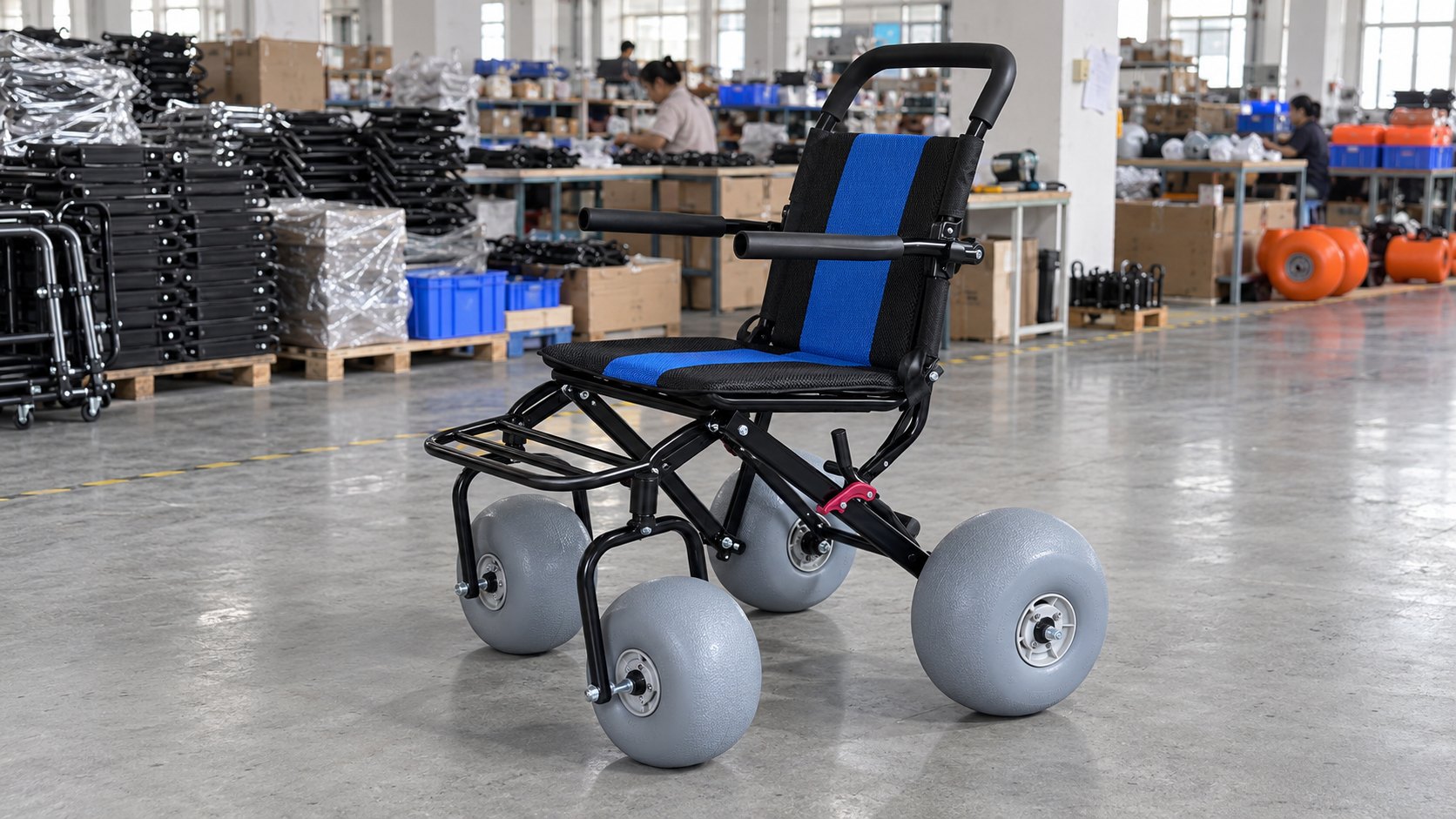
Identify this model through its complete configuration, not upholstery color alone. The supplied documentation shows a black frame, black-blue seat and back, four balloon wheels and a visible folding mechanism. It belongs in the land-mobility product discussion, separate from floating chairs.
For a travel company, a named model gives purchasing and operations teams a shared reference. They can ask about the same product, retain applicable instructions and explain which configuration is being considered for a traveler. An unspecified lightweight chair leaves those details open.
Match the model name with a complete product view.
- Identify the frame, seat and wheel arrangement together.
- Confirm which supplied version the quotation covers.
- Keep product identity separate from individual suitability.
Use the lightweight folding beach wheelchair page as product-family context. Request current AY-ST-V3.0 details rather than borrowing values from another chair described as lightweight.
Identify the configuration
| Feature | What it helps identify | Question to confirm |
|---|---|---|
| Black-blue seating | Supplied appearance | Current color and version |
| Folding frame | Product structure | Applicable operating instructions |
| Four balloon wheels | Beach-oriented arrangement | Exact supplied components |
2. What is the practical value of a folding frame?
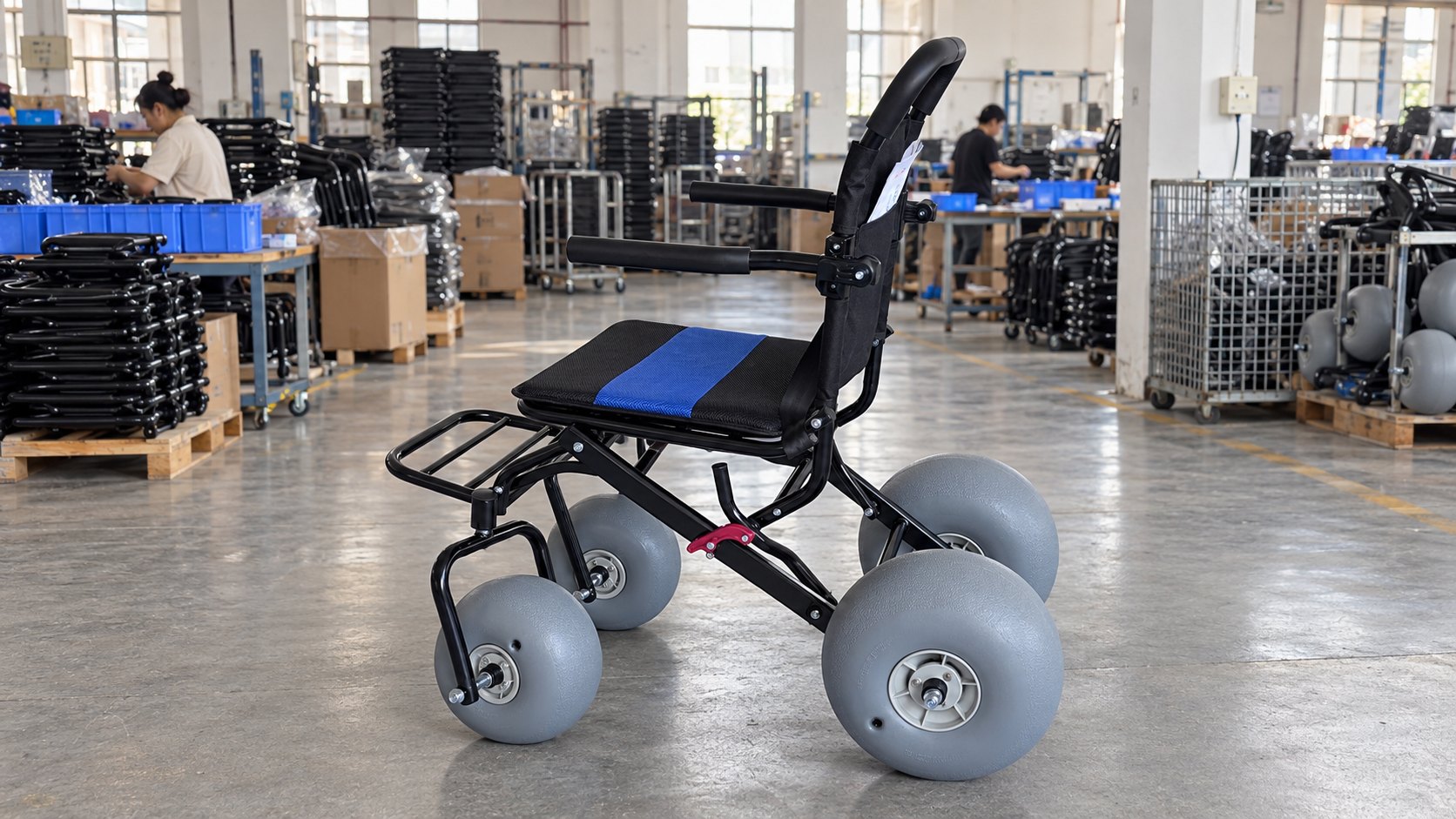
A folding structure gives a buyer another product state to consider for storage and empty-equipment movement. That can matter when equipment travels between a base, vehicle and destination. That benefit depends on its actual folded configuration and the work needed for preparation.
Do not translate foldable into fits anywhere. A folded frame still occupies space, and associated items may require separate arrangements. Compare confirmed measurements for your supplied version against actual storage or vehicle constraints.
Compare the product states your team will handle.
- Request an assembled configuration view.
- Request the permitted folded or transport configuration.
- Identify what remains attached in each state.
The portable beach-wheelchair travel resource can organize those questions. A tour operator should assess the complete movement task rather than buy on a photograph of an isolated folded frame. The product’s portability has value only where an appropriate handling arrangement exists.
Evaluate folding as a product feature
| Product state | Relevant evidence | Useful decision |
|---|---|---|
| Assembled | Current complete configuration | Operating-space review |
| Folded or prepared | Applicable instructions and dimensions | Storage or transport review |
| Packed shipment | Confirmed package information | Receiving and freight planning |
3. What should lightweight mean in a buying comparison?
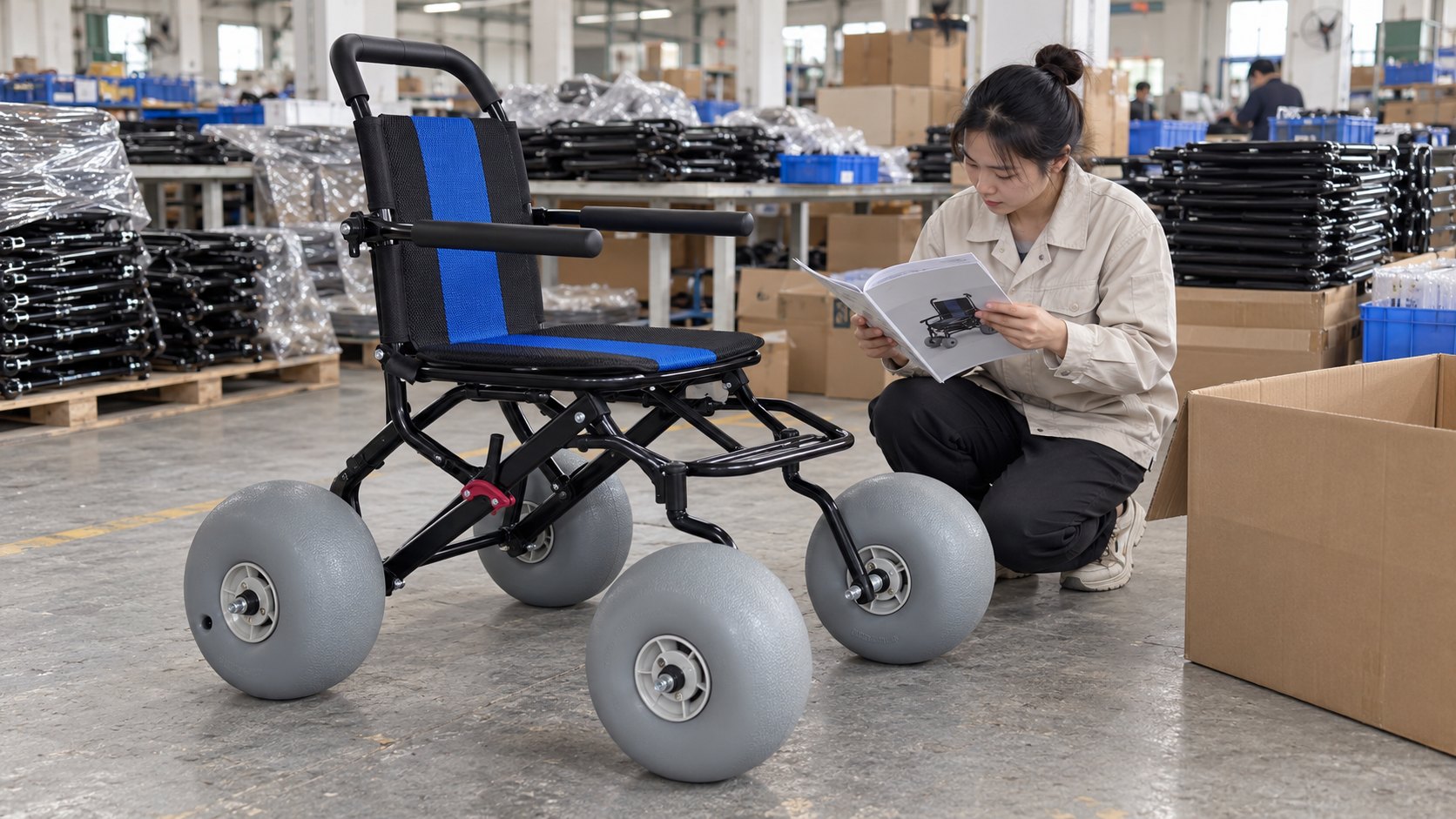
Treat lightweight as a reason to request verified mass information, not as a lifting instruction. Buyers need to know what a quoted figure includes: the complete chair, a frame alone or a particular transport configuration. Compare equivalent product states.
Handling requirements depend on more than mass. Shape, grip locations, vehicle access and permitted preparation methods also affect the task. A lower figure does not establish that one employee can lift a chair safely or that every vehicle can carry it appropriately.
Ask what is included in the stated product weight.
- Request current complete-product mass.
- Separate net product and shipping-package figures.
- Refer handling decisions to competent personnel.
Use the delivery and collection planning guide to connect confirmed product information with actual movements. This article does not quote an unconfirmed weight or promise a staff reduction. The useful product comparison needs a consistent definition before anyone calculates logistics implications.
Compare equivalent weight information
| Figure | Clarify | Avoid |
|---|---|---|
| Complete product | Included configuration | Comparing with a bare frame |
| Prepared transport unit | Permitted state and included items | Assuming identical handling |
| Shipping mass | Packaging and contents | Calling it product mass |
4. How do balloon wheels affect its product role?
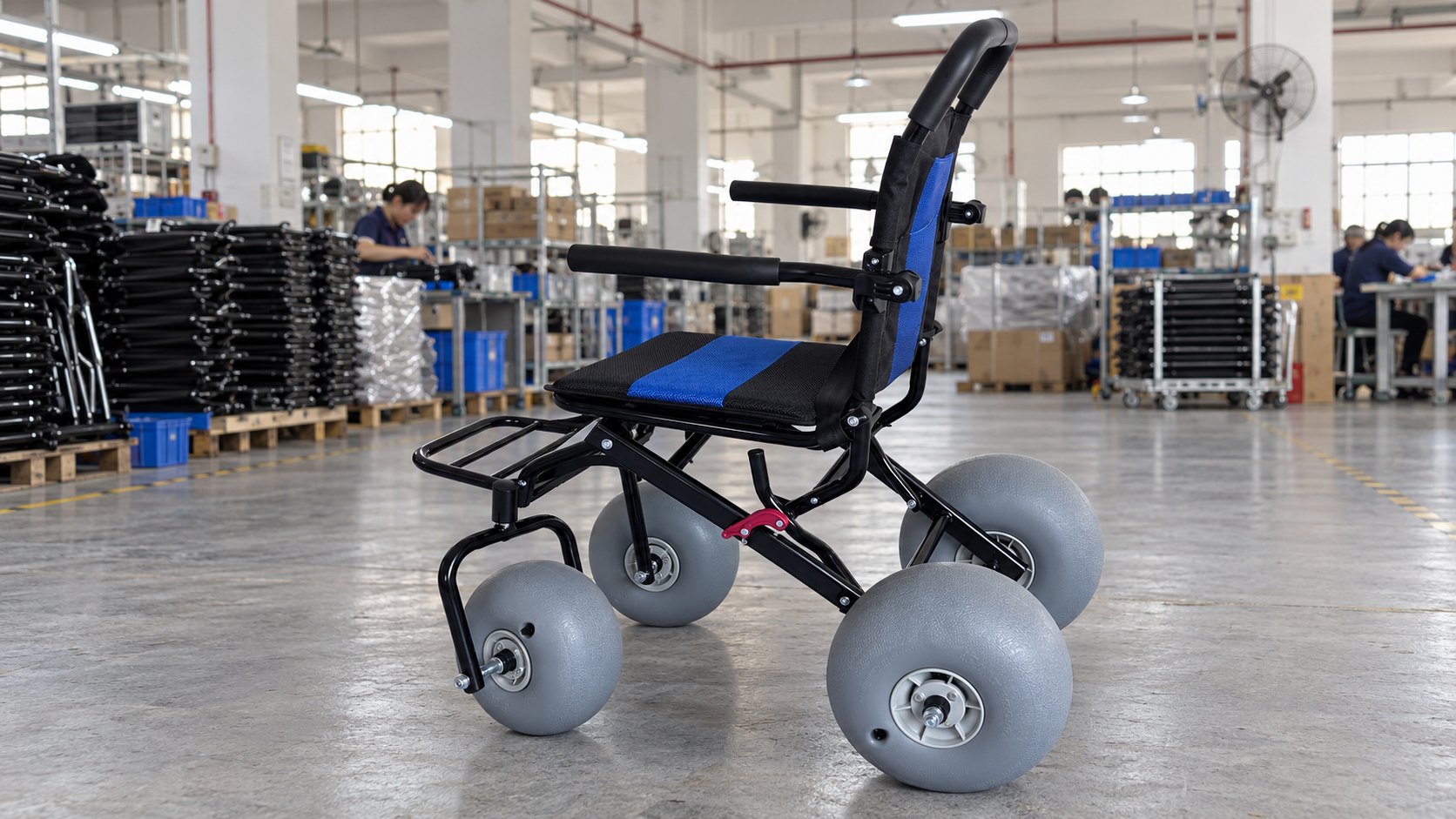
Four balloon wheels form part of the AY-ST-V3.0 beach-mobility configuration. They distinguish its wheel setup from many everyday indoor or pavement-oriented chairs. Evaluate the complete supplied arrangement rather than treating a wheel label as a universal sand-performance guarantee.
A travel company can use that distinction to offer a product discussion focused on beach access. It still needs current guidance and a local review of the intended surface. Loose sand, changing conditions and different loads cannot be reduced to one promotional photograph.
Compare the whole wheelchair, including its wheels.
- Identify the supplied front and rear wheel references.
- Keep applicable care information with the model.
- Review terrain assumptions before making service promises.
The balloon-wheel information page provides a route for component questions. It does not make every balloon wheel interchangeable. Ask about exact compatibility before treating existing spare stock as support for this model.
Keep wheel benefits credible
| Product characteristic | Potential value | Limit |
|---|---|---|
| Beach-oriented wheel setup | A dedicated equipment option | No universal terrain approval |
| Identifiable wheel references | More precise support requests | No visual compatibility assumption |
| Complete frame-and-wheel arrangement | Meaningful model comparison | No guaranteed pushing effort |
5. What should buyers review about seating and foot support?
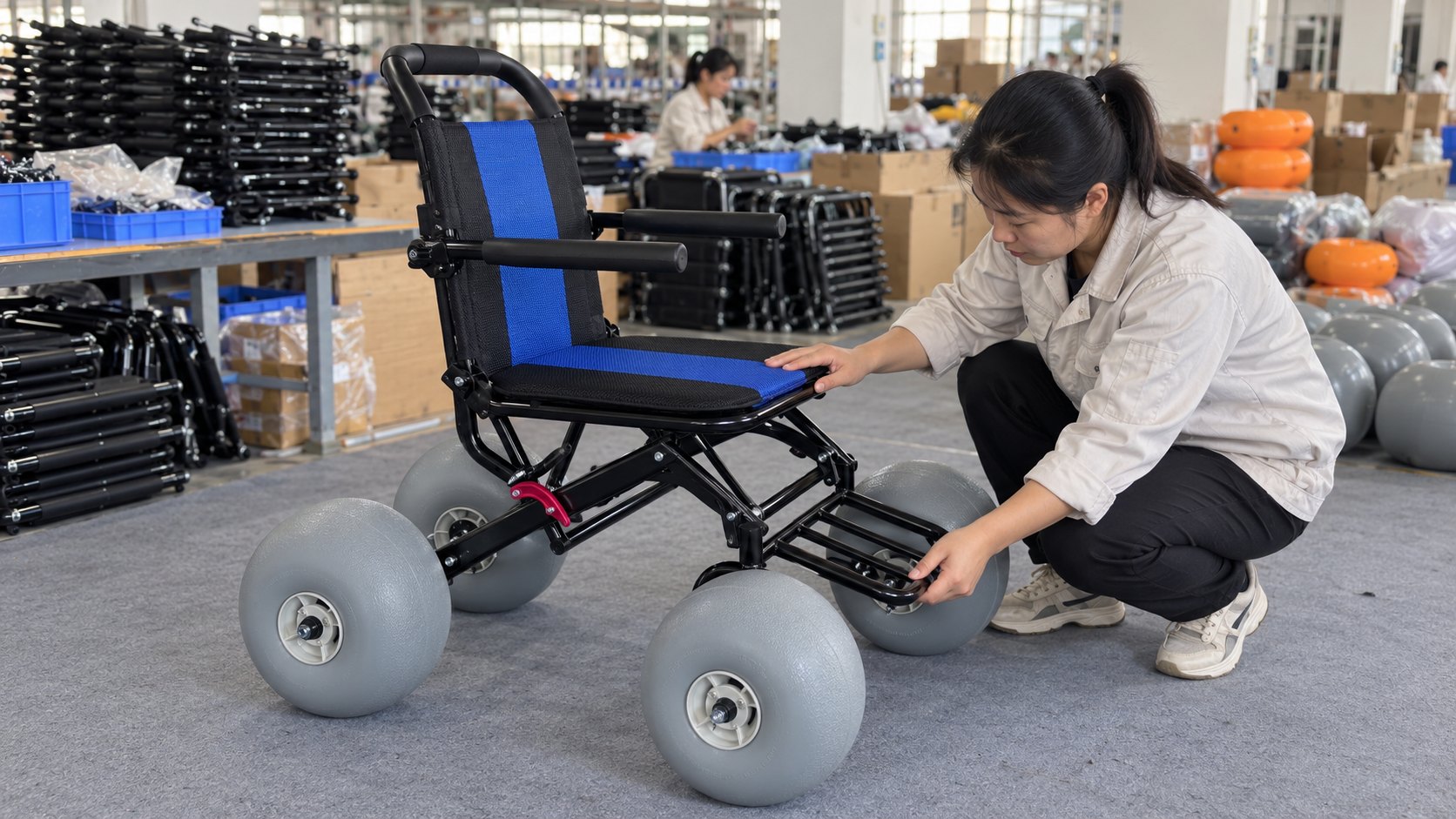
The supplied model documentation shows black-blue fabric seating and a flip-up foot-support arrangement. These features should be explained as parts of the actual configuration. They do not establish comfort, transfer suitability or a permitted operating position for every individual.
A clear product photograph helps a traveler ask relevant questions before equipment is allocated. It also helps purchasing staff distinguish this model from a high-back chair with a longer leg-support assembly. That distinction can prevent an inaccurate promise about what a compact configuration includes.
Show the seat and foot support without inventing a benefit.
- Use current photographs of the complete configuration.
- Request applicable instructions for moving components.
- Obtain appropriate input for individual requirements.
The tour-program model guide can support comparisons. Focus your review on the actual supplied features rather than claiming that compactness makes a chair suitable for everyone in a group.
Describe seating features accurately
| Feature | Useful information | Separate question |
|---|---|---|
| Fabric seat and back | Current configuration and dimensions | Individual suitability |
| Flip-up foot support | Applicable permitted positions | Personal assistance arrangements |
| Compact profile | Visible comparison with other models | Comfort or prolonged use |
6. When should a buyer compare it with the high-back model?
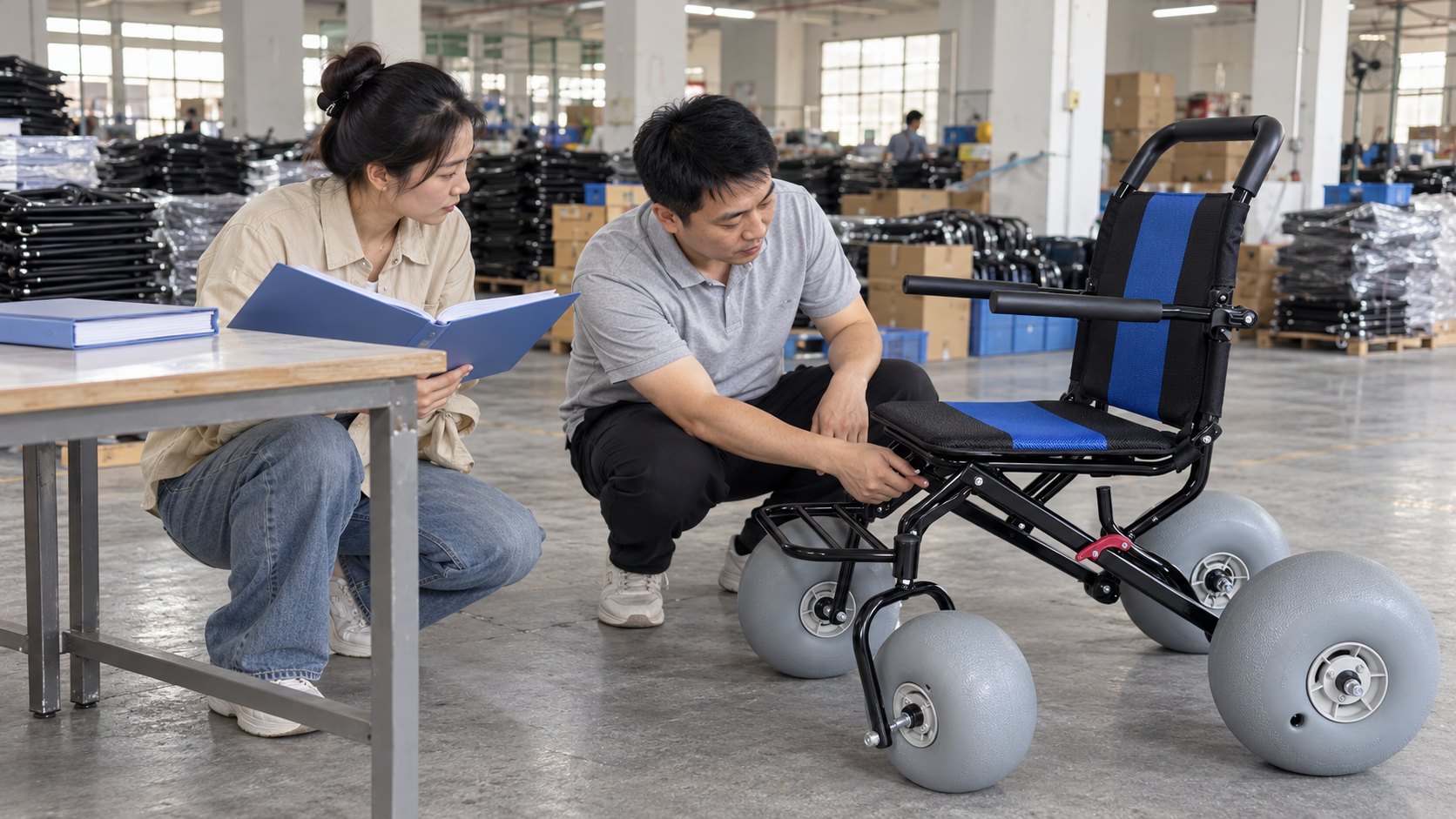
Compare the AY-ST-V3.0 with a high-back configuration when product requirements extend beyond portability. The buyer may need to discuss a different backrest or leg-support arrangement. More compact and more supportive are not interchangeable purchasing descriptions.
The supplied AY-ST-V2.0 material shows a distinct high-back and adjustable-leg-support configuration. That creates a concrete product comparison. It does not establish that either chair is clinically superior or suitable for a particular traveler without further review.
Choose around the required configuration before ranking portability.
- Identify which seating features need discussion.
- Compare actual current product information.
- Keep unconfirmed substitutions outside accepted bookings.
Refer to the all-terrain high-back product family when requesting current details for that alternative. A tour operator can retain a clear reason for each model in its offer rather than treating every available chair as an equivalent replacement.
Compare different product priorities
| Priority | Product question | Avoid |
|---|---|---|
| Portability | Which permitted state supports the movement task? | Fits-anywhere claims |
| Backrest configuration | Which actual profile is required? | Higher automatically means better |
| Leg support | What assembly and adjustments are supplied? | Unreviewed substitution |
7. How can this model work alongside an access mat?
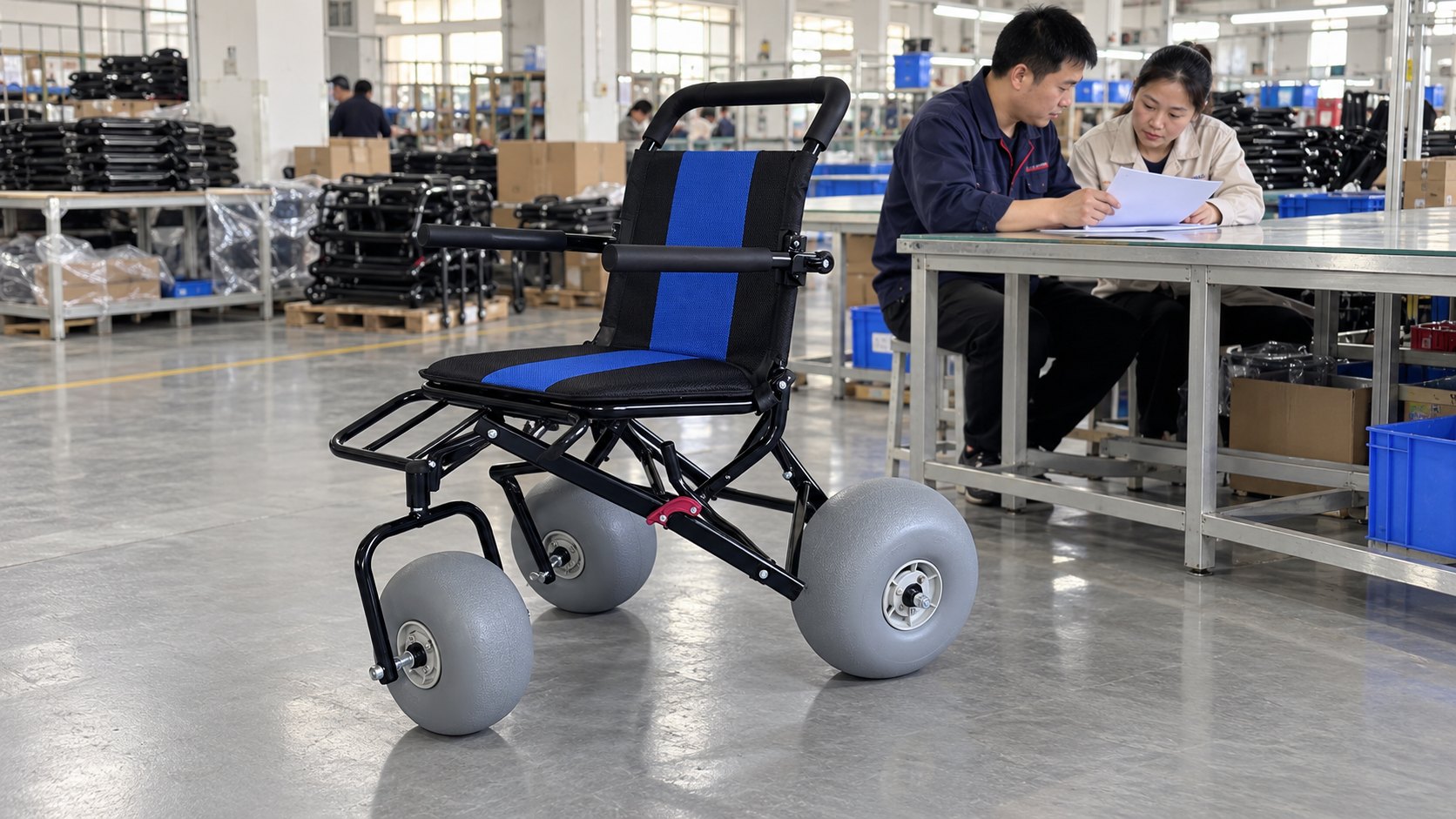
Treat the wheelchair and mat as different parts of a beach-access proposal. The chair provides an identified mobility configuration. A mat provides a route-surface option. A buyer may need both products. Neither proves that a complete route suits every intended user.
For a tour operator using partner hotels or public access points, that distinction helps specify what equipment is actually needed. A firm route may already support a traveler’s preferred arrangement, while another segment prompts a beach-chair discussion. Do not require a change of chair simply because the operator owns one.
Match each product with the access task it addresses.
- Identify the proposed route connection.
- Review the actual equipment configuration.
- Preserve guest choice within confirmed arrangements.
Use the accessible beach mat information for a separate surface specification. Review transitions and operating conditions locally before describing the combined offer as available for a visit.
Separate the product roles
| Item | Role in a proposal | Check before commitment |
|---|---|---|
| Folding beach wheelchair | Mobility-equipment option | Configuration and suitability |
| Access mat | Route-surface option | Installation and current condition |
| Existing personal equipment | Traveler’s preferred arrangement | Actual route and individual requirements |
8. What product information supports repeated use by a travel company?
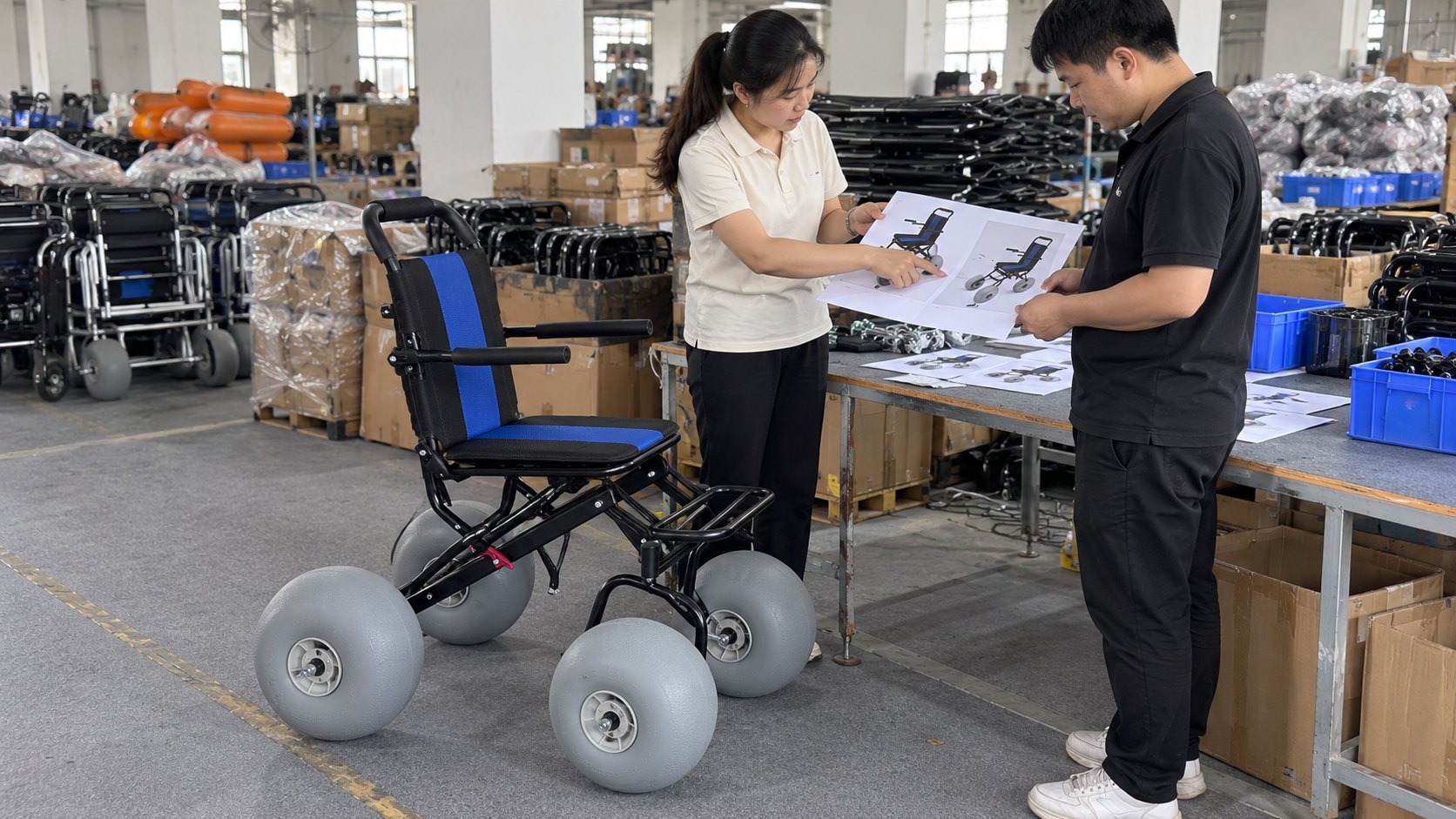
Ask for current instructions and clear identification of the supplied version. Repeated use depends on appropriate preparation and care, not on a claim that folding equipment needs no maintenance. The operator should know which questions require supplier clarification.
Keep folding and component-handling information tied to the actual unit. Do not adapt another model’s procedure because the frames look similar. Staff need a clear reference for permitted tasks, especially when equipment moves between destinations or different teams.
Include current instructions in the product package.
- Confirm model and document applicability.
- Request identification of associated items.
- Clarify the support route for uncertain product details.
The user-manual resource can help locate relevant documents. It should lead to an applicable information set, not an improvised assembly or repair procedure. A tourism buyer gains more useful control from identifiable product information than from broad promises about effortless operation.
Specify usable support information
| Information | Purpose | Limit |
|---|---|---|
| Applicable instructions | Define permitted product tasks | No substitute for competence |
| Version identity | Match equipment and records | No guessing from color |
| Support contact | Resolve technical questions | No invented response-time promise |
9. What belongs in an AY-ST-V3.0 quotation request?
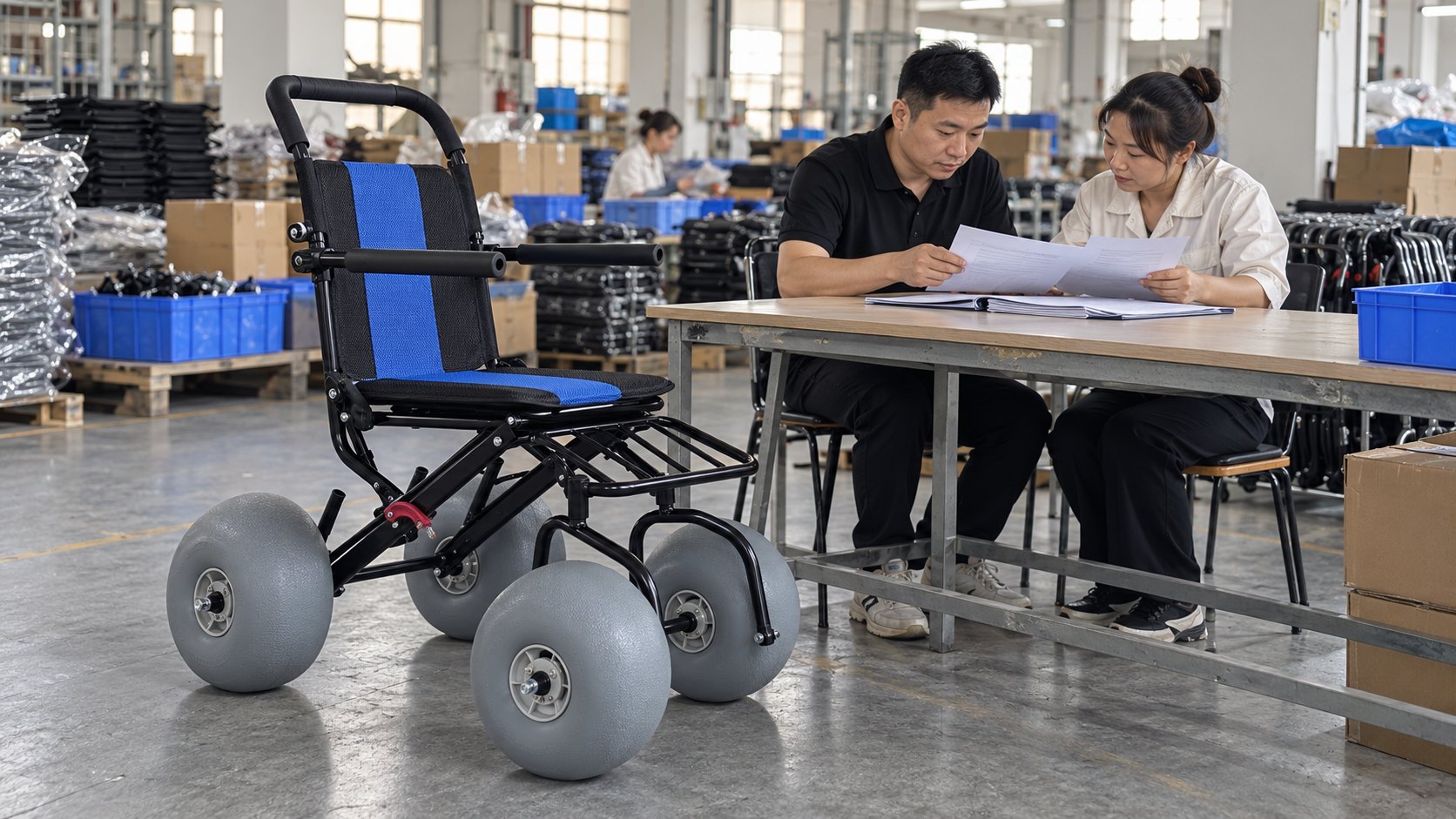
Name the black-blue folding configuration and explain why portability is being evaluated. Provide relevant verified storage and transport constraints without sending unrelated guest information. Ask for current product figures rather than using values copied from another version.
Separate the complete chair from optional items, replacement stock and freight. A price comparison becomes more useful when each supplier describes the same package. Confirm commercial terms through the actual offer instead of treating general website language as an order commitment.
Request a clearly defined folding-chair package.
- Identify the current supplied version.
- Ask for confirmed assembled and transport details.
- Separate equipment, optional items and shipping scope.
Use the tourism buyer checklist to organize your inquiry. Ask how replacement requests should identify this model. Keep uncertain quantities or destinations visible until the team can provide a complete purchasing brief.
Make the request specific
| Requirement | Supplier response needed | Buyer use |
|---|---|---|
| Folding configuration | Current applicable details | Review portability |
| Supplied package | Itemized scope | Compare offers |
| Destination | Current shipping proposal | Plan receipt without guarantees |
10. When does the AY-ST-V3.0 merit a closer review?
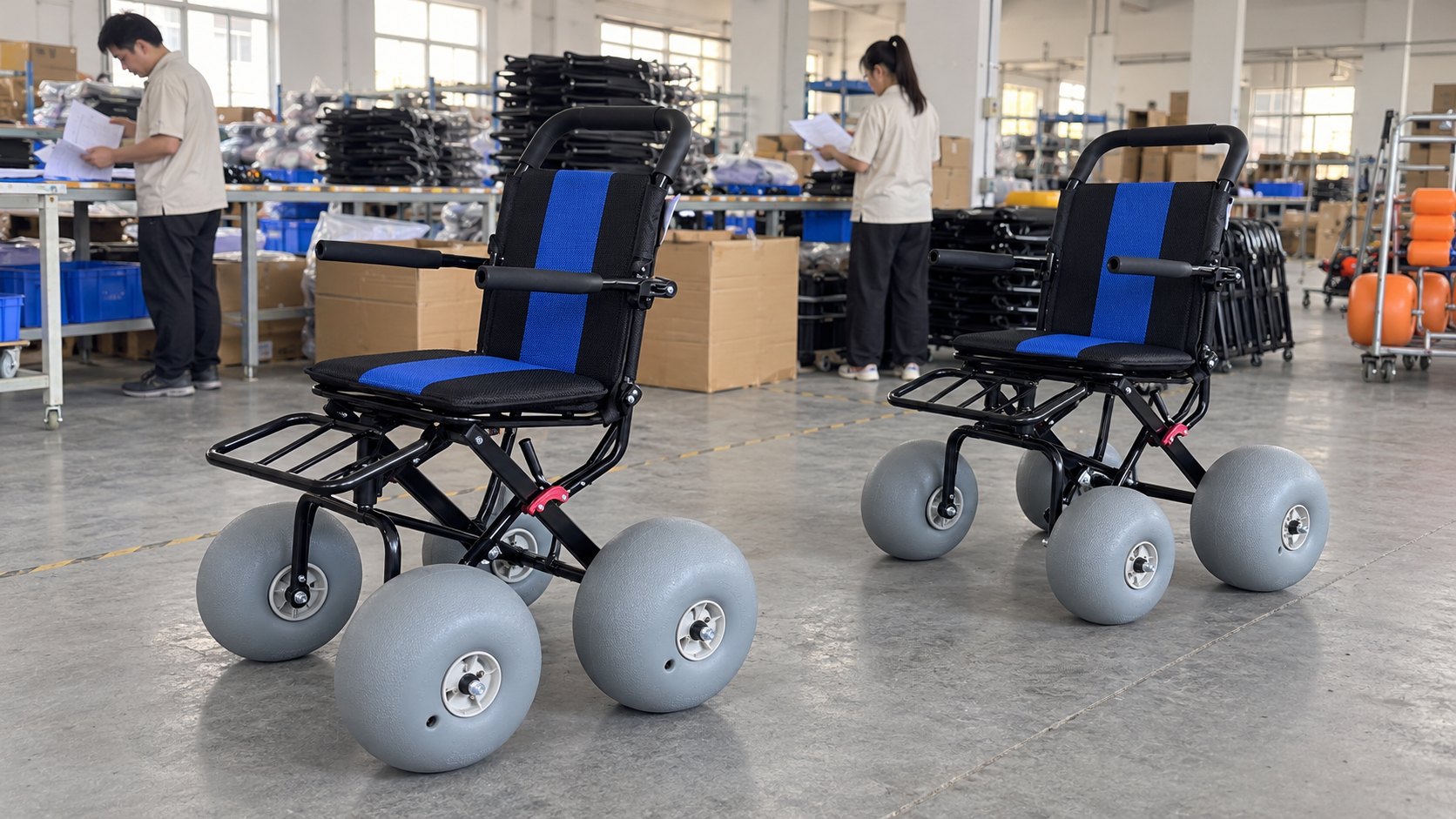
Consider this model when a folding four-wheel beach chair could address a defined transport or storage requirement within an accessible-travel offer. Keep its seating configuration and individual suitability in the same decision. Portability should not override another requirement that the product does not meet.
The practical value for a tour company is an identifiable beach-mobility option it can evaluate against its own equipment movements. That benefit depends on confirmed product details and workable local arrangements. It does not imply fewer staff, faster transfers or automatic compatibility with every vehicle.
Ask for evidence of the configuration your company would buy.
- Identify the actual portability requirement.
- Confirm current product information.
- Review seating and assistance questions separately.
- Agree the supplied scope before ordering.
Contact Ary Beach with AY-ST-V3.0 in your inquiry. Request current photographs, applicable instructions and a configuration-specific quotation so your team can evaluate the product on a consistent basis.
Q1: Does foldable mean the complete chair fits every vehicle?
No. Confirm its permitted transport configuration and current dimensions, then review the actual vehicle and handling arrangement.
Q2: Does lightweight mean one person can lift it?
No staffing or lifting conclusion follows from that label alone. Handling requires an appropriate assessment of the actual task.
Q3: Is this model a floating beach wheelchair?
Evaluate it as the documented land-mobility configuration. Floating products require a separate model and operating discussion.
Q4: Can the same instructions be used for another folding model?
Match instructions with the actual supplied version. Similar appearance does not establish identical permitted methods or compatible components.
Q5: What should a buyer request before ordering?
Ask for current model identity, confirmed specifications, permitted transport details, included items and applicable instructions for AY-ST-V3.0.