
Two travelers on the same tour may ask for a “beach chair” and want quite different outings. One wants to join lunch on a dry terrace. Another wants a supervised activity in calm water. Ask what each person wants to reach, how they prefer to move and what support they already use before reserving equipment. Vehicle space and supplier stock matter once there is a model that can serve the requested activity.
Which model belongs on the shortlist?
| Request to discuss with the traveler | Model evidence and the next question |
|---|---|
| A seated land outing where the traveler wants a high back or adjustable leg support | The four-wheel AY-ST-V2.0 has a reclining high back, five-position leg support and a listed 45 cm seat width. Can the configured chair, guest and attendant use the agreed route and turn at the destination? |
| A seated land outing where a smaller chair is being considered | The AY-ST-V3.0 is a folding land wheelchair with flip-back armrests, a 40 cm seat width and a 13 kg net weight. Do its seating and support work for this person before transport convenience is considered? |
| A traveler wants to walk with a mobility aid and stop with the group | AY-STZ1.0 is a four-wheel walking aid with adjustable handles and hand brakes. Does the traveler want this arrangement, and can the provider check the setup, route and return with them? |
| A traveler specifically requests a supported calm-water session | AY-ST-V1.0 has three wheels and inflatable armrests. Refer the request to the aquatic operator, who must confirm suitable conditions, trained supervision and a viable exit. |
The manufacturer lists equipment dimensions and features in the V2.0 land-chair manual, V3.0 land-chair manual, AY-STZ1.0 walking-aid manual and V1.0 floating-chair manual. The figures describe four separate products. A seat width alone cannot establish individual suitability, and a chair being in stock cannot establish that the destination is open.
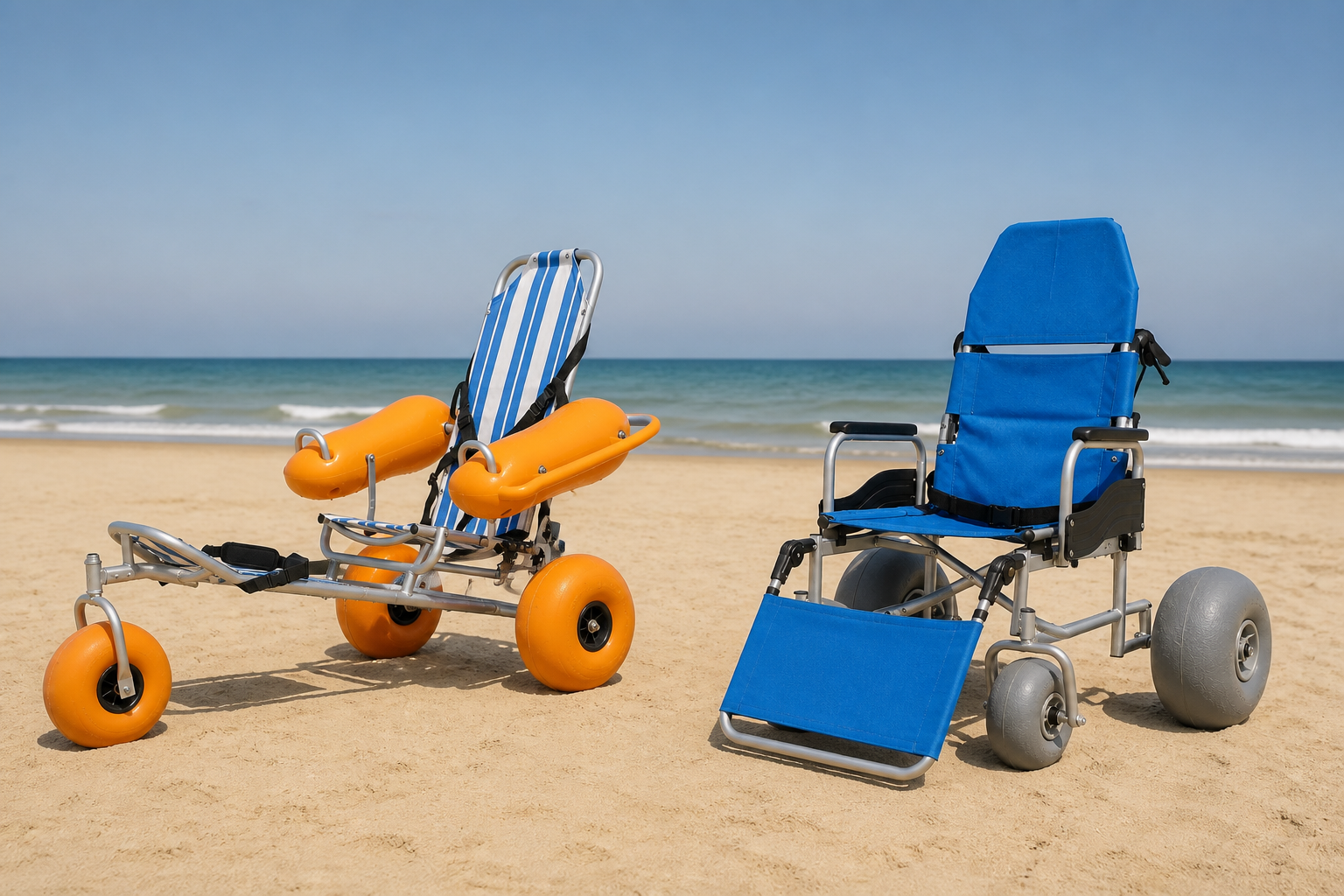
Test the difficult part of the promised visit
For a land outing, start with the actual turn or gate between the issue point and the place the traveler wants to sit. A V2.0 is listed at 110 cm overall width. The V3.0 is 92 cm wide, but its narrower seat and different supports make it a different offer. Suppose the confirmed V2.0 cannot pass the gate. Ask the venue whether another entrance can deliver the same visit with the same chair. If a different model is proposed, the traveler and provider must review its fit and assistance arrangements before the operator changes the booking.
For a walking tour, the useful questions may be how far the group goes before a rest and whether an earlier return is available. For a requested water activity, check with the aquatic provider separately. A land-chair booking at the same beach does not extend that booking into the water. A destination may be suitable for one group member’s plan while another person would prefer a different stop.
Give reservations an exact offer to confirm
Describe the model, the seat or walking support discussed, the named land destination or conditional aquatic activity, who provides assistance and what happens to the traveler’s usual device during the outing. Ask the provider to identify any unresolved question, who can answer it and when it must be resolved. Share relevant information with the traveler’s permission. A tour guide can explain the route and schedule while an appropriately qualified provider addresses individual fit or transfer needs.
Keep the traveler’s choice with the reservation. If the selected model or service changes, return to the particular need that led to the original selection and discuss the proposed alternative. Once the selection is agreed, the excursion equipment handoff guide connects the chair with the vehicle, shore stop and return journey.