
A cargo cart can make three runs and still leave one requested delivery incomplete. If dispatch counts runs as orders, the dashboard rewards splitting a load and tells the store little about what the beach station actually received. Give every delivery request an ID, its promised window, the goods and quantity requested, the cart assignments and the date and quantity accepted by the receiver.
Give each measure a unit the next shift can count
Use delivery requests for service outcomes and cart-hours for equipment status. Start with requests due during the reporting period. Keep cancellations with a reason and apply the same inclusion rule each week. Late or unconfirmed deliveries should stay visible. A receipt for part of an order records movement of goods but does not prove the request was filled in full.
| Indicator | Count in the numerator | Count in the denominator |
|---|---|---|
| On-time, in-full delivery | Unique due requests whose whole agreed quantity the receiver accepted within the promised window | All eligible requests due during the period |
| First-trip completion | Unique completed requests that needed a single trip | All requests completed in the same reporting cohort |
| Mechanical availability | Scheduled cart-hours mechanically released, including time assigned or in use | All scheduled cart-hours, including mechanical holds |
| Unresolved delivery requests | Requests due and still incomplete at cut-off | Report a count, with oldest due date and named owner |
Use actual local times for acceptance and release. A cart with goods on board can be mechanically available while unavailable for another dispatch. Separately display the current count of released, unassigned carts when the dispatcher needs to allocate the next job.
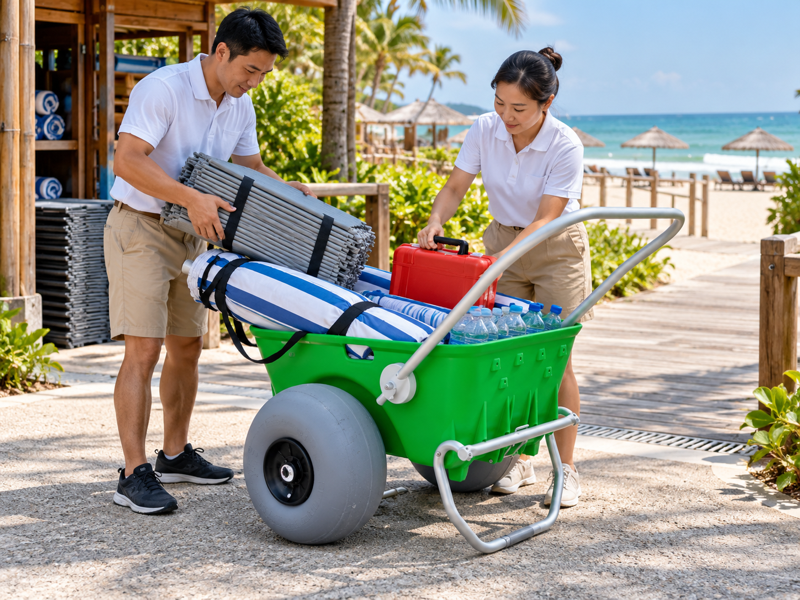
Rebuild a week from the records
Suppose 20 delivery requests fell due in a week, with no cancellations. Sixteen reached their stations in full within the promised window. Two were completed late and two remained incomplete on Friday. On-time, in-full performance was 16/20, or 80%. Eighteen requests were completed by cut-off. If 13 of those took one trip, first-trip completion was 13/18, about 72%. An incomplete Friday request that finishes on Monday retains its Friday due date. Record when the later completion was added so the earlier published report can be reconstructed.
Now consider two carts, each scheduled for 25 hours that week. An unresolved wheel-retention issue kept one cart on mechanical hold for six hours. Assuming no other equipment holds, 44 of 50 scheduled cart-hours were mechanically available, or 88%. A queue at the unloading bay or an unavailable operator can delay deliveries during those released hours. Record that waiting time under the appropriate dispatch cause.
Put a person and a next action beside exceptions
Look at unfilled requests by destination and cause. A receiver who repeatedly declines oversized cartons needs a different load arrangement or delivery window. Repeated parts shortages on the same cart point to the relevant wheel and axle assembly and its service history. Keep a reasonable split delivery available when it is the controlled way to move bulky goods. The first-trip figure should never become a reason to overload the cart.
When reviewing expansion, compare the request backlog with operator coverage, waiting time and mechanical availability. Add raw counts before calculating a combined figure for multiple stations. Keep the original pickup record and receiver acknowledgment available for a sample check. A supervisor should be able to trace one poor result to the actual delivery and decide whether dispatch, stores, maintenance or the receiving station can fix it.