
On an adaptive sports event day, the mat may still be needed long after the final race or demonstration. An athlete may be waiting to recover their usual wheelchair. A spectator may still be at the viewing bay. Write the removal time around the last supported return, then work back to the staggered sessions, public opening and time needed to lay and inspect the route.
Draw the event as people will move through it
Start at accessible drop-off, registration and changing. Identify the route to equipment exchange, competition or activity handover, first aid, spectator viewing, toilets and the return pickup. Mark where people can pause or turn without occupying a participant lane. Ask willing participants and staff which movements require more space or assistance than the general admission route allows.
Use the dimensions and configuration of the wheelchairs and sports equipment actually expected. A sport chair’s wheel track, carried equipment or attendant position may change the practical turning space. Ask the supplier whether the mat, connections, supporting surface and transitions are suitable for each proposed use. A route planned for people using mobility devices is not automatically suitable for service vehicles, trailers or loaded equipment carts.
Rehearse the build before the public arrives
Allocate bundles by zone and label their matching joins and end treatments. Lay a representative hard-to-sand connection under the operator’s approved method. Check how the installer obtains the parts, how the finished joint sits, and how sections will be returned to their proper package when the event closes. Use the supplier’s instructions for actual materials, anchoring and handling. Beach mat physical sample checks
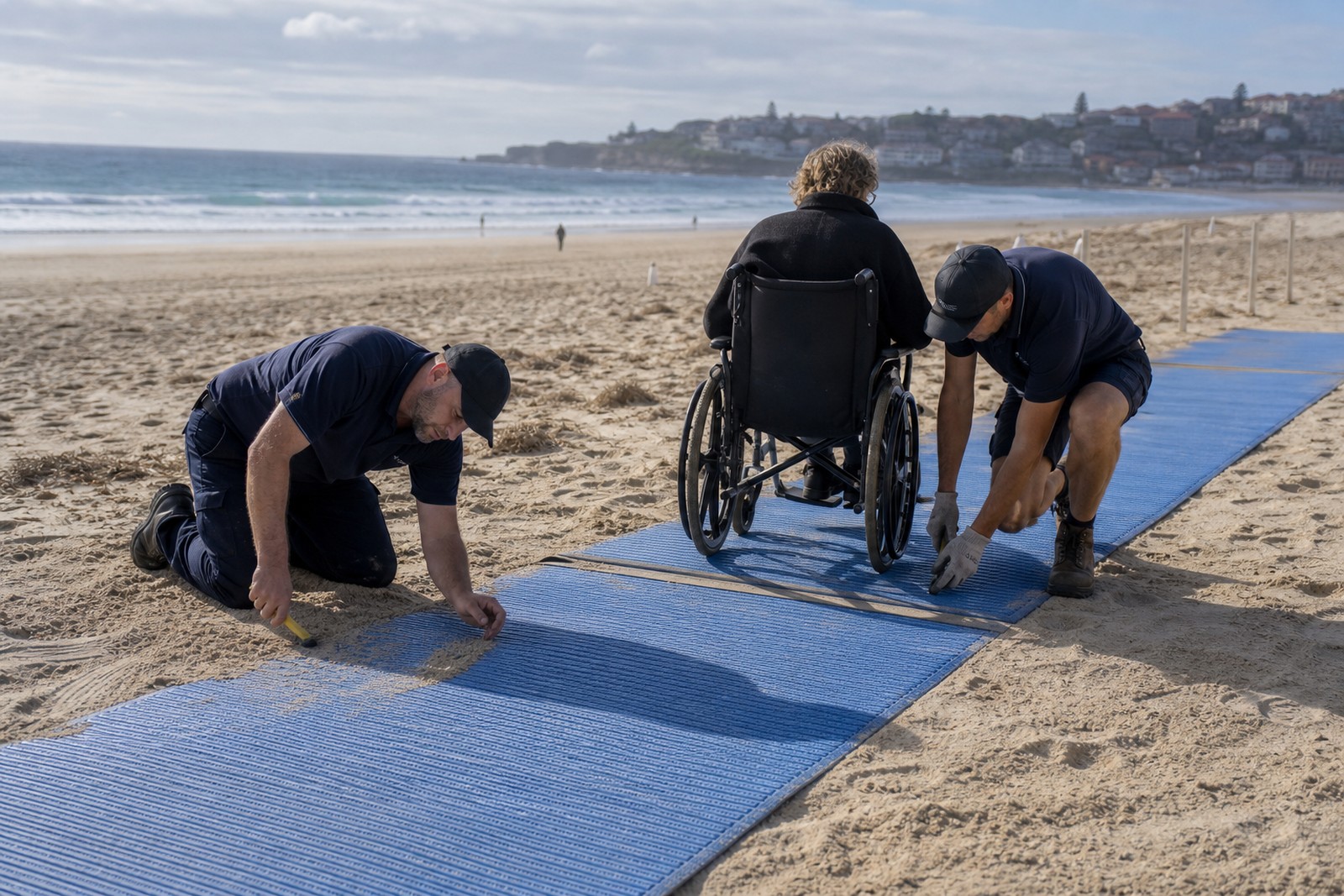
With the empty, permitted equipment, rehearse a participant leaving registration, reaching the correct staging bay, turning at the activity area and returning to pickup. Try the spectator route at the same time. If both streams converge at a single mat junction, agree where a marshal waits, how incoming people are held and how an early return receives space. Site emergency arrangements and response access must be confirmed by the people responsible for them.
Schedule the route between heats or demonstrations
| Event moment | Route crew’s practical task |
|---|---|
| Before spectator admission | Confirm all required destinations, joins, edges, barriers and return paths are ready. Release each advertised area only after its own check. |
| Between sessions | Keep participant returns clear of entering spectators and equipment changeovers. Reinspect joints subject to heavier movement or displaced sand. |
| When part of the layout changes | Identify who is beyond the change, support their return and announce the exact area affected. Check any alternative route before an announcer offers it. |
| After the last activity | Physically clear participants, officials, spectators and their mobility equipment from the route that would be removed. Confirm an alternative for anyone staying on site. |
For example, a hypothetical final ends at 16:00, an assisted transfer is scheduled at 16:15 and the pickup service will not reach its bay until 16:30. A crew booked to collect the last section at 16:05 would remove the return path before the participant is ready. Adjust the crew’s assignment, provide a verified route at the required time or reschedule the pickup with the participant. A public event finish time alone cannot release that section for collection.
Strike the route in an order that preserves an exit
The route lead confirms which branch may come up first. The installation crew removes and packs it by the specified method, leaving any remaining travel line, required response access and equipment recovery area available. Count the mat sections, connectors, transition fittings and spares separately. Identify damage by location and package before moving components to another event.
Give the venue a final walk-through of the restored ground and remaining facilities. Ask participants who want to give feedback to identify the particular turn, transfer or waiting point that affected their day. Use that location to revise the next layout and its setup or removal timings. Beach mat incident records · Community input for beach mat routes