
At a tidal water sports centre, the mat needs a clearly agreed handover point. It may connect the changing area to a dry briefing space or a staffed transfer area on shore. Launching a craft, entering water or boarding from a floating structure is a separate activity. Identify the person responsible for accepting each participant at that interface and for getting them back to their usual mobility equipment afterwards.
Lay out one participant route and one gear route
Walk the journey from reception and changing to briefing, equipment fitting, the agreed shore handover and return. Do this at a session change, when one group is returning wet kit while another is trying to leave. Mark where boards, paddles, trolleys, hoses, bags and drying gear actually go. A dry, clear mat in a plan drawing can become a temporary rack as soon as the first group comes back.
Use the installed clear width and the room required to turn and wait. Give staff a place off the travel line to fit equipment, park a trolley or leave a board. If a handling crossing is unavoidable, identify who can hold that movement while a participant passes. No crew member should be expected to control a participant transfer and an equipment trolley simultaneously.
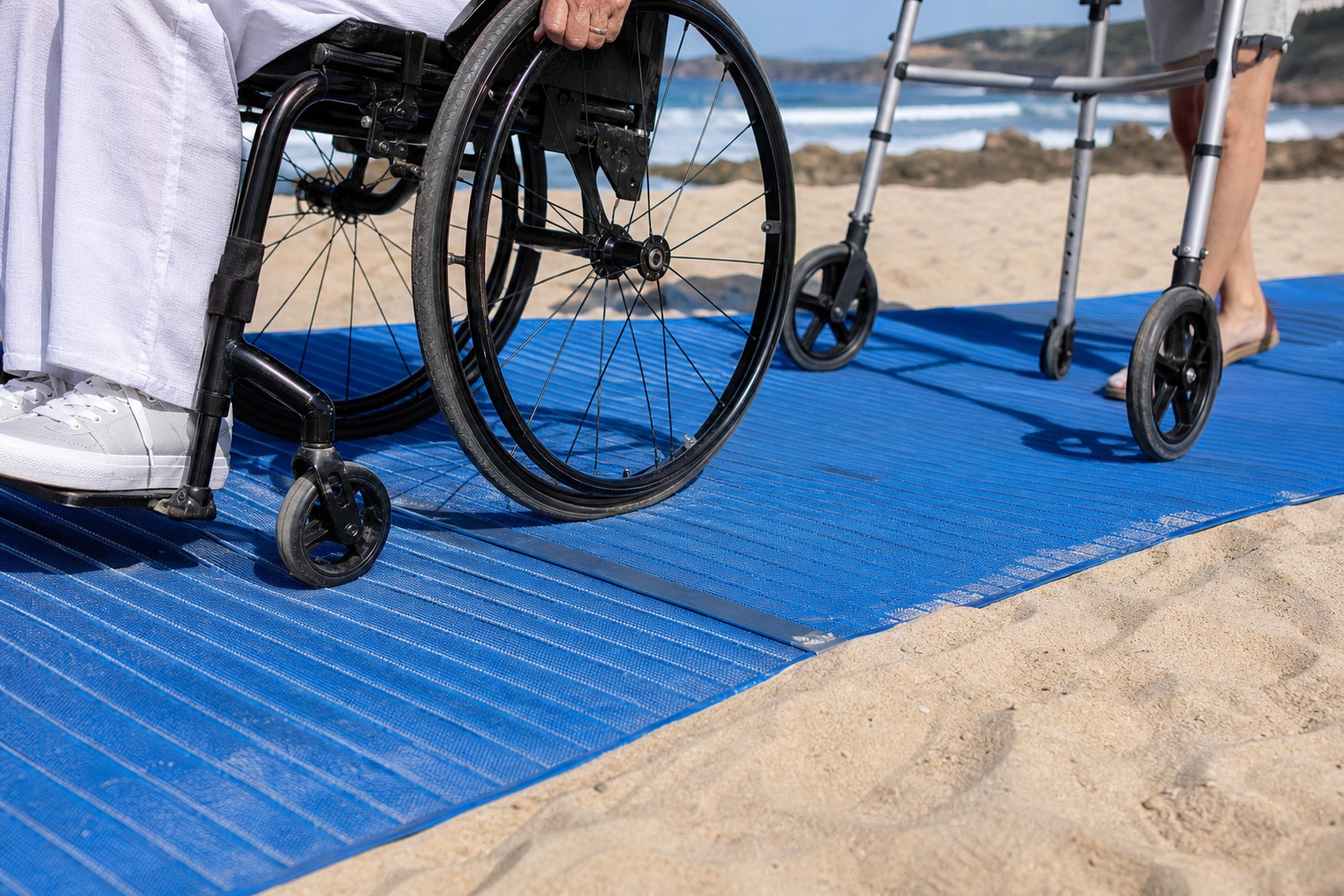
Decide what happens as the tide shifts
The far edge of the mat and the planned shore handover may have a different relationship at the start and end of the session. Ask the activity operator to check where the returning group can leave the water or return to the agreed land point under the conditions expected for that specific session. If an incoming tide will cover the planned shore-side staging area, move the activity to an approved alternative, change its timing or keep it closed. An access mat cannot serve as a substitute gangway or craft-launch structure without the appropriate design and approval.
Sandown Town Council in England describes summer deployment of beach matting subject to conditions including weather and tides. It is a local example of why an operating calendar alone cannot confirm an installed route. A sports operator must obtain its own land and activity decisions at the chosen site. Sandown Town Council accessible facilities information
Inspect the mat participants and staff will use
At the shore-side end, look for sand loss, lifted edges, a step at the transition and space for the return manoeuvre. Follow the supplier instructions for the specific mat. A modular system requires its identified connections and compatible end details. Obtain written approval for any proposed trolley or other equipment traffic, including the actual loads and contact surfaces. An instruction for pedestrian or mobility-device use does not establish suitability for a loaded craft trailer. Beach access mat configuration information
At the next block, check what changed when wet equipment came ashore. A hose across the turn, grit carried onto a hard ramp, or a boat left in the waiting bay can close the participant route even when the mat itself is sound. Move the obstruction only through the authorised crew and recheck the approach in both directions.
Brief the coach, shore assistant and participant
Give everyone the same destination and stop signal. The coach identifies which activity and water conditions have been accepted. The shore assistant describes the available mat, the transfer arrangement and where the person’s own device will be waiting. Ask the participant how they would like assistance and how they can pause or return early. A visitor who has booked the land-based viewing area does not need to be assigned a water transfer.
For an illustrative handover, the outgoing coach reports that a returning trolley now occupies the usual route from the mat to the changing area. The shore lead keeps new departures at briefing, ensures the returning group has a supported way back, moves the trolley with the designated handler and checks the restored path. Reopen only the activity and route that staff can deliver during that time block. Beach access route risk assessment