
An excursion advertised as “two hours at the beach” can include a coach walk, equipment collection and a return to a different loading bay. Tell the traveler how much time the agreed equipment and assistance actually give them at the destination. A coach seat, a beach chair and an attendant are three separate commitments, sometimes made by different providers.
Put both journeys on the itinerary
Start with the meeting point at the hotel and the final destination at the shore, such as a dry viewing terrace beside the group’s lunch tables. Where will the traveler use their own device? Where is the loan chair released? Who has agreed to receive their usual device and restore it on return? Check that the two pieces of equipment can reach the same handoff point when the group is due there.
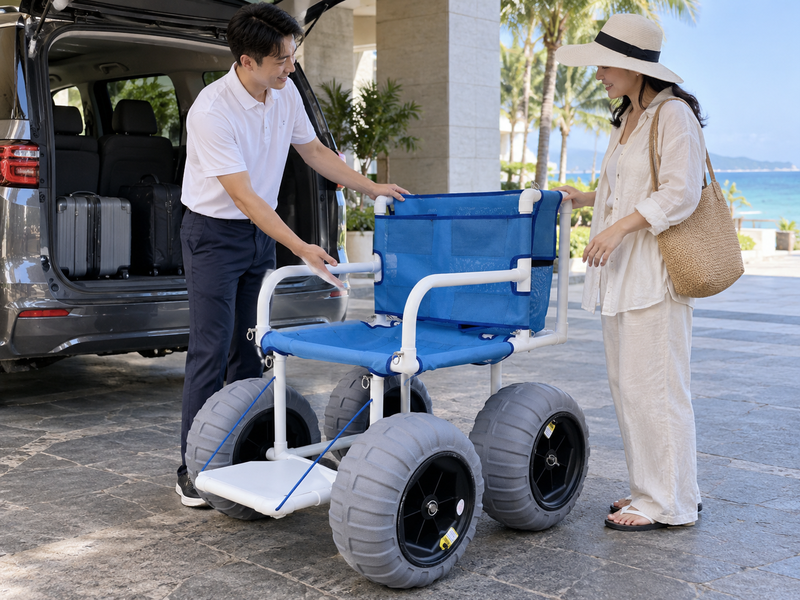
One possible arrangement leaves the venue’s beach wheelchair at the shore and takes the traveler’s personal mobility equipment on the transport provider’s agreed arrangements. Another requires an empty loan chair to travel as cargo. For example, the AY-ST-V2.0 land chair is listed at 120 × 110 × 122 cm deployed and 19.5 kg net. Its carton dimensions do not tell a driver the size of the empty unit in the configuration they will load. Confirm actual cargo space, restraint and time for authorised refitting. Arrange passenger travel with the transport provider separately. AY-ST-V2.0 manual
Work backward from the return departure
Consider an illustrative half-day trip. The coach reaches the beach bay at 10:00 and must depart at 12:00. The local provider allows 20 minutes to reach the meeting point and complete the agreed handoff, then 15 minutes to the terrace. Returning by the same route takes another 15 minutes. Handback and travel to the bay need 20 minutes. The 120-minute stop therefore leaves 50 minutes at the terrace before any allowance for delays. Discuss an appropriate margin with the traveler and guides before confirming time at lunch.
| If this leg changes | What the excursion lead needs to resolve |
|---|---|
| Coach arrives 20 minutes late | Ask whether the return departure or lunch timing can move. With every other assumption fixed, the terrace time drops from 50 to 30 minutes before any margin. |
| Return coach uses a different bay | Walk the route from equipment handback to the new bay. Check the actual surface, shared gates and available staff. |
| The beach attendant can cover the outward trip only | Name a prepared person for the return and introduce them to the traveler, or offer a different agreed visit. |
| The traveler wants to leave before the main group | Confirm who can accompany the return and who has access to the traveler’s usual equipment at that time. |
Keep the meeting point attached to the local name guests will see on signs. A message saying “same place as last time” is useless to a visiting driver and a new guide. Give the traveler a contact they can use if separated from the group. Ask the guide and equipment receiver to acknowledge a changed pickup point before the coach moves on.
Resolve a delay while the traveler still has a choice
Suppose the equipment guide is ready at the beach hut while the coach is held at the hotel. The tour lead updates the hut with the revised arrival, confirms how long assistance remains and gives the traveler a realistic choice of terrace time or another activity. Never treat a nominal chair reservation as permission to shorten an agreed handoff or recovery time to catch the coach.
On return, confirm that the traveler has their own device, the local team has possession of the loan unit and the transport provider knows the traveler is ready for the agreed journey. A stop involving water requires a separately accepted floating-chair activity. A group continuing along the shore can use the land-chair route guide for the next leg.