
A beach wheelchair delivered to a hotel can solve the sandy part of a trip. It does not tell a traveler how they will move from the aircraft to baggage reclaim, from the terminal into a vehicle or from the hotel lobby to their room. Define the first and last points covered by the destination rental before asking someone to travel without their usual arrangements.
Draw the boundary around the rental
Ask what the traveler plans to bring, which part of the destination visit requires additional equipment and where they want to meet the local provider. Confirm how the traveler prefers to communicate. Obtain permission before passing contact details to a partner.
| Part of the journey | Who confirms the arrangement? |
|---|---|
| Airport and flight | The traveler discusses their own mobility equipment and assistance needs directly with the airline and relevant airport services. |
| Terminal to accommodation | The ground transport provider confirms passenger access, the vehicle and any agreed equipment carriage. |
| Destination rental | The rental provider confirms the available model, condition, delivery point and time, support contact, terms and collection arrangements. |
| Property access | The hotel confirms which entrance, storage space and staff contact are available at the agreed delivery and collection times. |
Send the traveler each confirmation and contact. A rental supplier cannot settle the airline’s acceptance terms, and an airline reference cannot reserve a chair at a resort. Give anyone waiting for an answer an expected update time and identify the outstanding leg.
Reserve the right unit for the destination
For example, a traveler requesting a high back and adjustable leg support for a dry beach outing might discuss the four-wheel AY-ST-V2.0 with the provider. The manufacturer lists a 45 cm seat width and five-position leg support. A supplier offering “a lightweight chair instead” must identify that model and allow the traveler to discuss fit before agreeing to the change. The 40 cm seat on the AY-ST-V3.0 illustrates why two land chairs are different rental offers. V2.0 model manual and V3.0 model manual
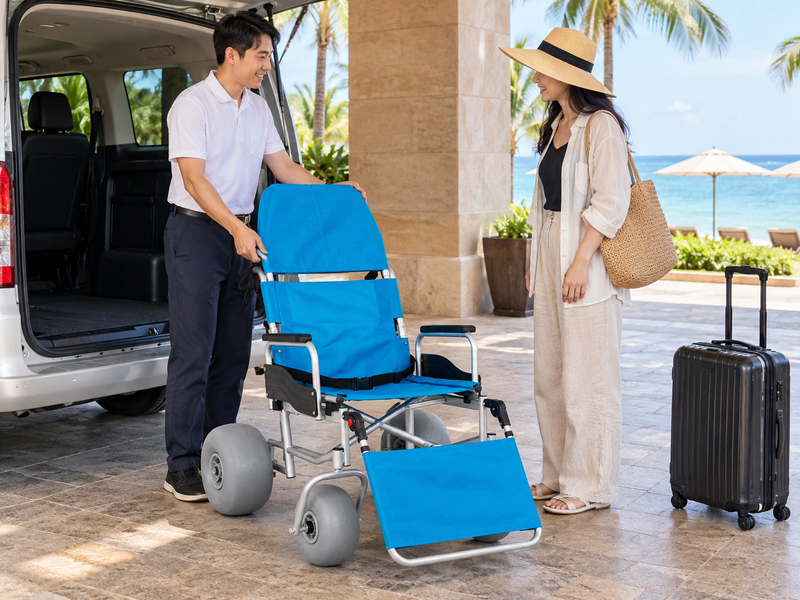
Agree who delivers to whom. A rental to the named guest at a staffed beach desk involves a different handover from a courier leaving a carton in hotel luggage storage. Confirm whether the provider supplies a prepared unit, who briefs the guest and who can address a fault. Ask where the traveler can keep their own device and who can return it. Get the charges, deposit, cancellation arrangements and any delivery or pickup fees from the rental provider.
If the flight arrives after the desk closes
Suppose the rental is booked for a 17:00 hotel handoff, the provider’s last delivery is 18:00 and the flight is delayed until 20:30. Notify the hotel and rental provider with the guest’s permission. Find out whether a later attended handover can be confirmed or whether the first workable appointment is the following morning. Ask how the traveler will manage the route from the terminal to the room. An empty room key envelope and a chair at a closed beach desk cannot bridge that gap.
If the traveler accepts the new plan, send the revised receiver, place and time in writing. If no workable arrangement exists, resolve the affected service or its cancellation under the agreed terms. A hotel whose concierge contacts an outside provider can use the hotel referral guide to assign responsibility at reception.
Close the hire before the return flight
Work back from hotel departure. Allow time to return the loan unit, reunite the traveler with their own equipment and receive the supplier’s acknowledgement. If the collection driver will arrive after checkout, arrange a named person whom the provider authorizes to receive temporary custody, with the traveler’s agreement. Record the actual return. Give the traveler a reference and a contact for any outstanding payment or deposit question.