
A coastal tour can offer a good beach stop without promising to reach the waterline. Start with the view or activity the traveler actually wants. A high promenade may let them sit beside their group and watch the harbor. A lower stopping point might offer a closer view but no room to turn once visitors line the rail. Choose a destination with a usable arrival, place to stay and return.
Survey the chair’s route from the viewpoint back
Stand at the proposed stopping place and look for the landmark that marks the return entrance. Consider what someone sees from chair height. Follow the route back through the busiest turn, each change of surface and the meeting place with the transport provider. Note any section where the only clear approach depends on a shop keeping a gate unlocked or another party moving furniture.
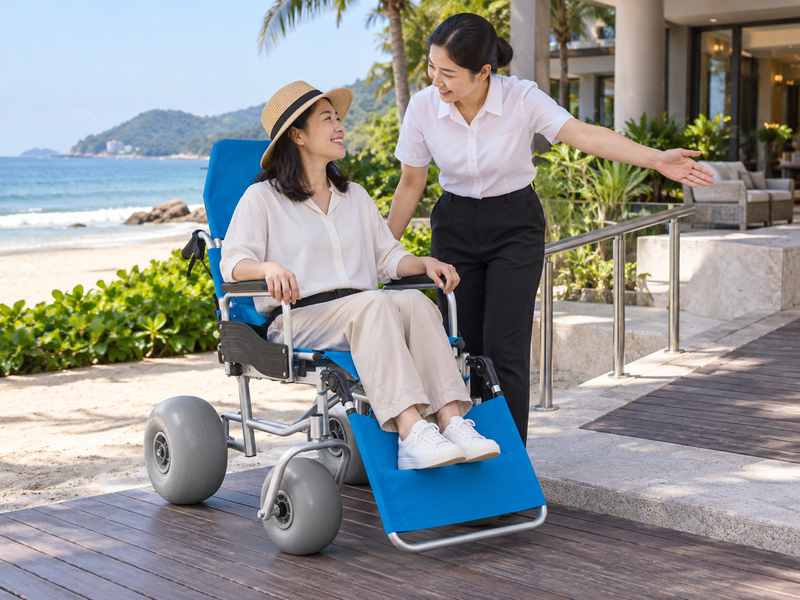
The AY-ST-V2.0 is a four-wheel high-back land chair with a reclining backrest, five-position leg support and overall dimensions of 120 × 110 × 122 cm. A 110 cm wide chair is already wider than a gate with a measured clear opening of 104 cm. It cannot go straight through that gate in its normal deployed orientation. Measure another entrance and inspect the turn beyond it. The equipment width alone cannot tell the guide how much working space an attendant needs. AY-ST-V2.0 manufacturer’s manual
Distinguish a place to pass from a place to stay
| Route feature | The question to answer on site |
|---|---|
| A heritage gate opening onto a boardwalk | Can the deployed chair and attendant negotiate the approach and the turn while the gate stays in its normal open position? |
| The change from paving to mat or sand | Is there support under the edge on both sides, and what does the return approach look like after the group passes? |
| A lookout or picnic stop | Can the traveler remain beside their party, see the destination and leave independently of an unrelated queue? |
| A rest or regrouping point | Can the group stop without the chair blocking the path or the traveler having to move away whenever someone passes? |
Record the named endpoint, the usable surface before and after it and what the guide can communicate if the group wants to go farther. If wet sand encroaches or wave wash reaches the route, choose a verified dry endpoint or suspend the affected segment. The tour uses the V2.0 on land. A tide table, broad tires or a route pass from last week cannot extend that use into the water.
Decide between two defensible stops
Imagine an upper terrace reached by a maintained path and a lower cove reached across sand. On the outward trial the empty chair reaches the cove. Returning to the maintained path would require negotiating a newly exposed lip with no verified maneuvering space below it. Keep the cove off the offer until the operator can verify a safe return under its site arrangements. If the upper terrace remains suitable, describe the view, distance and assistance there and ask whether the traveler wants that visit.
A traveler who wants to meet family at the lower cove may reasonably decline the terrace. Do not mark the original request fulfilled merely because another scenic place was available. Give reservations the actual endpoint to offer and identify what would have to change before the cove can reopen. The surface transition guide covers the observations to pass to the site team.
Give the guide and driver the same return point
Name the agreed pickup gate and an alternate confirmed by the venue if a coach cannot wait there. Tell the guest how to request an earlier return. Allow time to recover their usual mobility equipment and to board the passenger vehicle through the transport provider’s agreed arrangements. Move the empty loan chair separately if it travels onward. At the next coastline stop, repeat the route check there. A chair can stay with the tour while the surfaces and working space change completely.