
A guest reports having to turn back before reaching the beach seating. Reception records a wheelchair complaint. Maintenance finds the chair in working order. A post-occupancy review lets the resort investigate what happened between the issue point and the promised destination before spending money on another chair. Start with the original service commitment, then compare it with what visitors and staff actually experienced.
Reconstruct a trip that did not work
Build one evidence index and label missing data instead of filling blanks with assumption. Gather the booking or enquiry reference, equipment ID, departure and return times, route version, reported obstruction and staff assigned. Keep identifiable guest details with the appropriate service owner and use only the information required for the review. A guest’s own words describe their experience. A technical diagnosis needs its own supporting evidence.
Repeat the original journey map and photograph changed interfaces from consistent viewpoints. Walk the route while routine operations are under way. At the time the guest turned back, was beach furniture being delivered, had sand accumulated at a mat edge, or was the return gate already being prepared for an event? Observe the same reach in both directions. A morning inspection before opening may miss the afternoon condition the guest described.
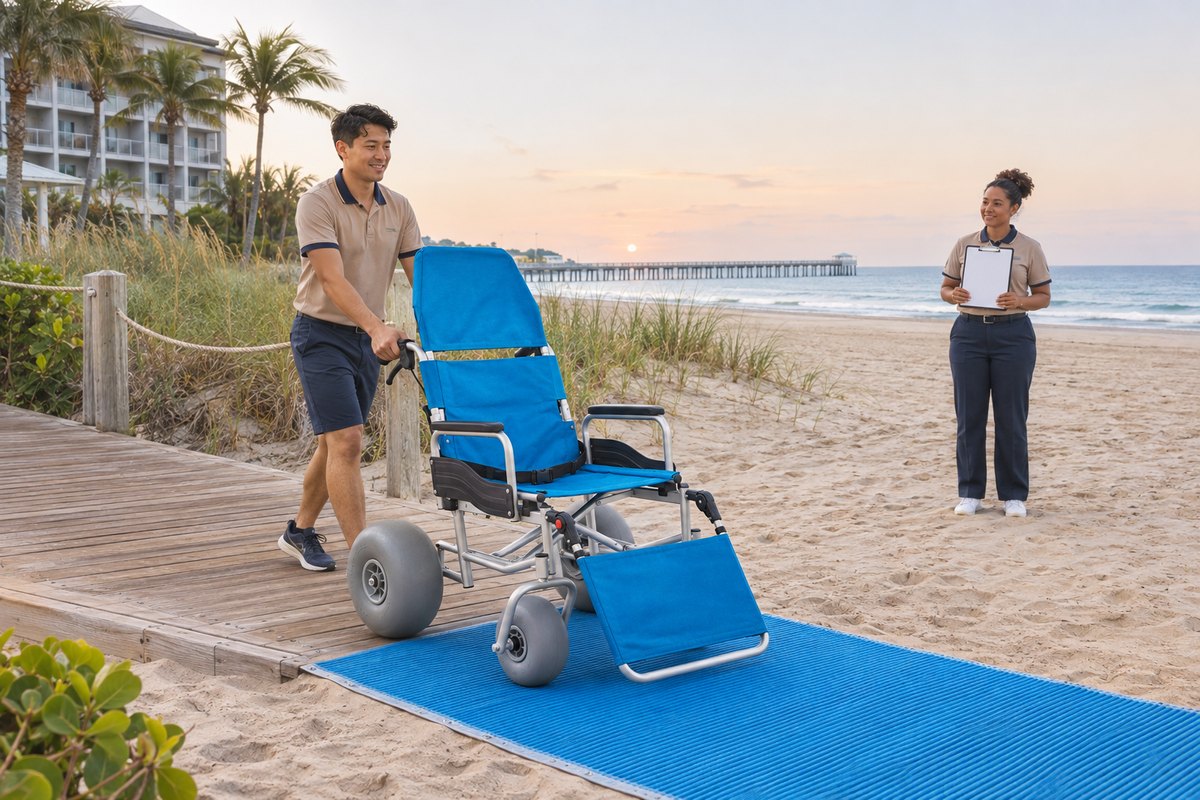
Separate problems that call for different spending decisions
| What the records show | How to check the explanation | Likely owner of the next action |
|---|---|---|
| Several chairs stop at the same boardwalk turn during deliveries | Compare actual gate and turning space during affected and unaffected periods | Facilities and the delivery supervisor |
| One high-back chair repeatedly rubs on one side across different routes | Trace its wheel position, repair history, refitting and authorized empty checks | Equipment technician |
| Guests reach the beach but wait past the agreed collection window | Compare the promised return with staff coverage, actual contact and pickup time | Recreation or duty supervisor |
| Guests expect access to water when the maintained route ends on dry sand | Compare the booking wording with the route and ask what the guest understood | Reservations and the content owner |
An AY-ST-V2.0 has a listed overall width of 110 cm. That establishes one equipment dimension, but does not reproduce the turn taken by the configured chair and its attendant. If observations identify furniture crowding the turn, changing the furniture plan or delivery time may resolve the complaint without buying equipment. Use the model manual and the actual land-route check for the configuration in question.
Test whether the corrective action worked
Suppose staff recorded four shortened visits out of 20 scheduled afternoon trips, all when the trolley crossed the return turn. Operations moves that delivery to an earlier window. During the next comparable set of 20 afternoon trips, one outing is shortened for an unrelated equipment hold and none for the crossing. The count for crossing-related interruptions changed from four to zero in those observed periods. Keep the equipment hold in its own category. The comparison does not establish a permanent result across weather, seasons or changes in hotel occupancy.
Write one action per finding with a person who can carry it out, a deadline, the test that would demonstrate improvement and the date to revisit it. Ask a staff member and, when appropriate and voluntary, a guest to describe whether the original trip now works. Update the layout, staff instruction or public pre-arrival guide affected by the correction. Leave the finding open if the change is installed but the promised trip has not yet been observed.