
Two entrances can be the same distance from a beach viewing area and offer quite different trips in a high-back wheelchair. One may have an easy straight gate followed by a tight right-angle turn. The other may have a longer firm approach but an exposed join onto moving sand. Take the actual AY-ST-V2.0 configuration and its attendant’s working space into account before choosing which entrance to advertise.
Split each proposed trip into sections
Name the start, destination and return pickup. Mark fixed gates, thresholds, turns, mat joins and the surface at the viewing area. For each section, record whether it is firm paving, installed matting, compact sand or looser sand, the date and condition observed, and who can report a change. Draw the direction of travel both ways. A gate that opens away from an approaching chair may take up some of the returning chair’s landing.
The AY-ST-V2.0 manual gives overall dimensions of 120 × 110 × 122 cm and identifies four inflatable PU wheels, a high backrest and a five-position leg rest. Confirm dimensions for the actual setup. The space swept by the leg support through a turn and the room needed by an attendant cannot be read from a single width measurement. Inspect the unit, its wheels and fittings under the model instructions before an empty route check. AY-ST-V2.0 English manual
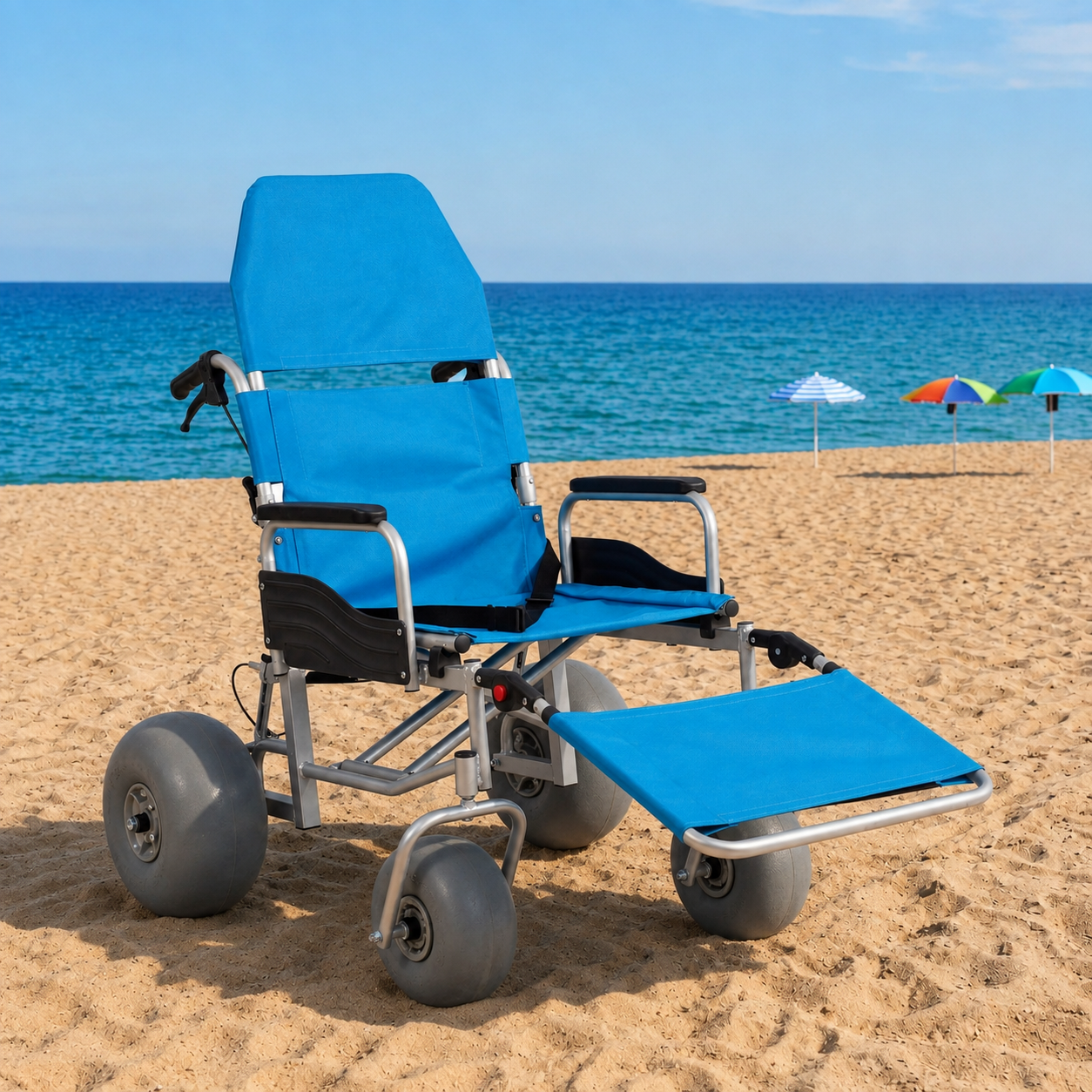
Compare the two entrances at the points that could end the trip
| Where to compare | What to observe going out and returning | What could change the route choice |
|---|---|---|
| Gate and first turn | Clear opening in its operating position, available landing and clearance for the configured support and attendant | A straight passage can clear the wheels while the next turn catches the support or leaves the attendant without room. |
| Fixed approach to mat | Support beneath both ends, edge position, loose sand and any movement at the connection | An unsupported edge calls for review by the site team before visitors use it. |
| Mat end to destination | Distance and actual ground beyond the last supported section, room to stop and face companions | A shorter route to a usable viewing point may be preferable to one that ends on loose sand without return space. |
| Return to transport | Opposing traffic, gate swing, opening hours and space for the collection vehicle | An easy outward leg can leave a visitor stranded at a locked or obstructed return gate. |
For example, an empty trial at the straight gate might clear the opening but show that the leg support approaches a wall before the attendant can complete the return turn. Record the exact location and configuration. Do not shorten a support needed by a particular visitor to make the drawing work. Have the team examine the second entrance or resolve the obstruction and retest.
Issue a route decision with an expiry condition
Record the verified entrance, permitted endpoint, return, chair configuration, test date and observed surface conditions. An empty trial helps staff identify physical obstructions. Any supported visitor trial needs its own suitability checks, agreement and qualified assistance. Keep this high-back model on the specified land route. Treat water activity as a separate service using equipment documented for that purpose.
Give staff a specific reason to recheck, such as moved event fencing at the turn or sand loss at the boardwalk end. If a defect removes the only usable return, hold the affected trip and tell the desk what can still be offered. Reinspect before changing the public route back. The staff training guide covers using the model on duty. The procurement guide covers resolving site constraints while the buyer can still change its order.