
A hotel group can share training material, supplier contacts and spare-part records, but it cannot send the same beach package to every property and assume the same visit will be possible. Choose an operating task for the pilot and another for the second site. Which guest can reach which destination, with what equipment and assistance, and how will that guest get back? That answer determines what to standardise and what each location must prove for itself.
Group sites by the trip they can deliver
A site where a firm promenade reaches a viewing bay may need a mat only at the final sand crossing. Another property might need an assisted land chair from reception to a distant seating area. A third may want a separate supervised water service. Group them by their actual route, support requirements, storage, staffing and operating conditions. Room count and coastal branding give little indication of which equipment will work.
| Possible site role | Product evidence to collect | Local question before wider purchase |
|---|---|---|
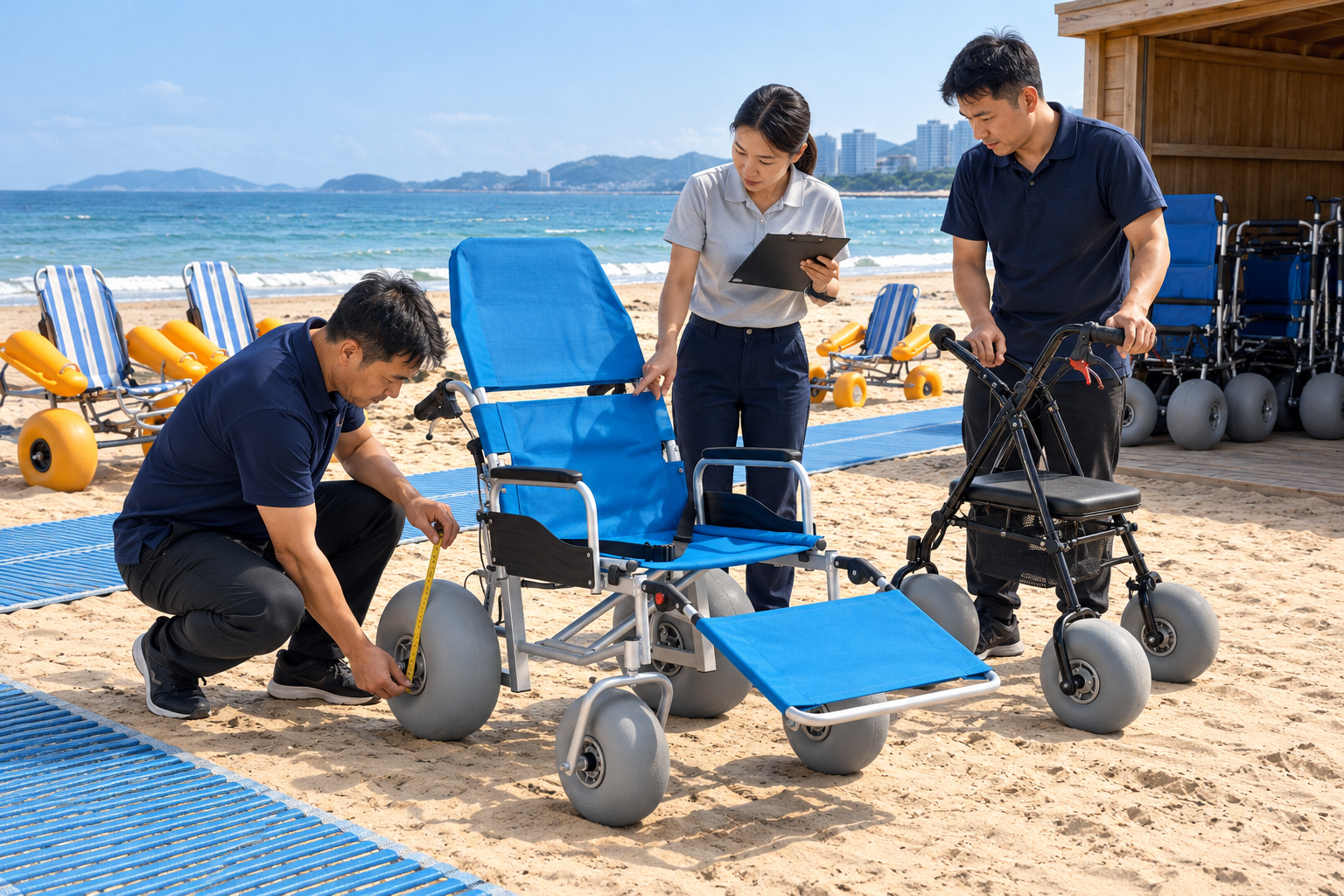
| Assisted travel on land | The AY-ST-V2.0 manual shows a four-wheel high-back chair with adjustable leg support. | Can the configured chair pass the gate, turn at the intended destination and return with the available assistance? |
| Frequent empty-chair transport | The AY-ST-V3.0 manual shows a folding chair with removable wheel assemblies and lists 13 kg net weight. | Can the site’s crew prepare, load, secure, unload and recheck the empty chair in the actual vehicle? |
| Supervised controlled calm-water service | AY-ST-V1.0 has three inflatable wheels and detachable inflatable PVC armrests. | Are the local water conditions, trained supervision, stable attendant footing and exit arrangements suitable for that particular session? |
| A mat for guests using their own mobility devices | Confirm construction, usable width, effective coverage, joins and end treatment for the offered version. | Can a guest reach the mat in their usual device and stop or turn where the property intends to offer access? |
These are examples for different service jobs, not a recommended standard fleet size. The named chairs are documented in the V2.0 manual, V3.0 manual and V1.0 manual. Water operation also requires the model’s stated operating conditions.
Pick a pilot that can teach the second property something
Choose a realistic constraint shared by the intended group: a transfer through a narrow reception gate, a change from mat to sand, a seasonal installation or a long journey from store to beach. Record the baseline before buying. How many requests concerned the proposed destination, what currently prevented the trip and which part would new equipment change?
Rehearse one complete outing with the local team, including retrieval, the agreed transfer, route, return and care. Empty-equipment checks can identify clearance and setup problems. Any participant stage needs the person’s agreement, appropriate assessment and support. Keep the route condition, actual staffing, interruptions and unresolved matters with the outcome. Give the second property those assumptions as well as the purchase list. Site and equipment assessment
Test one transfer of equipment between sites
Suppose the pilot property has a spare V2.0 while a neighbouring property has an afternoon booking for assisted land travel. Before counting it as regional cover, identify the unit, its approved configuration, compatible transport arrangement, dispatch and return custodians, and person who will recheck it at the receiving site. Transport consumes real time at both ends. One spare cannot cover two overlapping requests.
Test the same point for a mat connection kit. A matching colour or nominal width at the second beach does not establish compatible joining geometry. Store the product reference and drawing revision in the shared parts register. Require each site to confirm the exact installed version before promising a spare. If that confirmation cannot be made, plan local stock or supplier support instead.
Release the next site against its own evidence
Share the model documentation, issue and return fields, example training tasks, supplier contacts and method for recording closures. At each property, verify the actual route and destination, fit and assistance arrangements, local operating authority, trained cover, care, storage, maintenance and a method for telling guests about changes. A pilot approval does not travel with the chair.
Compare missed requests and recurrent defects at the pilot before releasing a larger order. If the binding constraint is a locked beach gate or a single qualified return checker, correct that constraint before adding more equipment. Expand only to sites that can reproduce the service they advertise, and give the next site a named contact for support during its first operating period. Program budget and operating constraints