
A grant that buys a chair may leave the resort or council paying for a route improvement, a trained attendant, cleaning space and repairs throughout its operating season. Give finance a service to price: the entrance and destination, opening days and hours, equipment roles, assistance offered, and period over which the operator intends to maintain them.
Use separate lines for capital purchases and recurring work. A lump sum labelled “accessibility equipment” cannot show what happens to visitors if the mat stops short of the viewing bay or the only trained person is occupied at another handover.
Cost a complete season for one defined service
| Cost group | Information that makes two options comparable |
|---|---|
| Route and facilities | Survey, design or permission work, connections, matting or fixed construction, signage, transfer and care space, and continuing inspection. |
| Equipment | Exact configuration, active and reserve quantities, optional components, delivered price, receiving work and applicable instructions. |
| People | Cover for service hours, overlapping handovers, training, cleaning, inspections and relief during breaks or absence. |
| Continuing support | Compatible spares, approved service work, freight or transport for repairs, temporary substitute capacity, storage and eventual disposition. |
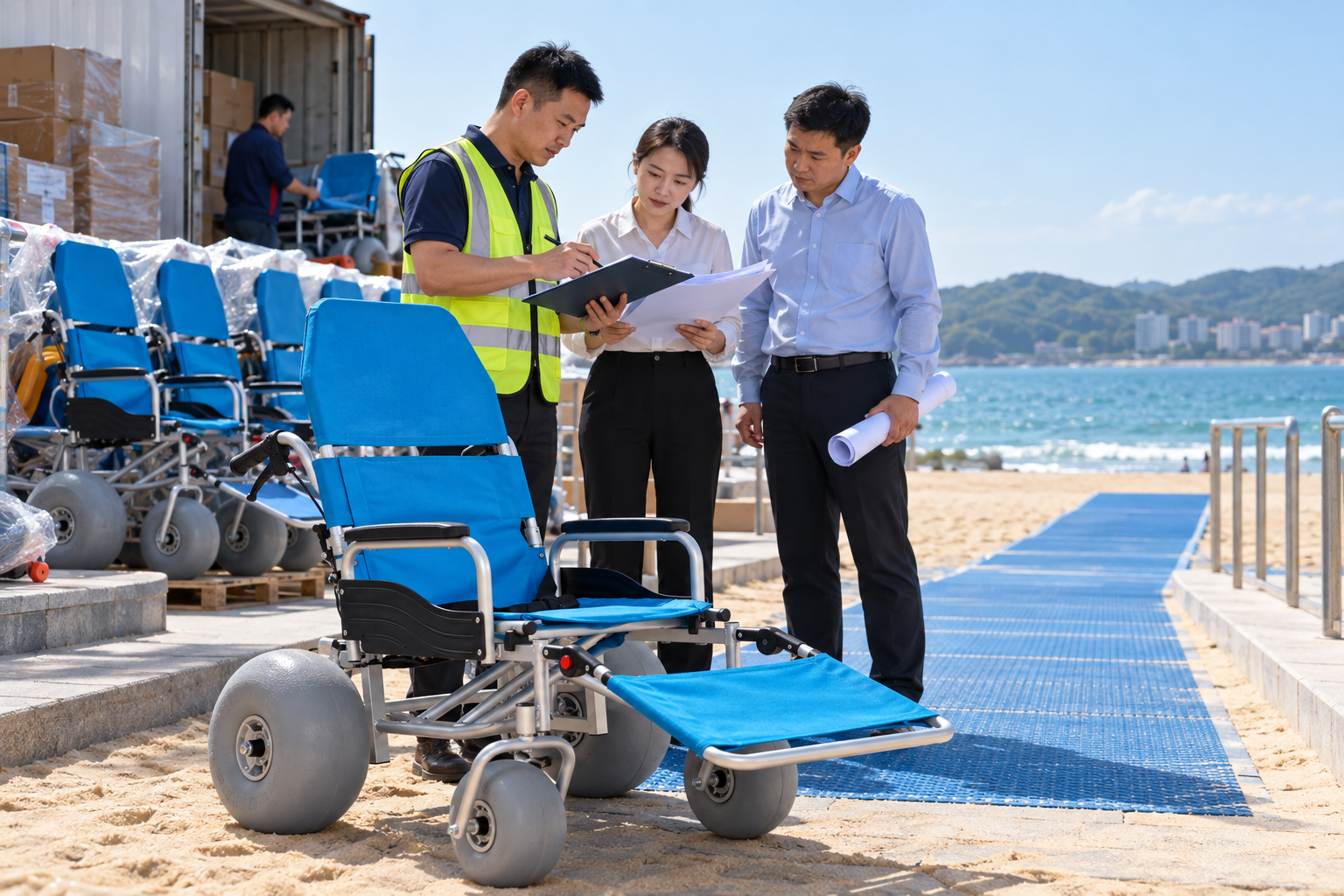
Price route work separately from devices. For matting, obtain the as-designed installed coverage and complete component list. For walkers or chairs, estimate quantities from requests overlapping in time and check that the service has the staff and space to support them. Additional equipment stored in a distant building may solve no peak-period problem if the same person has to retrieve it and attend a guest. Budgeting a seasonal mat route · Planning the beach equipment mix
Calculate labour using people, hours and the actual roster
Consider a hypothetical land-only service running four hours per day, five days per week for eight weeks. That is 160 public service hours. Suppose the operator budgets one person for all public hours, and a second person for two peak hours each operating day. The peak overlap adds 2 × 5 × 8 = 80 person-hours, bringing planned public-facing cover to 240 person-hours.
Now suppose one employee spends 30 minutes on assigned preparation or closeout outside those public hours on each of the 40 operating days. That adds 20 person-hours, for 260 person-hours before training, relief, leave or any specialist repair callouts. Multiply each role’s hours by the locally approved rate and add the costs actually applicable. These staffing assumptions illustrate arithmetic, not a required staffing level or an assessment of any specific outing.
Test the busiest hour against the rota. If one guest returns while another needs a handover and a third phones about collection, name who handles each task. Do not add time for a task twice if it is genuinely completed within paid cover and no additional person is needed. Conversely, a staff member already supporting another service does not create free cover at the beach.
Compare like-for-like delivered and continuing costs
Obtain separate quotation lines for equipment, agreed options, spares, packing, freight to the named site, training and post-delivery support. Identify any buyer-paid onward movement, local works or import services and have the responsible parties confirm them. A price at the shipping port differs from equipment inspected and ready in the beach store.
Choose a common review horizon and identify renewal assumptions explicitly. Enter repair frequency or replacement timing from actual records where possible. When the service is new, use a scenario rather than presenting a guessed life expectancy as a product specification. Show the cost of one plausible disruption, such as replacing a failed assembly and covering the next supported appointments while the unit is unavailable.
Show the decision when the budget changes
Compare a supported land phase with any proposed supervised water phase as different service commitments. The latter can add distinct equipment, trained cover and site requirements. A reduction in the budget may lead the operator to retain one reliable destination and defer an extension. Show the revised visitor service and remaining fixed costs when presenting that fallback.
Mark which funding source pays each line, whether it is available for continuing operations, and which amount needs a supplier or site decision. Return next season with actual operating days, readiness delays, downtime, staff time and unmet requests. Those figures let the budget holder decide whether the next unit of funding should go to route works, staff cover, a replacement part or another compatible device.