
A delivery of twenty-four wheels may still leave the assembly line one insert short. Ask the shipper for a carton-level list that identifies which wheel references, inserts and separately packed fittings are expected in each package. Give receivers the same revision of the list. A total wheel count alone cannot show whether the right combinations arrived.
Agree how each wheel set will travel
Ary reports that it ships balloon wheels deflated, commonly two, four or six to a carton. Treat those as examples from this supplier. Confirm the actual pack count, protection, dimensions, gross weight and inflation state for the size and order being shipped. A wheel’s inflated diameter is a fit dimension. The forwarder needs the packed carton dimensions. Manufacturer’s export packing information
Keep valve and hub areas protected as specified for the shipment. Label loose inserts and fittings with the appropriate wheel reference and quantity. For mixed orders, ask the supplier to identify which cartons contain the hardware as well as which contain tires. A bag marked only “small parts” will be difficult to reconcile after cartons are opened in different bays.
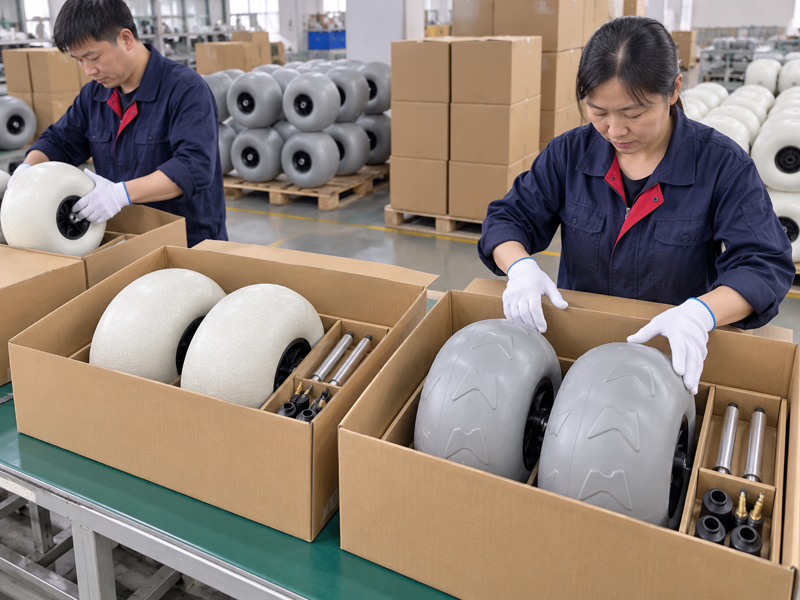
Make the carton marks do some work
Suppose an illustrative order contains 16 wheels of reference A and eight of reference B, packed four to a carton. The shipper marks A1 through A4 and B1 through B2. The accompanying list says each B carton includes four specified inserts. Six cartons is the expected total. That count tells dispatch what to look for while the A and B marks let receiving tell which wheel family a shortage affects.
Before collection, supply the carrier and receiving team with the agreed shipment references, delivery address and unloading arrangements. Send the packing list and any required photographs to the people opening the cartons. Confirm who handles a visibly damaged package or a short count and how the relevant contract requires it to be reported. Price and transport obligations belong in the agreed order.
Inspect before mixing stock
- At the dock, record the package marks actually delivered and photograph damaged areas before opening where practical. Retain the packaging associated with any complaint.
- At the bench, open a single marked carton. Compare the wheel references, markings, hub configuration and separately bagged hardware with that carton’s entry.
- Look for cuts, damaged valve areas, cracked hubs or protection that has shifted. A deflated wheel’s shape on arrival does not establish its working condition. If an inflation check is required, follow the instructions for that wheel and use its specified pressure.
- Move identified, accepted items into the appropriate stock location. Keep items with an unresolved identity, damage or shortage together with their package reference.
If carton B2 contains four B wheels but only three inserts, record four wheels and three inserts received. One B wheel cannot be issued as a complete kit. Check the packing arrangement and ask the supplier to identify or replace the missing item. Do not relabel an A insert as a B insert because it happens to slide into the opening. Hold the affected quantity according to the buyer’s acceptance procedure.
Preserve the trail through the first issue
Connect the supplier lot and drawing revision to the receiving record, then to the store location. If the first installer reports an unexpected hub length, purchasing can find the affected cartons without recalling every wheel in inventory. Compare the part with the approved sample and the agreed supplier quote line. A delivery signature, a complete carton count and a technically accepted wheel assembly each answer a different question.