
A replacement beach wheel can slide onto an axle and still leave nowhere for its retainer to engage. Diameter answers whether the specified bearing or bushing can mate with the axle. Length, shoulder position, spacers and retention determine where the wheel sits and whether it can be secured. Record both sets of measurements before ordering a hub.
Establish where each measurement starts
Identify the cart, wheel position and revision. Photograph the original assembly from the equipment side and the outer face. Include the inner shoulder, spacers, hub, washer and actual retaining feature if visible. If the instructions authorize removal, keep the components together in order and label the side they came from. A part already missing from the assembly belongs in the discrepancy record.
| Measurement | Where to take it | What to avoid reporting in its place |
|---|---|---|
| Axle diameter | The specified cylindrical mounting surface for the bearing or bushing | Thread outside diameter, a worn groove or a dimension read from a photograph |
| Finished wheel bore | Inside the bearing or bushing that actually sits on the axle | The larger opening in the plastic hub before its insert is installed |
| Hub seating length | Axially between the faces identified on the offered assembly drawing | The widest point of the inflated tire |
| Usable mounting length | From the defined inner locating face to the relevant retention reference | Total axle length including inaccessible or threaded portions beyond that reference |
| Hardware and offset | Identify each spacer, washer, retaining feature and the wheel centerline relative to its mounting face | A single overall dimension that hides how the wheel is positioned |
Use appropriate measuring tools and record units, reference faces and which part was measured. If the axle is distorted or worn, ask the manufacturer for the design dimension and permitted condition. A close measurement of a damaged shaft may be precise yet inappropriate as an order specification.
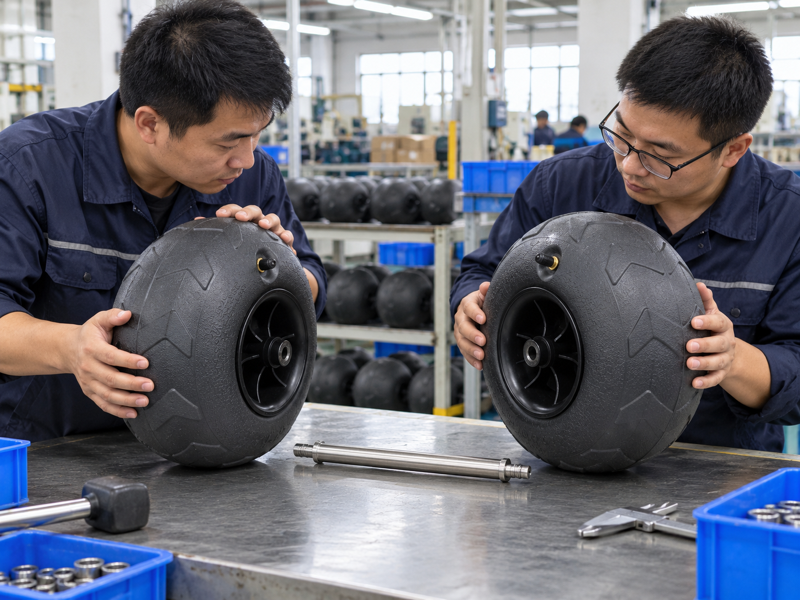
Check the stack on paper before fitting it
For illustration, suppose the drawing gives 74 mm from the inner shoulder to the agreed outer reference. A proposed hub occupies 65 mm, the inner spacer 7 mm and the outer washer 4 mm. Those three pieces already need 76 mm, or 2 mm more than the available distance. Stop and obtain the correct assembly. Even a shorter stack that appears to fit still needs the designed end clearance and full engagement of the prescribed retainer.
The manufacturer’s wheel table illustrates why the fitted insert must be named. Its 16-inch PU version lists a 20 or 25 mm bore with a bearing. Its 7.5-inch PU row lists a 75.4 mm hub figure and bushing options. Those entries describe different features on different wheels. Use the drawing to establish the reference for each number. A set of nominal diameters in an online selector cannot supply the missing shoulder or spacer dimensions.
Ask for a yes or no against the marked drawing
Send the original equipment reference, photos, sketch and measurements to the supplier. Ask it to identify the wheel, insert and any reused fittings, show the mounting order and confirm the position of the outer retainer. Request the applicable tolerance and fit procedure. Avoid grinding a hub, drilling a bore or removing a specified washer to make an unmatched assembly seat.
On receipt, reconcile the assembly with the approved references. Have the designated person check seating, retention and free movement under the equipment instructions, then verify clearance to adjacent parts and through the permitted movement. Record the fit result by asset and wheel position. If an otherwise similar cart uses another axle or retainer, keep it as a separate application in the replacement wheel register.