
A request for larger beach wheels usually starts at the sand. The first place a 16-inch wheel can rule itself out may be the cart frame or the storage gate. Check the available space from the axle center outward before proposing a size change. A wider tire can also move the outer edge of the cart into a post while the inner face rubs its support.
Compare the two 16-inch assemblies on their own terms
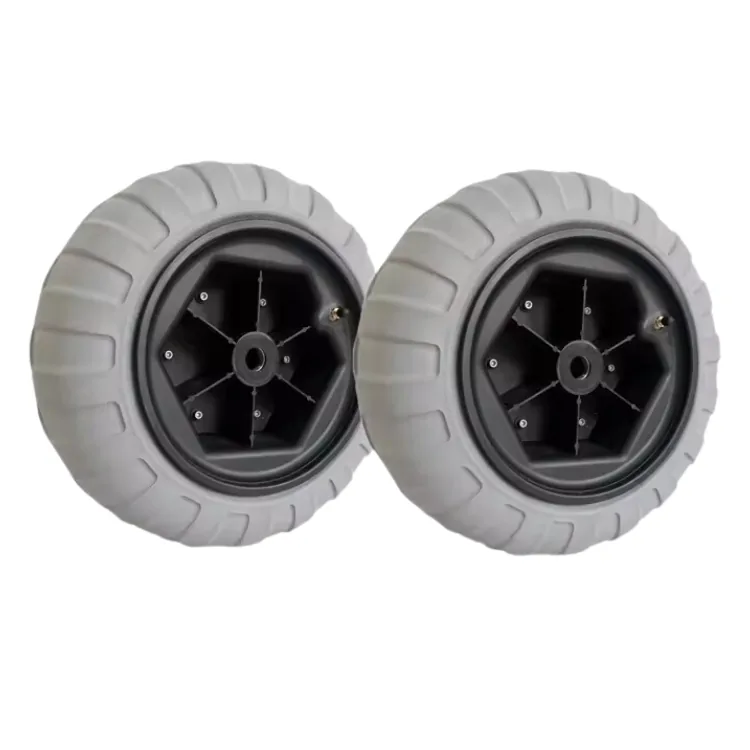
The manufacturer’s listed 16-inch PU and PVC wheels both have a 400 mm inflated outside diameter. The PU version is 200 mm wide and lists a bearing with a 20 or 25 mm bore. The PVC version is 210 mm wide and lists bore options from 8.5 to 30.5 mm. Its row gives an 80 kg wheel rating. The PU row does not state a numerical load rating for this size. Ask for the load limits and conditions for the particular wheel and the approved host equipment. Manufacturer’s 16-inch wheel specifications
A 20 mm nominal axle might make the PU bearing option worth investigating. It says nothing about whether the bearing seats against the correct shoulder or leaves sufficient axle length for retention. The PVC option range likewise requires a specific available insert and finished bore. Do not assume an adjustable universal hub. Ask for the actual assembly drawing, including hub seating length and the wheel centerline relative to the inner mounting face.
Predict the tight spots before mounting a sample
Suppose a designer is comparing a listed 315 mm wheel with a 400 mm candidate about the same axle center. The radius increases from 157.5 mm to 200 mm, an increase of 42.5 mm. If the existing tire has 30 mm of radial space to a fixed guard at the critical point, the larger nominal envelope would overlap it by 12.5 mm before allowing for operating clearances or variation in inflated size. That is grounds to reject this layout or obtain a redesigned, approved arrangement before a trial.
| Check on the proposed equipment | What the larger wheel can change |
|---|---|
| Space above and around the axle | Clearance to tub, fork, guard or other moving assembly through its permitted travel |
| Space sideways from the mounting face | Inner tire-to-frame clearance and the outer width at storage doors, ramps or narrow gates |
| Cart geometry and working position | Deck or tub height, stand contact, handle position and unloading height if the axle and frame now sit higher |
| Installation on the axle | Bearing or bushing seat, spacers, exposed retainer position and compatibility on both sides |
Limit the decision to the approved build
A nominal 400 mm tire is not a release dimension. Use the supplier’s finished drawing and specified operating conditions to set the actual clearance checks. Confirm that the original equipment maker permits the wheel change. If it does, have an authorized person verify the empty fitted unit before considering a representative goods trial with the intended route, load and handling arrangement. Document the assembly and stop if the tire contacts the frame or retention is uncertain.
Keep a 16-inch spare under its exact material, hub and equipment reference. The same diameter across the two material options does not make them interchangeable. If the larger envelope conflicts with the original cart, reconsider the route or the 12-inch configuration rather than fitting an unsupported axle extension or removing a guard.