
At a beach delivery gate, a cart can fit between the posts while the operator’s hands do not. A wide grip may work on an open path yet leave little space beside a latch or wall. Put the proposed handle on the actual route with the person expected to use it. Check starting, turning, stopping and parking, including the turn needed to leave the delivery area after unloading.
Identify what the quoted handle actually does
The standard two-wheel cargo tub has a wide U-shaped metal pull handle. Its product drawing lists a 66 cm handle width and 86 cm outer width across the wheels. Those figures describe different parts of the cart. Also ask for the height and grip position when the cart is supported and when it is held in its normal travel position. Two-wheel tub cart drawing
For a folding cart, distinguish a telescoping adjustment from a handle that folds only for storage. The folding range lists an adjustable 35–53 inch handle on the four-wheel model and a fixed handle with a 44-inch overall height on the quick-fold 30021-SIS. The latter figure is not a grip-length measurement. Record which handle and lock will arrive with the quoted variant. Folding cart handle comparison
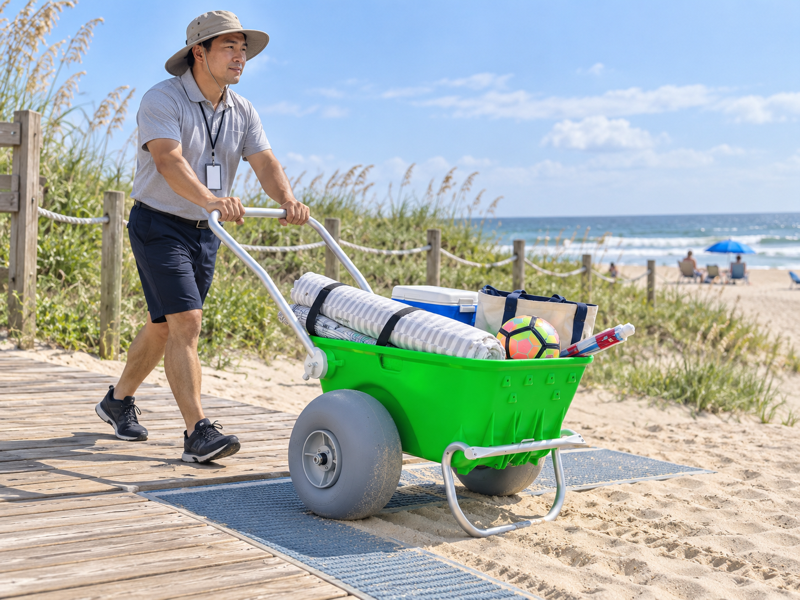
Follow the operator’s hands through the turn
Have a staff member familiar with the task inspect the empty cart first. Check grip condition, secure attachment and the specified lock on an adjustable or folding part. Walk the route empty before trying representative goods under the site’s handling assessment. Record the cargo, handle setting if applicable, worker feedback and the precise location of any difficulty.
- At pickup, can the operator reach and take control of the parked handle without leaning across the cargo or placing fingers near a moving joint?
- At the gate, is there room for hands and elbows near the latch when the cart turns, including when the gate swings back the other way?
- On firm ground and sand, can the worker start, steer and stop the cart under control? Record any change in cargo position, grip or effort that prompts a stop.
- At unloading, can the operator place the cart in its approved supported position and step clear while colleagues receive the goods?
Ask a second trained worker who normally shares the deliveries to try the same task if appropriate. Record their observation separately. A handle position accepted by one person on a straight path does not establish fit for everyone or for an entire shift.
Resolve a control problem before buying a different grip
Suppose a worker can control the empty tub through a service gate, but a long item in the proposed load projects into the handle area. Check the packing arrangement and approved restraint first. If the load still interferes, split the delivery or select a suitable alternative. A longer handle could create a new turning conflict and should only be fitted when the supplier approves that configuration.
Keep a cart with a slipping adjustment or unexplained movement out of the trial. Record the part, setting, cart ID and observed fault. Give the buyer the accepted grip position and route limits with the tested load arrangement. Where a fixed handle leaves no suitable working position at that site, change the cart choice or the handling plan before ordering.