
Write down the first load the new beach cargo cart will carry. A lidded cooler, two bags and a bundle of folded parasols need a different carrying surface from six flat cartons delivered to a beach kiosk. Measure the items in the condition staff will move them. Include lids, handles, straps and the space a worker needs to take a case out at the far end.
Choose a tub or a deck before comparing prices
A rigid tub contains loose, irregular items and gives the crew somewhere to put small pieces during cleanup. Check that the largest item fits through the opening, the lid can be reached and the worker can lift it out at the unloading height. The standard two-wheel model has a molded tub, two 12-inch balloon wheels, a metal pull handle and a stand. The manufacturer lists a 60 cm tub width and 35 cm depth. Request the internal dimensions where your case will actually sit. Two-wheel beach cargo cart specifications
A folding deck can suit stackable cases or a store short of floor space. Compare the particular deck, basket, restraints and open-frame lock offered. On the manufacturer’s folding range, the four-wheel cart, the quick-fold 30021-SIS and the two-wheel sling cart have separate specifications. Record the offered variant on every quote. A shared description such as “beach cart with balloon wheels” does not establish a shared deck, capacity or wheel assembly. Folding beach cart comparison
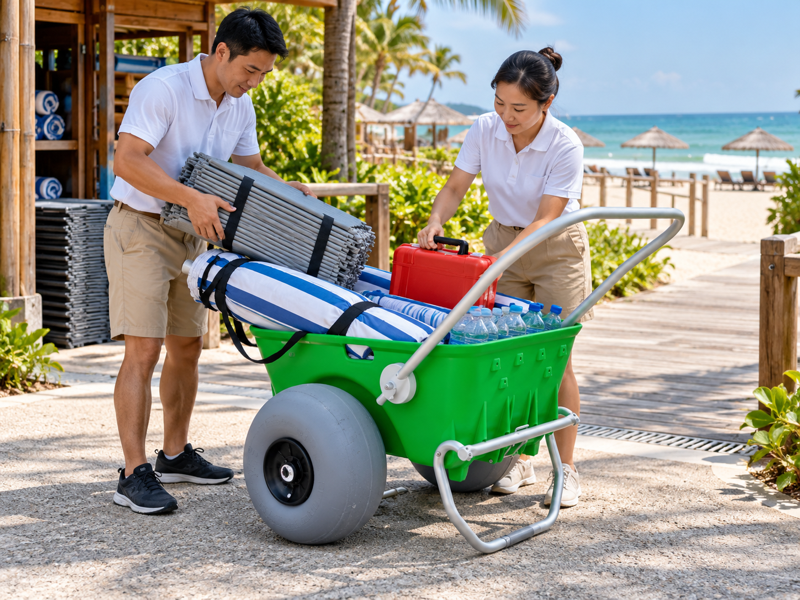
Bring a case and a tape measure to the route
| Buying question | A useful check with the site team |
|---|---|
| Can the load be contained? | Put a representative container in the empty sample. Check usable floor space, projections and approved restraint points. |
| Can the crew reach the destination? | Measure the narrowest gate across the actual travel line. Check corners, thresholds, firm-to-sand transitions and room to turn back. |
| Can it be loaded and parked? | Check an authorized loading place on suitable ground, access to the handle, and how the supplied stand or parking arrangement works. |
| What fits in storage? | Compare the assembled footprint or confirmed folded dimensions with the bay and its door. Decide where removable components will stay. |
For example, a kiosk might have an 82 cm clear service gate. The standard tub cart is listed at 86 cm across the wheels, so that configuration cannot pass straight through the gate. The buyer can inspect an alternative authorized entrance or ask for a separately documented configuration. A narrower carton would solve a shipping question only. Write the actual access requirement into the inquiry.
Award against the delivered cart
Ask suppliers to itemize the complete cart, wheels, fittings, accessories, delivery point, unloading responsibilities and spare-part terms. Confirm the goods rating on the drawing for the ordered configuration. It is a purchase limit, not a guarantee that a person can move that load on a particular sand route. If the route or cargo remains uncertain, use the sample review to resolve one measurable question before award.
On receipt, compare the unit and documentation with the accepted drawing. Ask the crew to identify its cargo, permitted route and operating limitations. These carts carry goods. Use equipment designed and assessed for passenger transport when the travel request involves a person.