
Begin the practical session where the hard approach meets the first beach mat section. Give the trainee the actual installation drawing and ask them to find that junction, the first connection on sand and the place where visitors turn back. A worker who can roll out material on a workshop floor still needs to show that they can recognise a displaced joint or an unsupported return edge at this entrance.
Demonstrate the supplied system with the receiving crew
Lay out one complete training set with its section or roll references, connectors, specified end treatment and the tools authorised for the job. Point out which side faces the direction of use and the relevant mating features according to the supplied instructions. For a modular system, demonstrate two matching sections and their particular connection. For a roll system, use its own joining and handling method. The manufacturer’s modular product description does not prescribe the installation of another supplier’s system. Beach access mat construction and instructions to request
The instructor shows the approved method, explains what they look for when the connection is made, then lets the trainee repeat it. Ask the trainee to identify any part that cannot be positively matched. A missing end fitting calls for a hold and the right component, not a substitute improvised during a demonstration.
Move the exercise to the actual entrance
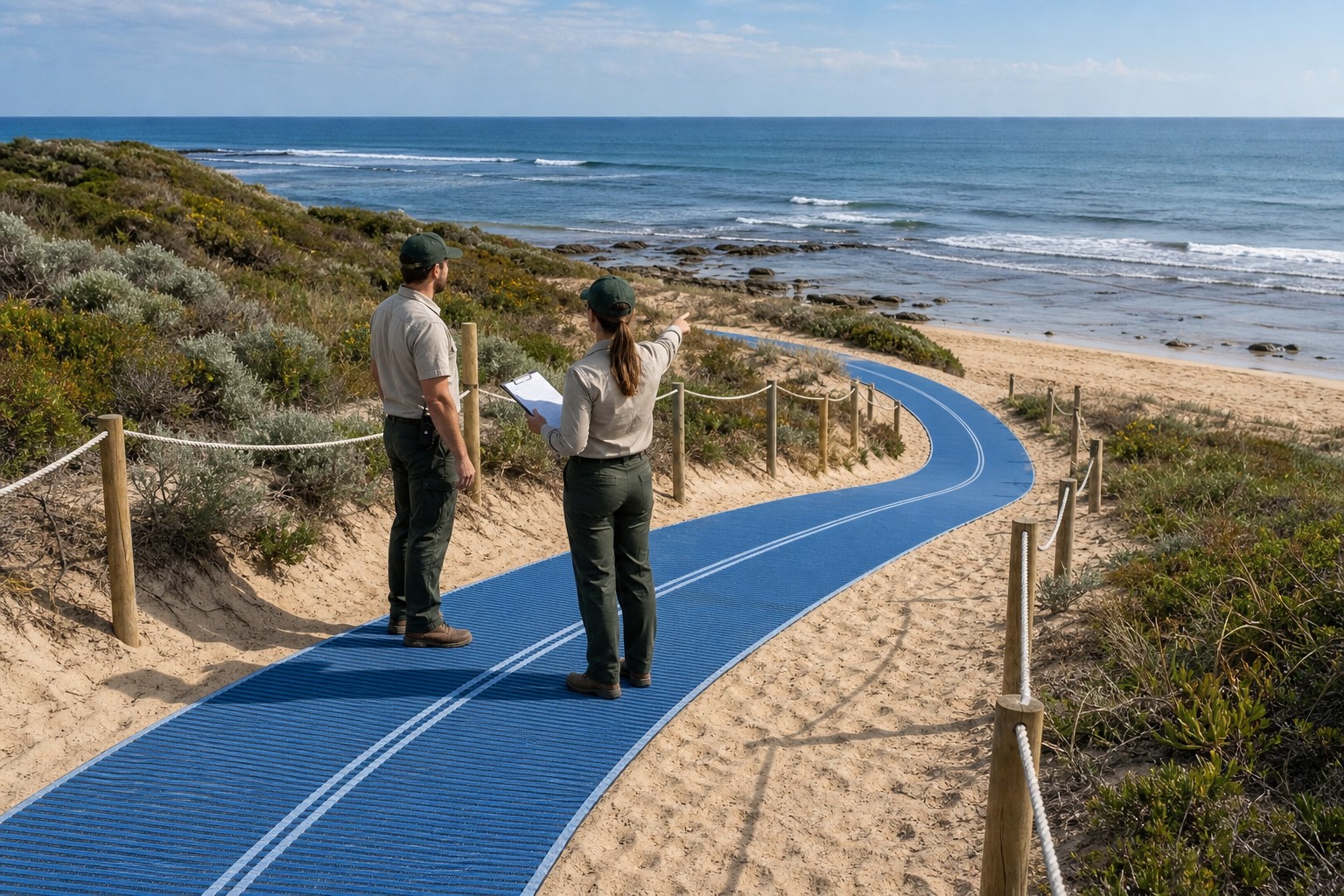
Keep the practice area controlled under the site operator’s procedure. Have the crew move the pieces from the real store using the agreed handling method and check that they can reach their working position. At the route, ask them to inspect the supporting surface, prepare the area within their authority and assemble the approved layout. The instructor should see the changeover from the firm path, the joins across the installed run and the far edge in the return direction. Ramp-to-mat transition checks
| Ask the trainee to show | What the observer can verify |
|---|---|
| Locate the accepted start, endpoint and direction of return | The trainee uses the signed entrance and physical landmarks and knows where the mat ends. |
| Assemble and inspect the representative connection | The correct parts and instructions are used. The trainee checks the mating edges and adjacent support. |
| Inspect from both directions | A possible lip, gap, obstruction or loss of sand is identified at the place a visitor would approach it. |
| Respond to a changed condition | The trainee identifies the affected section, protects it within assigned authority and contacts the person who can correct or release it. |
| Hand the route to visitor staff | The desk receives a precise endpoint, current status, time checked and any remaining restriction. |
Use the site’s established emergency procedure if someone needs urgent assistance. In a drill, use photographs or discussion to introduce a defect. Do not create a trip hazard on a route open to visitors.
Rehearse one handover that changes the answer
Suppose a fictional training exercise starts with a complete mat set and a planned opening at the viewing bay. At the last panel, the observer shows the trainee a photograph of sand eroded beneath the return edge. Ask which outings depend on that edge, who needs to inspect the base and what the visitor desk can actually say. A trainee who reports only “all sections installed” has counted the equipment but has not settled whether the planned trip is usable.
Have the trainee repeat the handover after the authorised correction is checked. The person at the desk should be able to point to the open or closed segment and explain the return to a visitor. The facility inspection and repair guide covers the maintenance team’s ongoing work after the handover.
Record the task observed, then practise the removal
Name the worker, system version, location, observed task, limits on their role and any further supervised practice required. Someone trained in surface cleaning may still need separate authorisation for anchoring or replacing connections. Keep those assignments clear when experienced staff hand over to relief crews.
End the session by having the crew remove and store the practice set as authorised, account for each component and deliver a closed-route message. Schedule another observed practice when a changed connection, new entrance, revised removal plan or recurring fault changes what workers must do.