
Before counting visits, define what a person was supposed to be able to reach. A mat that is open from the promenade to a resting bay but closed beyond it can support that shorter visit. If the advertised destination is farther along, report the interval as a partial opening. Calling the whole route available would conceal the part of the visitor journey that failed.
Give every interval one meaning
Use the published service hours for a defined route and reporting period. Record start and end times of changes against the advertised endpoint. If the site promises a seasonal service, use that season’s scheduled hours as the denominator. State how staff treat planned non-operating time, unobserved intervals and changes to the route. Keep unknown periods visible rather than assigning them to “open.”
| State for a named route | What it means for the calculation |
|---|---|
| Full route open | The agreed start, all required connections and advertised endpoint are available under the stated operating arrangement. |
| Partial route open | A verified shorter route is available. Name the endpoint visitors can reach. |
| Route closed | No usable trip is offered on that route during its scheduled hours. |
| Status unknown | Evidence is insufficient for that interval. Investigate or disclose it separately. |
For a hypothetical 40-hour scheduled week, suppose the full route was open for 27 hours, a shorter route for six, and the route was closed for seven. Full-route availability was 27 ÷ 40 = 67.5%. A visitor could reach at least the shorter verified endpoint for 33 ÷ 40 = 82.5% of the scheduled hours. Both calculations use the same complete 40-hour record. Label them separately so nobody reads 82.5% as a promise about the full destination.
Find the condition that cost usable hours
Record the affected connection or segment and why the status changed. A separated mat joint, sand loss under an edge, a known storm restriction and an inaccessible gate upstream require different responses. Measure each closure from its actual start until the authorised recheck and reopening. Separate active repair time from time waiting for a part, a site crew or a change in conditions.
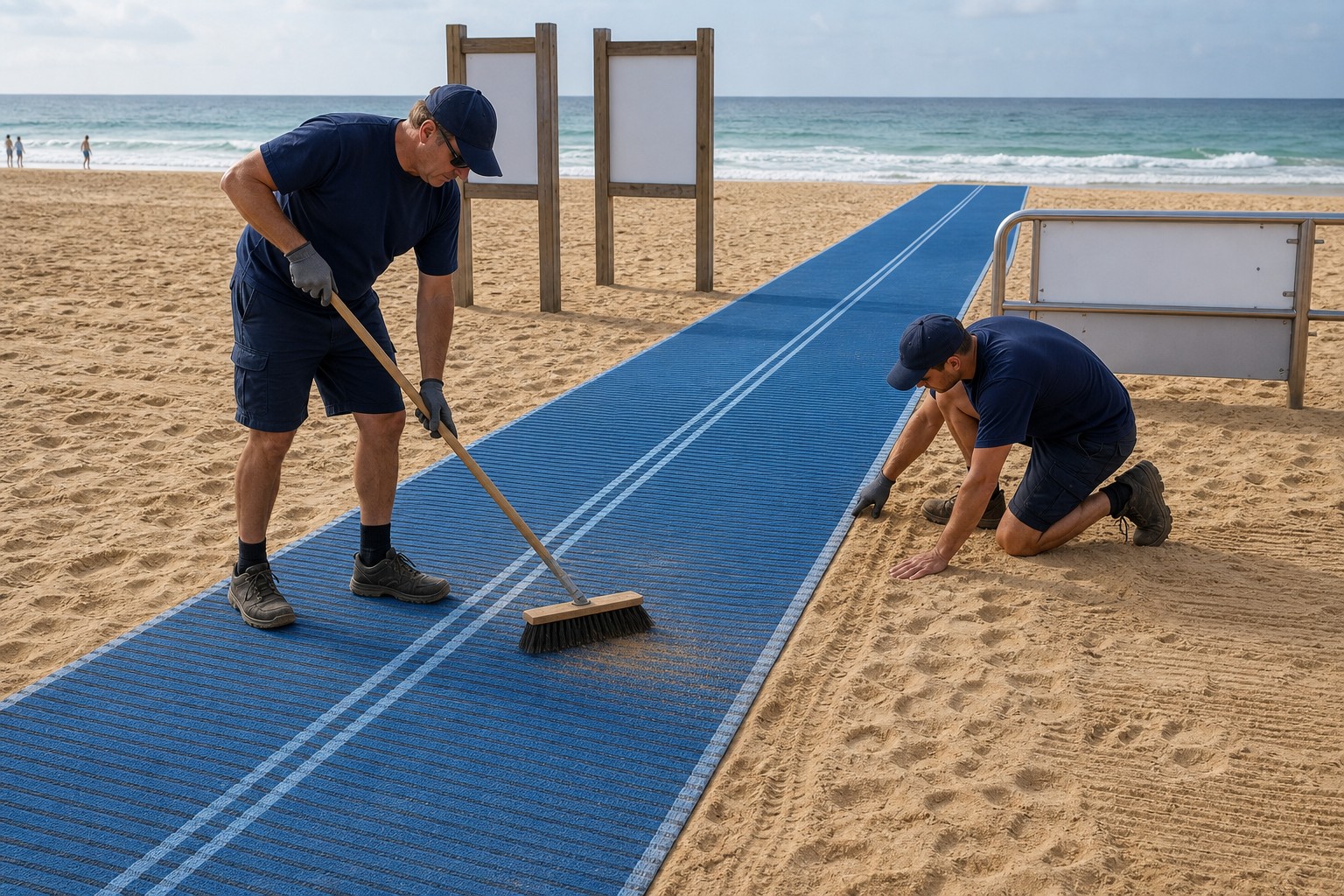
If several causes overlap, record the primary cause for the time total and keep other contributors as notes. For example, a gate closure during an existing storm closure does not add another full block of lost route hours. Check whether it delayed reopening after the weather restriction ended. Beach mat storm response
Record use and unmet demand separately
A counter at the boardwalk entrance may record walkers, returning visitors and people who turn back before reaching the mat. A loan register may count beach wheelchairs issued without capturing people using their own mobility devices. Identify the location, counting method, coverage period and known gaps before comparing counts between seasons.
Keep requests people could not use alongside completed outings. If a visitor asks for the closed viewing bay and declines the shorter route, that is a missed requested visit. Record the reason under the site’s privacy policy. Avoid treating low recorded use during a lengthy closure as evidence of little interest in the destination.
Use the monthly review to choose work
Compare recurring failures by location, downtime and consequence. A connector that is quick to replace may still account for long closures if the correct spare has to travel from another site. A recurring gap at the same boardwalk transition may need the grounds team to assess drainage or supporting sand. Ask which change could recover useful route hours and how the team will recognise an improvement.
If a repair is made, compare the same endpoint, season and measurement rules over a suitable later period. Record any change in weather, service hours or counting coverage that could affect the comparison. Keep the agreed service responsibilities beside the figures. Those responsibilities describe what the team committed to deliver, while the measurements show what visitors could actually use.