
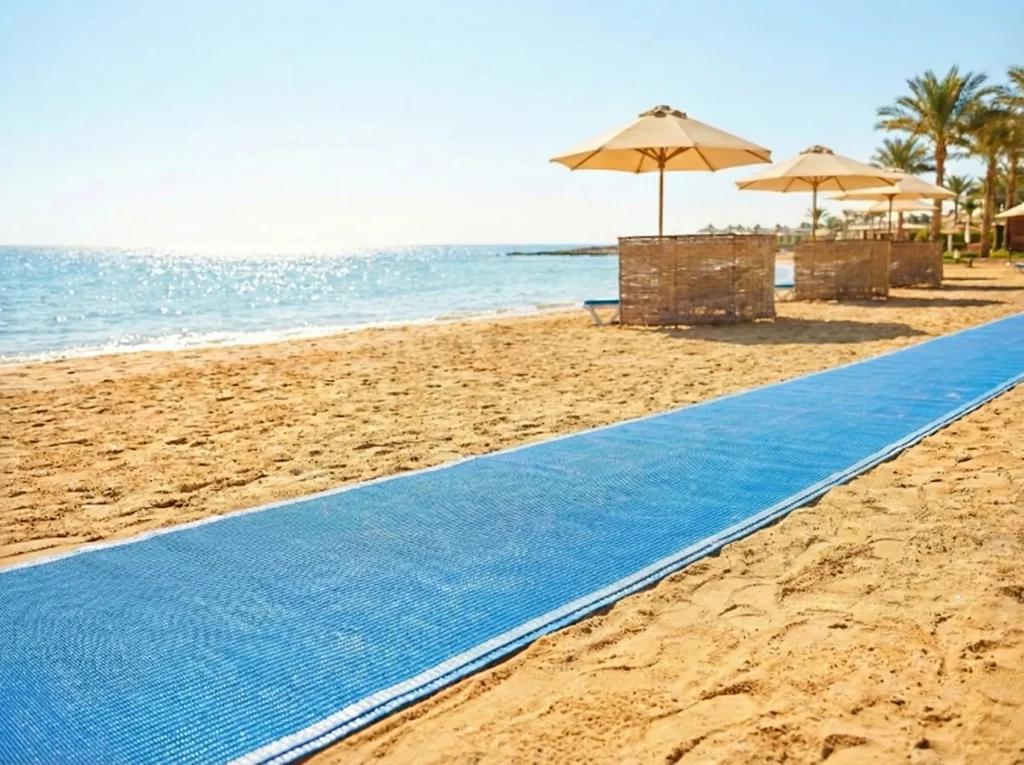
A wheelchair can travel the length of a boardwalk and still stop at the last few inches. Sand may have washed away from the foot of a ramp, leaving a lip before the mat begins. A mat may reach the picnic area yet end where there is too little room to turn. For a visitor planning an outing, the practical question is how far the connected route goes.
A resort or parks team can answer that question with a route walk. Start at the entrance a visitor will actually use, follow the ramp and mat to a useful destination, then make the return trip. Include access to toilets, shade or an equipment collection point if the site advertises those connections.
Draw the route a visitor can use
Mark the starting surface, ramp landing, first mat section, joints, bends and endpoint on a simple plan. Name the destination precisely. “Mat from the boardwalk to the viewing area” gives someone deciding whether to visit more information than “wheelchair accessible beach.” Add the location of any remaining stretch of loose sand.
Measure clear space where it narrows. A sign, railing or bin can take up part of a landing. On a bend, note the space needed by a wheelchair and anyone accompanying its user. Record the date and an identifying landmark alongside each measurement so a colleague can return to the same spot. The operator can use that sketch when choosing section lengths and connection details. Beach access mat buying guide

Check the ramp-to-mat connection from both directions
At the bottom of the ramp, look across the full width of the joint. Does the mat meet the landing as the approved installation detail shows? Check the sides as well as the centre. Sand piled against one edge can conceal a change in level. Sand lost beneath the other edge can leave an unsupported corner that appears flat from above.
Approach from the beach side on the way back. A visitor may have room to come down a ramp but little room to line up with it for the return. Note where an attendant would stand and turn, particularly if a handrail or adjacent traffic constrains that movement.
| Where to look | What to record | Who can use the finding |
|---|---|---|
| Foot of ramp | Change in level, exposed lip, clear landing space and dated side view | Site lead checking the installed connection |
| First mat section | Edge condition, support below it and fit with the specified transition piece | Installer comparing it with the approved detail |
| Along the mat | Separated joints, displaced edges, exposed fittings or sand deposits | Crew locating and correcting an affected section |
| Endpoint | Surface reached, space to stop or turn and route back | Visitor-services team describing available access |
Use the connection and anchoring instructions for the mat supplied to the site. If adjoining sections move apart or a fitting projects into the path, keep the affected connection closed while the installer reviews it. After correction, inspect the joint and the neighbouring sections together. Beach mat installation guidance
Which access guidance applies?
In the United States, the Access Board explains how firm, stable and slip-resistant surfaces are assessed on routes covered by the ADA Accessibility Standards. A mat’s surface texture describes only one aspect of an installed route. The reviewer also needs the approach, connections, changes in level and clear space. Access Board guide to floor and ground surfaces
Beach access routes covered by the federal Architectural Barriers Act outdoor provisions have specific requirements. The Access Board explains the scope of these federal provisions and distinguishes them from the Department of Justice’s ADA Standards for state and local governments and private entities. Ask the project’s accessibility lead which requirements apply at this site and what measurements belong in its acceptance record. Access Board guide to outdoor developed areas
Match equipment and visitor information to the endpoint
A visitor using their own wheelchair needs to know whether they can remain on the mat for the whole outing. Someone considering a beach wheelchair loan also needs the collection location, the surface between that point and the mat and the space available for their agreed handover. Describe those arrangements separately when the collection point is elsewhere.
For example, suppose the mat connects a ramp to a shaded viewing area and loose sand continues beyond it. A useful notice would read, “The mat ends at the shaded viewing area. The path back to the boardwalk uses the same ramp.” If work closes the ramp joint, change the entrance notice and booking information together. Visitors need that update before they travel to the beach. If another part of the outing crosses loose sand, assess the chair and assistance for that stretch separately. Wheelchair access beyond the mat on soft sand
Recheck after the beach changes
Wind, beach grooming or a change in sand level can alter a connection that was usable at opening. Give the duty team the plan and the most recent inspection photos. Staff can then identify the exact joint a visitor describes, assess the affected stretch and direct people to a confirmed alternative when one exists.
For a visit today, ask the operator where the mat starts, which destination it reaches and when staff last checked the connection with the ramp.