
Two surfaces can each be usable while their junction stops a beach wheelchair. At the end of a boardwalk, feel for movement in the first mat section and look along the joint from wheel height. At the far end of the mat, check what supports the last section and where the front wheels will go when they reach sand. Inspect the same edges on the return. A drop encountered going out becomes a step on the way back.
Boardwalk to mat: look at what carries the edge
Locate the last fixed board, the first mat section and the ground supporting that section. Look for a lifted corner, a gap, an exposed fixing, a lip across part of the width or an unsupported hollow under the mat. Check the width at the edge itself. Sand fencing or a handrail post can restrict the approach even when both surfaces are wide enough away from the join.
If a joint has changed, take one photograph across it and one along the direction of travel. Include a scale and a fixed landmark. Note which side is high, the height difference you measured, whether it runs across the whole junction and what happens when the unoccupied chair approaches. Compare the finding with the site’s approved drawing and the supplied system instructions. The installation contractor or facilities team should determine the repair. A loose board laid over a joint creates another unverified surface.
Mat to sand: inspect the landing and the return approach
Sand can build up over the last panel or wash away from underneath it. See whether the end still bears on the ground and whether the adjacent sand provides space for the chair to turn. Inspect where a person pushing will stand as well as where the wheels pass. A track made earlier in the day gives little information about what now supports the edge.
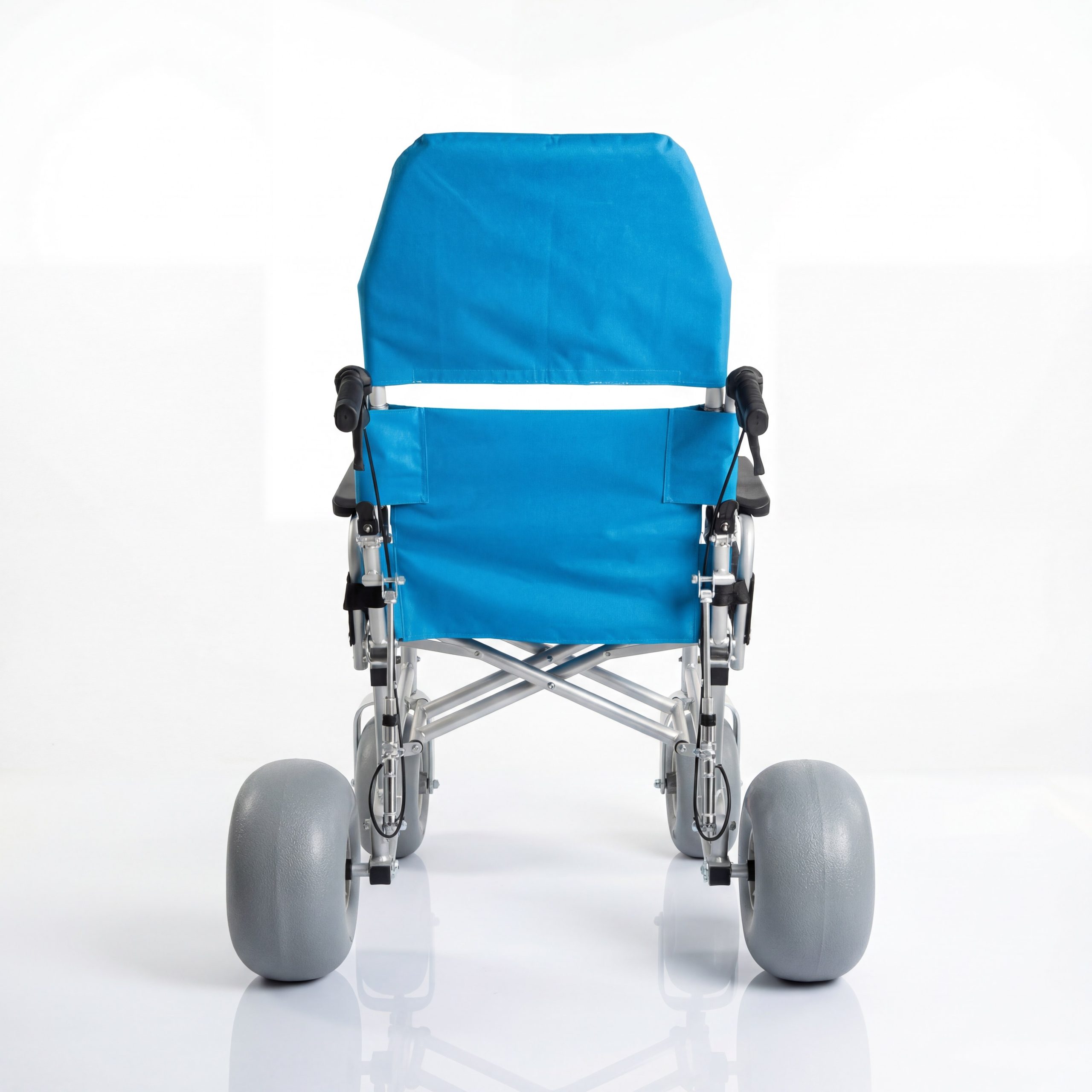
For the four-wheel AY-ST-V2.0, the specified front tires are 9 × 4.5 inches, the rears 12 × 5.5 inches and the overall width 110 cm. The two wheel positions reach the edge at different times. During an authorized empty-chair check, observe both pairs from each direction and check whether the leg support clears in the intended configuration. The manufacturer’s dimensions do not set allowable lips or gradients for the installation. AY-ST-V2.0 manual
Record a usable endpoint while a joint awaits repair
Imagine the boardwalk-to-mat joint is sound but an overnight washout leaves the far end of the mat suspended above the sand. Close that junction to travel and tell the site lead exactly which end is affected. If there is a checked, sufficiently spacious stopping place on the boardwalk, describe it to visitors. A sign inviting them to turn on the last unsupported panel would direct them to the defect.
After repair, compare the joint with the installation requirements, inspect the ground supporting it and repeat the check in both directions with the configured chair. The person authorized by the site records the result and releases that segment. Link the finding to its location on the site assessment. Keep the soft-sand route beyond the mat as a separate decision. Repairing an edge restores a crossing, while the remaining sand still needs a workable return.