
A folded beach wheelchair may fit inside a van and still fail to pass through its door. Measure the chair in the exact empty configuration the team will carry, then measure the narrowest opening and the path from the door to its assigned cargo space. Take those figures with you when a vehicle is substituted. A booking for “a van” gives the loading crew little to work with.
Three different sets of dimensions
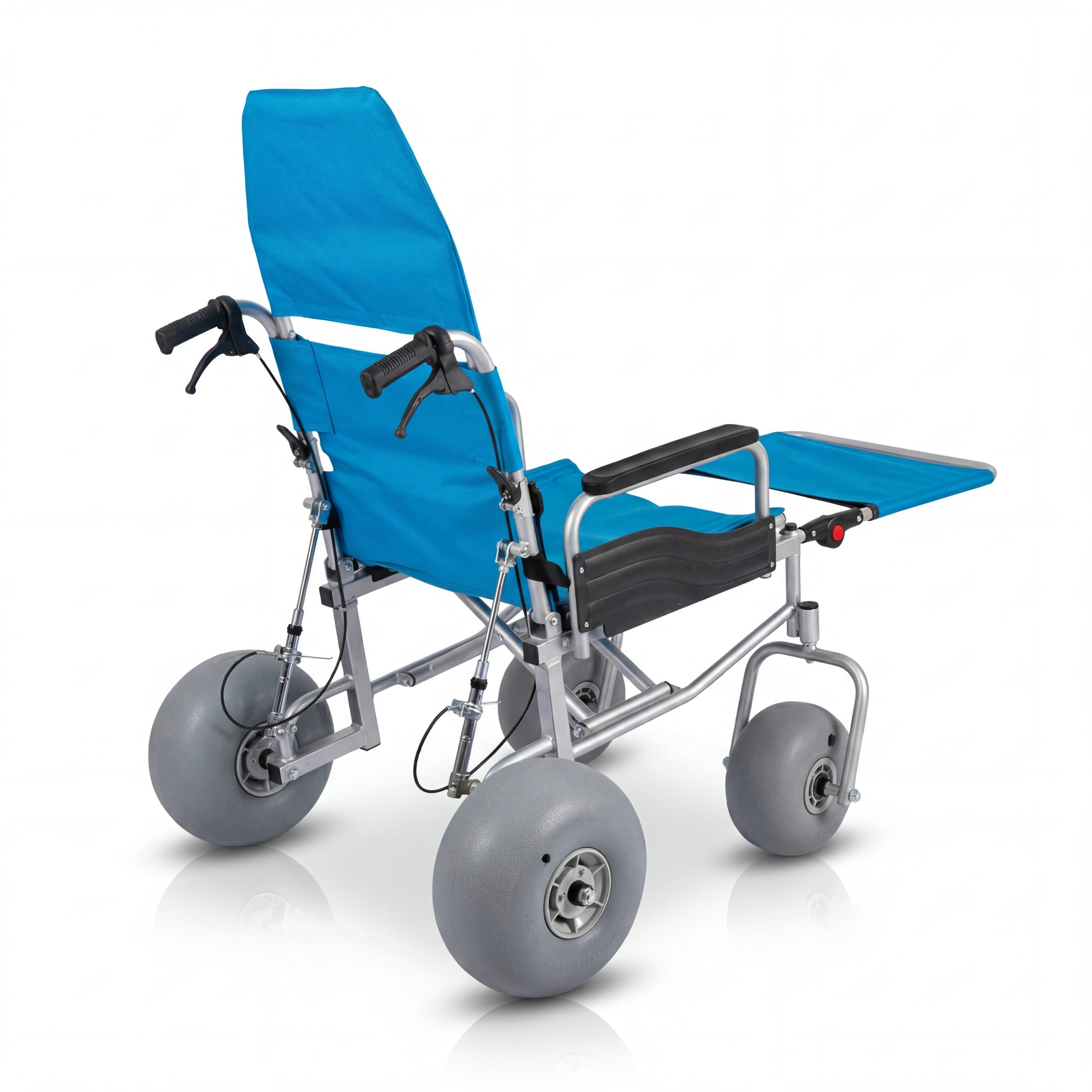
For the AY-ST-V2.0, the manufacturer lists an overall size of 120 × 110 × 122 cm, a folding frame and a net weight of 19.5 kg. It lists a shipping carton of 80 × 25 × 90 cm and a packaged weight of 22.5 kg. The carton measurements describe the manufacturer’s shipping package. The manual gives no folded dimensions for the particular combination of components your crew plans to carry. Measure that combination at its widest, tallest and longest points. AY-ST-V2.0 manual, page 2
Use the equipment manual to identify which components can be removed and how they are reinstalled. Note the position of anything that protrudes beyond the frame. Do not assume that an adjustable back or leg rest can serve as a lifting or load-restraint point. The vehicle operator needs a suitable loading and cargo-restraint arrangement for the actual equipment and vehicle. This trip carries the chair empty. Arrange appropriate passenger travel separately.
Try the load with everything else on board
An illustrative vehicle check might find 105 cm between the narrowest points of the rear doorway. A 110 cm wide assembled chair cannot pass straight through in its normal orientation. Folding or using another approved empty configuration may change the result. Take new measurements and try the loading path with the actual equipment. Do not let a catalogue drawing or a diagonal measurement substitute for confirming that the crew can move and secure the load.
| Measure or locate | Why it affects the vehicle choice |
|---|---|
| Clear doorway and sill | Door trim, hinges and the height of the sill can limit the path before the chair reaches the cargo bay. |
| Usable floor between wheel arches | Cases already booked into the vehicle can occupy the only space wide enough for the chair. |
| Height along the loading path | A chair that passes the door may strike an internal shelf when moved toward its assigned position. |
| Places for loose components | Wheels, supports and fittings need identifiable, protected storage and restraint during the journey. |
| Unloading order at the destination | Another crew may need a different item first. They must be able to access it without disturbing unsecured parts. |
Count the components back in at the destination
Assign each removed part to the same asset number as the frame. Before the doors close, compare the list with the load, identify who holds any small fittings and record the configuration carried. At the receiving point, arrange a dry area for assembly and enough time to check the chair before offering it to a visitor.
If a wheel fixing cannot be found on arrival, report the specific asset and position, check its labelled container and hold the chair. A temporary replacement chosen because it looks similar defeats the reason for identifying the parts. After installation, complete the prescribed assembly checks and the wheel condition review. Include the receiving person in any transfer between lending sites so the booking record follows the physical chair.