
When deciding how far a beach wheelchair can go across soft sand, work backwards from the return. The outward leg may run downhill on sand recently smoothed by a maintenance crew. Coming back can mean crossing deeper footprints, finding the entrance again from below and reaching the firm path before the available assistant has to leave. For a visitor who wants to sit with family, a shorter route with a reliable return can offer a longer stay together.
Find the last place the chair can turn and come back
Walk the planned land route in both directions. From the proposed destination, identify the return entrance by a landmark visible at chair height. Examine the depth and consistency of the sand at the turn, the narrowest passage, the approach to the path and any side drift across it. Mark where the team has checked an earlier turning place. Distances should describe the actual segment walked and the conditions at the time.
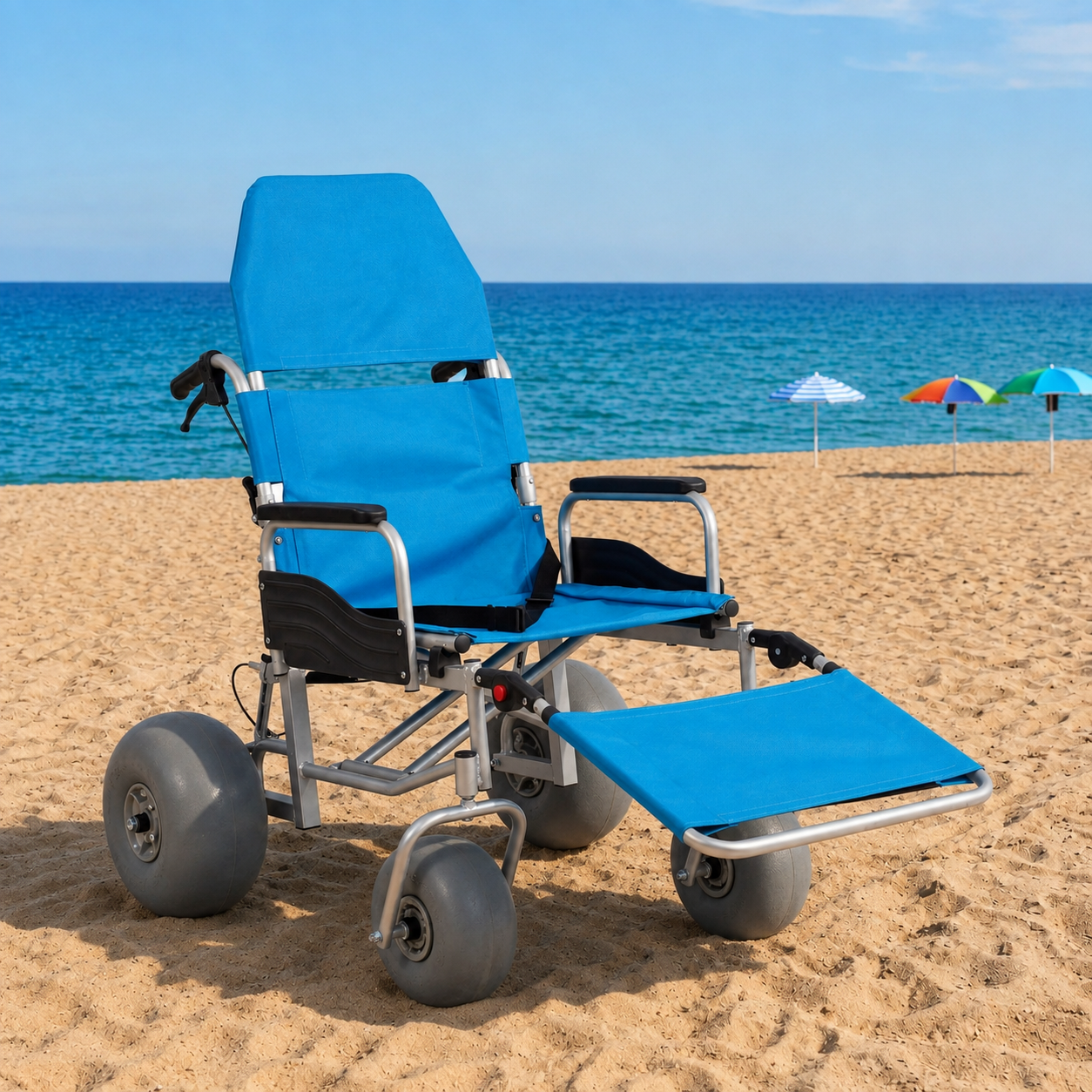
A wide tire still has to roll through the sand that is there today. The AY-ST-V2.0 manual lists four inflatable PU wheels and a recommended pressure of 2–4 psi front and rear. It gives no soft-sand distance or allowable grade for this trip. Keep the wheels within their specified range and use site observations to choose a route the team can support. AY-ST-V2.0 wheel specifications
Count the time available for the return
Suppose a visitor asks at 2:10 p.m. for a trip to a marked dry seating area. The assistant must be back at the desk by 3 p.m. A previous supported trial of this short route under comparable conditions allowed 12 minutes out and 18 back. With 10 minutes set aside for delays, the 50-minute window leaves 10 minutes at the destination. These figures illustrate scheduling only. Sand, the visitor’s wishes and today’s staffing can all change the plan.
If the visitor wants half an hour at the seating area, the desk can offer a later, longer appointment, an earlier turning place with a view or another staffed route. It would take 70 minutes to deliver the full stay under the example assumptions. A vague assurance that the assistant can “make up time” on the return leaves the visitor with the shortfall.
Agree what will end the outward leg
Before leaving firm ground, agree on the landmark where the group plans to turn, how the visitor can request an earlier return and how to reach the operator. Confirm that the promised person can stay for the whole trip. If the operator relies on a second person at the entrance, confirm their availability rather than assuming someone from the next shift will be there.
Stop extending the trip when the staff member can no longer confirm the return surface, assistance or time. Use the last checked option and explain the change while the visitor still has choices. Record the particular problem, such as a drift at the return ramp, so the next reviewer knows what to reassess. The route closure guide explains how to keep other available destinations visible when just one section is affected.