
The shortest path from a store to a beach kiosk may put a loaded cart through the deepest dry sand. A longer path along the promenade may leave only a short sand crossing and a firmer place to unload. Compare the whole delivery cycle, from the store door to the recipient and back. Count any extra handling needed at a gate, step or crowded crossing.
Map where the cart changes surface
Walk both options before moving goods. Mark the threshold at the store, end of the boardwalk, mat joins, soft patches, turns and authorized unloading position. Describe the sand you actually find, such as newly raked loose material or firm sand disturbed by a service vehicle. Record the date and recent conditions. Ask whether work, tides or public activity can change the approved corridor later in the day.
The standard molded tub cart runs on two wide 12-inch balloon wheels and is 86 cm wide across them. Check its full width against gates and passing places. The wheels do not establish whether the operator can control a particular load at a steep threshold or on a crossfall. Walk around a step or closed area only where the site authorizes another route. Public access matting may have its own restrictions on service carts. Standard cargo cart drawing and dimensions
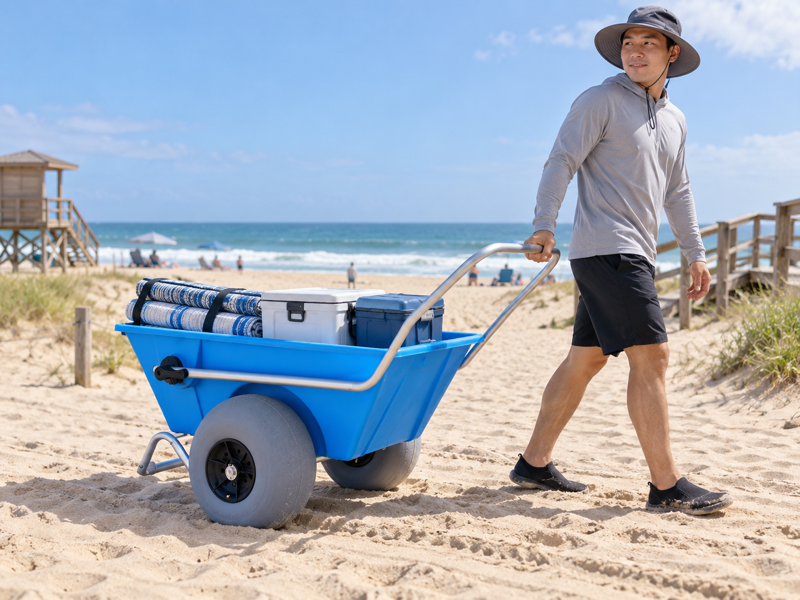
Observe the same delivery on both proposed lines
Begin with the empty, checked cart under the site’s handling arrangements. For a loaded trial, choose ordinary goods with known mass and dimensions within the documented configuration and local handling assessment. Use the same items and loading arrangement for both routes. Have a second person record observations from outside the working path.
| Point on the journey | Record the difference between routes |
|---|---|
| First pull from firm ground onto soft sand | Where the wheels sink, drag or skew and whether the operator retains comfortable control |
| Turn around a post or gate | Wheel and cargo clearance, space for the person pulling, and any need to stop or reposition |
| Crowded reach | Conflict with visitors, available passing place and whether delivery needs a different time window |
| Unloading and empty return | Suitable place to support the cart, who receives the goods, and whether the operator can regain the return path |
Stop if the cart becomes difficult to control, the cargo shifts or the path would put the operator or visitors in conflict. Record where the difficulty began and the load in place. A route that works empty can fail on the outward trip. Equally, a one-way delivery path may leave no way to turn the empty cart without entering a restricted area.
Write the delivery instruction from the trial result
Suppose the direct route needs a worker to restart a loaded cart several times in loose sand, while the longer route can use the firm promenade before public opening. Choose the longer route during its verified service window if it also has a workable unloading and return arrangement. If neither route works, consider a smaller split load, a different receiving point or postponing the delivery. Recheck any changed plan.
Give the next shift a named start, turn landmark, permitted delivery time, cargo configuration and condition that prompts another walk. A buried transition, new barrier or event crowd can invalidate yesterday’s result. The cargo load plan records what may travel together. Keep the route instructions alongside it so another crew can reproduce the trip.