
A PVC beach wheelchair procurement checklist should identify the complete offered assembly, its intended beach route and its service arrangements. Start with fixed PVC frame members, socket connections, seating and wheel attachments. Then compare quotations using the same configuration and receiving criteria.
Ary’s supplied photographs show a white PVC tubular assembly with blue fabric seating and four large wheels. Separate photographs show components removed for packing. That evidence supports a component-based purchasing review; it does not establish performance ratings or a folding mechanism. Browse the beach wheelchair range when defining your product shortlist.
Images are AI-generated illustrations based on product references. They do not document an actual inspection, factory visit, or project.
1. What service must the order support?
Describe where staff will issue, move, clean and store each chair. A public beach loan station has different handling needs from a resort with indoor storage. Buyers should give suppliers a marked route, doorway measurements and information about assistance arrangements.
List each intended route surface separately. A route may include paving, a boardwalk transition, dry sand and a designated stopping area. A product photograph on grass cannot answer how that route will work with your staffing.
- Name issue and return locations.
- Describe surfaces, turns and access restrictions.
- State planned supervision and excluded uses.
Write the service route before requesting a fleet price. Each supplier then receives an identical operating brief. Ask for a written response where offered equipment conflicts with your handling arrangements.
Our beach-access applications offer starting categories for that brief. Draw your actual route and attach photographs of its narrowest or most awkward sections.
Service brief for bidders
| Site detail | Procurement question | Buyer input |
|---|---|---|
| Issue point | Can staff prepare and hand over equipment here? | Space and staffing |
| Route transition | What trial should assess this connection? | Photos and measurements |
| Sand segment | Which conditions must a sample encounter? | Typical local condition |
| Storage | Does assembled equipment fit? | Clear access dimensions |
2. How should a fixed PVC frame be specified?
Describe the frame as its actual supplied assembly. In the reference photographs, white tubes connect through formed fittings around seat, back and arm areas. Record that layout and ask which connections remain permanently assembled and which may be separated during authorised handling.
Disassembly for shipping does not imply daily folding. Buyers need a repeatable assembly method and clear restrictions on connections. They also need confirmation of material identification, replacement policy and any surface-care requirements.
- Request a drawing or labelled assembly photograph.
- Identify each removable connection.
- Ask how permanent joints are identified and serviced.
Separate transport disassembly from daily operation. Staff should not have to discover that distinction after delivery. If routine dismantling forms part of your service plan, obtain an explicit written procedure.
Compare that requirement with alternative all-terrain wheelchair configurations during selection. Keep their frame assumptions separate from PVC procurement. Put approved assembly state on the purchase order.
Frame specification schedule
| Item | Detail to request | Why it affects ordering |
|---|---|---|
| Tube assembly | Identified material and layout | Confirms offered structure |
| Socket connections | Permanent or service-removable | Defines handling boundary |
| Support members | Supplied location and orientation | Supports assembly inspection |
| Replacement unit | Component or complete assembly | Determines repair stock |
3. What should a sample reveal about joints and alignment?
A sample review should examine joint condition and assembly accuracy under the supplier’s normal inspection method. Look at socket entrances, visible tube surfaces and alignment around the seat. Photograph cracks, separation, distortion or inconsistent seating of removable components.
Do not require weld inspection for this PVC assembly. Do not ask staff to force joints apart or apply plumbing adhesive as an acceptance remedy. If a joint appears loose, ask how its condition should be evaluated and corrected.
- Check corresponding connections on both sides.
- Compare installed parts with assembly references.
- Record visible damage before requesting a repair decision.
A joint description needs a location, not “frame issue.” Mark each finding on a photograph. A supplier can then identify a fitting and advise whether replacement concerns one part or a larger assembly.
Schedule sample inspection before committing fleet quantities. Include assembly and dismantling only where current instructions permit them, and preserve those results alongside the accepted configuration.
Sample joint review
| Location | Observation | Procurement follow-up |
|---|---|---|
| Back-support sockets | Alignment and visible separation | Confirm accepted assembly condition |
| Seat support connections | Cracks or displaced members | Resolve before sample acceptance |
| Arm-area fittings | Visible damage and matching layout | Confirm correct component |
| Removable interfaces | Assembly and retention behavior | Obtain handling instructions |
4. Which wheel details determine compatibility?
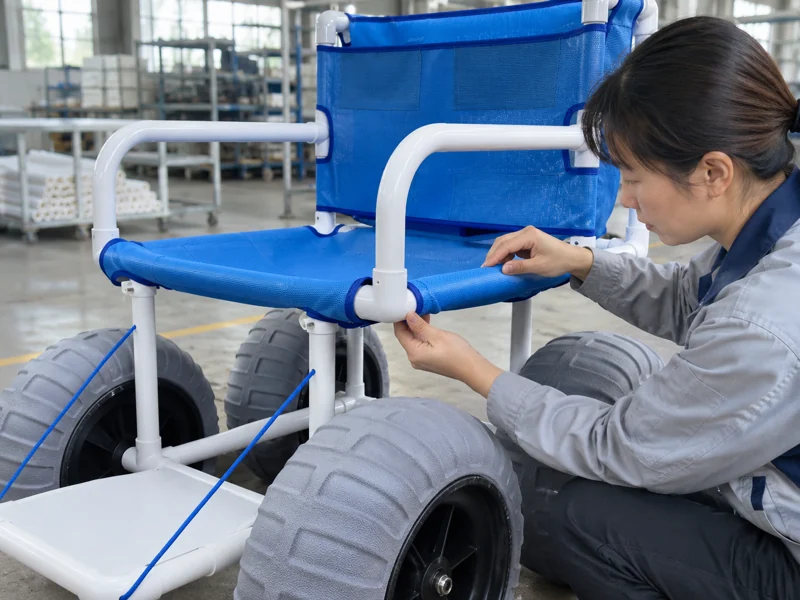
Order wheels as a complete matched arrangement, including mounting and retention components. A wheel diameter alone cannot identify compatibility. Ask for axle interface, hub arrangement, wheel location and replacement-part references tied to your offered chair.
The supplied PVC photographs show four large wheels and visible centre retention hardware. They do not provide verified dimensions or pressure instructions. Request those details from the supplier without transferring values from another model.
- Identify each wheel position and part reference.
- Confirm axle, hub and retention components together.
- Request applicable inflation and inspection instructions.
Price a usable replacement assembly. A low wheel price has little value if necessary mounting parts are omitted. Ask whether replacement quotations include those parts and their fitting instructions.
Use our beach balloon wheel information when framing compatibility questions. Approve wheel configuration after an instructed assembly check and a controlled route trial with appropriate local oversight.
Wheel purchase fields
| Field | Required clarification | Comparison mistake to avoid |
|---|---|---|
| Wheel identity | Part number and intended position | Matching by appearance |
| Hub interface | Compatible axle arrangement | Comparing diameter alone |
| Retention | Supplied fitting and replacement set | Omitting small hardware |
| Care | Model-specific inflation and inspection | Borrowing another pressure value |
5. How should buyers compare seating and support?
Ask for seat and back dimensions, attachment method and available support configuration in a current product sheet. Keep those supplier answers beside the exact sample photographs. Buyers can then compare equipment against their service requirements without claiming universal user suitability.
Inspect fabric, seams and fitted attachments. The reference configuration has fabric seat and back panels supported by its tubular assembly. Any added strap, cushion or support requires explicit identification and approval.
- Record supplied seat and back components.
- List optional accessories as separate order lines.
- Request replacement fabric and fitting information.
Buy the seating arrangement your team assessed. An accepted sample with one support configuration should not lead into a production order with another. Require written agreement before substitutions.
A mixed fleet may need several lightweight mobility equipment options for different services. Keep individual assessment separate from purchasing dimensions. Have your service lead review seating requirements before approving supplier drawings.
Seating comparison worksheet
| Component | Supplier response needed | Buyer review |
|---|---|---|
| Seat panel | Dimensions and attachment method | Service requirement match |
| Back panel | Support arrangement and replacement | Handover procedure |
| Foot or leg support | Exact supplied configuration | Intended use and fit review |
| Accessories | Included, optional or unavailable | Separate approval |
6. Which instructions must arrive before purchase approval?
Obtain assembly, permitted-use, inspection, cleaning and repair information for the offered PVC chair. A general brochure may identify a product family while leaving maintenance decisions unanswered. Review usable instructions before ordering a fleet.
Ask who may perform each task. Routine inspection, component replacement and structural repair can require different authority or skills. Written answers help buyers budget service support and prevent unauthorised repairs after a busy season.
- Request instructions matching sample configuration.
- Confirm excluded operating conditions.
- Identify service contact and required technician competence.
Read the repair boundary before buying spare fittings. A loose socket may require supplier service rather than a field replacement. Spare-parts availability alone does not authorise a repair.
Our manual resource page can start a document request. Ask for a PVC-specific pack if your exact assembly is absent. Public tender documents, such as the Beach Authority procurement example, illustrate document-based comparison but do not specify Ary products.
Instruction coverage
| Task | Document should answer | Resolve before order |
|---|---|---|
| Assembly | Which connections and sequence apply? | Unclear interfaces |
| Use | Which conditions and limits apply? | Missing model coverage |
| Cleaning | Which methods and products apply? | Unsupported chemical assumptions |
| Repair | Who may replace which components? | Undefined service responsibility |
7. What spare parts belong in an initial fleet package?
Build initial stock around compatibility and service interruption. Request separate prices for fabric panels, wheel assemblies and specified retention components. Include only parts your team may replace under approved instructions.
A new fleet has no local consumption history. Start with a documented purchasing assumption and revise stock after actual use. Keep complete assembly replacements available through an agreed supply route when field repair is unsuitable.
- Separate consumable stock from technician-only parts.
- Label compatibility by configuration.
- Confirm packaging and identification of small components.
Stock the parts staff can correctly identify. An unlabelled bag of similar clips creates another problem at repair time. Request a part reference and a diagram showing each location.
Ask the supplier about support arrangements using our sourcing information. Put lead times, availability terms and substitution approval in the quotation rather than assuming them.
Spare-parts planning groups
| Group | Initial planning question | Review after launch |
|---|---|---|
| Fabric components | Which panels are replaceable? | Damage and cleaning history |
| Wheel assemblies | What complete set can restore service? | Failures by wheel position |
| Retention parts | Which approved items may be lost? | Actual replacement frequency |
| Structural assemblies | What requires supplier intervention? | Downtime and repair outcomes |
8. How should packing support fixed-frame delivery?
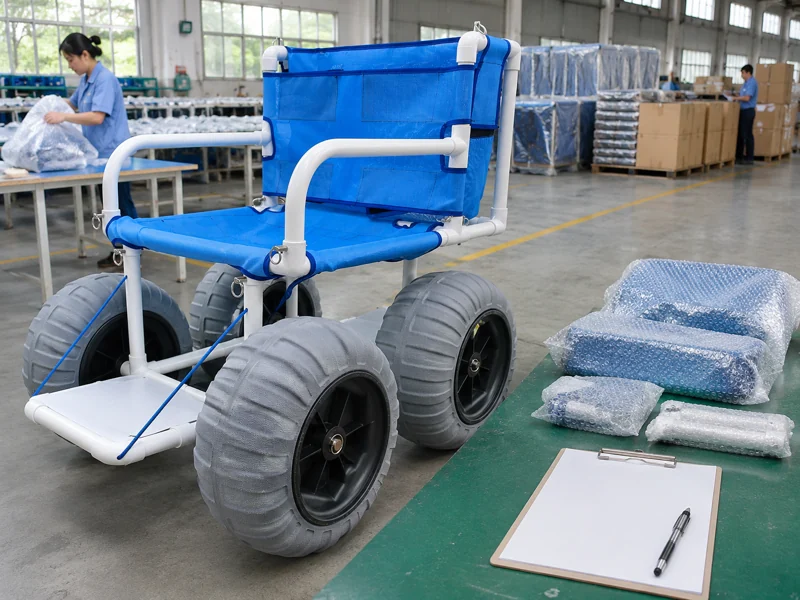
Request packed dimensions and a component allocation list for the actual shipping arrangement. Fixed frames can occupy substantial storage space even when some components are removed. Confirm whether quoted dimensions describe assembled equipment, a carton or a complete shipping unit.
Inspect sample packing around tubes, fabric and wheel interfaces. Loose components should remain identifiable when cartons are opened. Packaging photographs should show protection and component locations without becoming a substitute for a packing list.
- Identify assembled and removed components.
- Number packages where one chair spans several cartons.
- Include hardware and instructions in the allocation list.
Plan receiving space from packed and assembled dimensions. A shipment may fit a loading bay while assembled chairs cannot pass an internal doorway. Check both paths before order release.
Assign storage positions before arrival. For multi-site programmes, link package marks with destination and asset allocation so staff do not mix compatible but separately ordered components.
Packing comparison
| Packing field | Supplier entry | Receiving use |
|---|---|---|
| Packages per chair | Actual allocation | Completeness check |
| Assembly state | Parts removed for shipment | Labour and workspace planning |
| Protection | Contact and abrasion protection | Damage investigation |
| Package dimensions | Actual shipping unit size | Delivery access planning |
9. How can quotations be compared without hidden differences?
Compare identical technical scope before ranking total prices. Separate base chairs, selected accessories, spare parts, packing, delivery and services. A supplier should identify exclusions beside each relevant line.
Use a deviation register for configuration changes. A substitute wheel arrangement or revised assembly state may affect operations even when the total price remains unchanged. Give technical reviewers authority over those differences before commercial approval.
- Compare common quantities and configuration.
- List delivery responsibilities and receiving location.
- Record warranty wording and claim procedure.
A cheaper quotation may contain fewer usable items. Check component completeness against your accepted sample. Ask suppliers to price missing items explicitly instead of estimating them internally.
Send consolidated clarifications through Ary Beach procurement enquiries. Request one revised quotation incorporating agreed changes, then use that revision for the purchase order.
Quote comparison lines
| Cost or condition | Compare directly | Keep separate |
|---|---|---|
| Base configuration | Same assembly and quantity | Optional accessories |
| Spares | Complete identified parts | Unapproved substitutes |
| Delivery | Agreed destination and scope | Buyer-side services |
| Support | Written coverage and process | Unconfirmed expectations |
10. What must be closed before releasing a PVC wheelchair order?
Release the order after configuration, instructions, sample findings, packing and acceptance responsibilities agree. Each unresolved deviation needs a written decision. A fleet should not enter production with a seating substitution still awaiting review.
Attach reference photographs, parts list and current document versions. Define how receiving staff will compare delivery against those records. Include a route-trial plan separately because warehouse acceptance cannot establish performance under every beach condition.
- Approve fixed-frame assembly and permitted handling.
- Close sample faults and record accepted changes.
- Name the person authorising delivery acceptance.
Carry sample decisions into the production order. Copy your final accepted configuration rather than an earlier enquiry description. Require approval for later substitutions affecting joints, fabric, wheels or service parts.
Prepare one complete order pack and send it for confirmation. That pack should let another buyer identify exactly what was purchased without searching through disconnected messages.
Q1: Does a PVC frame mean this chair folds?
No. Confirm the structure of your actual chair. The supplied configuration uses a fixed tubular frame with specified removable components.
Q2: Can buyers specify plumbing fittings as replacement parts?
Use only approved components and repair methods for the chair. Similar appearance does not establish structural suitability.
Q3: Should PVC chairs use the same wheel pressure as AY-ST-V2.0?
Request instructions for the exact wheel assembly. A value from another model cannot establish the correct pressure.
Q4: Does PVC eliminate all maintenance?
No. Fabric, wheel interfaces, retention hardware and frame connections still need appropriate inspection and care.
Q5: Can a supplier change wheels after sample approval?
Require written review of compatibility, handling and documentation before accepting that change. Update the order and receiving reference together.