
A PVC beach wheelchair pre-season inspection should connect last season’s faults with present condition and completed repairs. Inspect fixed frame members and socket connections, seating, wheel interfaces and supplied hardware. Then run authorised functional checks and record who returned each chair to service.
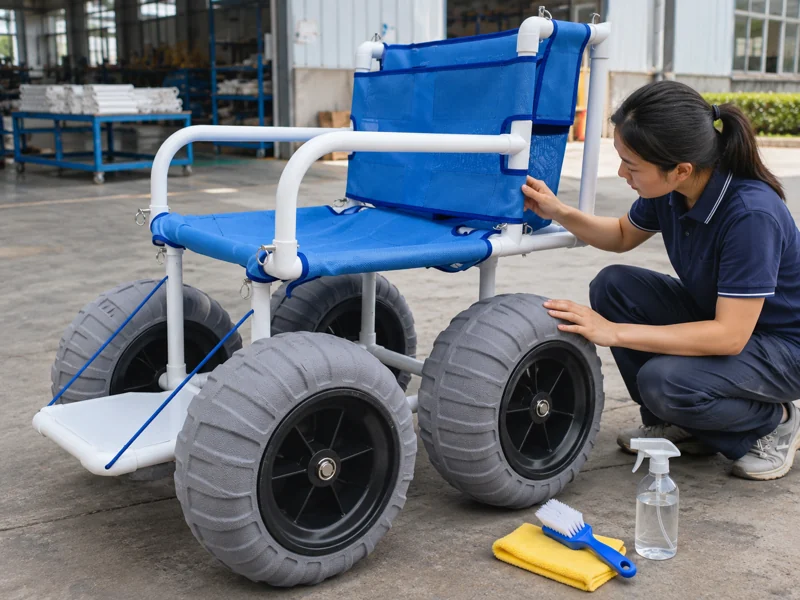
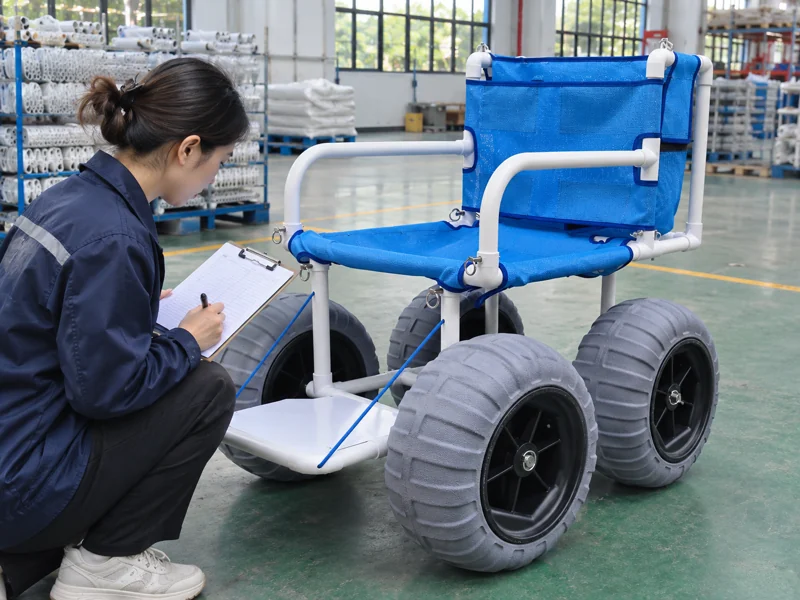
The white PVC configuration in Ary’s supplied photographs uses a tubular assembly with blue fabric panels and four large wheels. Its seasonal checklist should follow those parts. Use the beach wheelchair product range for initial identification, then obtain instructions matching your exact fleet configuration.
Images are AI-generated illustrations based on product references. They do not document an actual inspection, factory visit, or project.
1. What should staff retrieve before moving stored chairs?
Gather asset records, last-use findings and any unfinished repair orders before preparing equipment for reopening. A chair may look unchanged after storage while still carrying an unresolved fault from the previous season. Bring those items forward explicitly.
Count complete chairs and separated components together. If staff removed wheels or seating for storage, match each assembly with its asset or compatible group. Do not treat a storage shelf full of parts as a ready fleet.
- List assets expected for reopening.
- Retrieve unresolved defects and service advice.
- Identify missing or separated components.
Begin with last season’s unfinished work. Schedule repairs before promising equipment availability. This also prevents staff from discovering an old fault during a guest booking.
Use our manual hub when requesting a current instruction pack. Create one work card per asset with its previous findings visible at the top.
Reopening inventory
| Inventory entry | Retrieve | Immediate task |
|---|---|---|
| Complete chair | Asset and last-service record | Allocate inspection position |
| Separated component | Compatible asset reference | Match before assembly |
| Prior defect | Original description and photos | Confirm repair status |
| Missing documentation | Exact configuration identity | Request applicable instructions |
2. How should storage condition be recorded?
Photograph each chair before cleaning or reassembly. Record how fabric, frame members and wheels were supported during storage. Note visible distortion, contamination, pest activity or contact damage without assigning a cause prematurely.
Compare observations across assets stored in different locations. A pattern may point toward a storage practice needing correction. For example, several panels marked at the same contact point justify examining nearby shelving. That observation does not prove material failure.
- Record storage location and contact points.
- Photograph damp, contaminated or distorted areas.
- Separate unexplained damage from ordinary surface dirt.
Preserve a condition baseline before washing anything. Cleaning can remove evidence useful during a service discussion. Use wide photographs for context and close views for individual findings.
Keep questionable equipment outside the ready-to-use area. Assign cleaning or technical review according to each finding, then record results on the asset card.
Storage findings
| Observation | Inspect next | Record |
|---|---|---|
| Damp fabric | Contact surfaces and attachments | Affected area and storage condition |
| Uneven resting position | Frame alignment and supports | Full-chair views |
| Surface deposits | Underlying material after cleaning | Before-and-after photographs |
| Loose components nearby | Asset compatibility | Component count and identity |
3. What should technicians examine on fixed PVC members?
Inspect visible tubing and formed fittings around seat, back and arm structures. Follow connections systematically around both sides. Look for cracks, splitting, unusual deformation, separation or changed alignment. Note socket interfaces that differ from reference photographs.
The supplied assembly does not justify a metal-weld or folding-hinge checklist. Some connections may be removable for authorised assembly, while others remain permanent. Consult current instructions before moving, dismantling or repairing either type.
- Inspect accessible tube surfaces and socket entrances.
- Compare corresponding left and right connections.
- Record damage near load-supporting interfaces.
A suspect PVC joint needs technical review before reuse. Do not conceal a crack with tape or attempt an improvised adhesive repair. Request a repair disposition tied to that exact assembly.
For identification questions across mixed fleets, compare all-terrain wheelchair structures separately. Mark PVC findings directly on an asset photograph so technicians can locate them without dismantling unrelated parts.
Fixed-frame review
| Area | Condition concern | Required next step |
|---|---|---|
| Tube surface | Crack or pronounced deformation | Hold and seek service assessment |
| Socket entrance | Separation or damage | Compare approved assembly condition |
| Seat-support connection | Changed alignment | Identify affected assembly |
| Removable interface | Unclear engagement | Follow current assembly check |
4. How should fabric and fitted supports be checked?
Inspect seat and back panels after loose contamination has been removed using an approved method. Follow seams and attachment areas. Check whether fabric sits correctly across its supports and whether any section has shifted during storage.
Examine supplied foot or leg support only in the configuration actually fitted. Do not add an adjustment check from another chair’s form. Record optional straps or accessories separately and confirm their compatibility before including them in release.
- Look beneath accessible fabric folds.
- Check attachment condition on both sides.
- Identify tears, abrasion and separated seams.
Distinguish dirty fabric from damaged support. Cleaning may resolve contamination while a torn attachment still requires replacement. Record each of those outcomes separately.
When a guest needs another support arrangement, refer that decision through your service’s individual assessment process. Our application information can help define service scope, but maintenance staff should release only the inspected equipment configuration.
Fabric and support findings
| Finding | Inspection focus | Follow-up |
|---|---|---|
| Surface dirt | Material after cleaning | Complete hygiene review |
| Open seam | Seam length and attachment area | Hold affected assembly |
| Uneven fabric position | Correct mounting pattern | Resolve assembly or material cause |
| Unknown accessory | Part identity and intended mounting | Confirm before issue |
5. Which wheel checks matter after a storage period?
Check each wheel’s condition and mounting arrangement before rolling the chair. Look for visible damage, missing retention components and rubbing against adjacent parts. Review inflation only through current instructions for the exact wheel.
A wheel that turns while unloaded can still require further assessment. Record unusual resistance, noise or side movement observed during the authorised check. Do not invent acceptable play or pressure values from visual appearance.
- Identify wheel position and compatible assembly.
- Inspect accessible hub, axle and retention components.
- Check ordinary movement on firm, level ground.
Record wheel findings by position. “Front left wheel rubs near its support” gives service staff a starting point. “Wheels checked” does not preserve that observation.
Use our balloon wheel information when requesting component identification. Hold any asset with unresolved attachment or wheel damage and obtain the correct replacement assembly before retesting.
Wheel review by location
| Check | What staff record | Technical follow-up |
|---|---|---|
| Surface condition | Visible cuts or deformation | Determine repair or replacement |
| Rotation | Noise, drag or rubbing | Identify cause under approved procedure |
| Attachment | Fitted retention components | Confirm correct engagement |
| Inflation instruction | Applicable wheel reference | Resolve missing or conflicting value |
6. What should happen to pins and other removable hardware?
Review removable hardware against a component map. Some retention pieces may have been stored in bags or cartons after cleaning. Identify them before assembly rather than allocating similar-looking parts by convenience.
Check visible condition and intended engagement under current instructions. Do not assume every joint needs tightening. A PVC assembly may include different connection types, each with its own service boundary.
- Account for hardware at each specified location.
- Check for deformation, damage or incomplete engagement.
- Keep unmatched parts separate for identification.
Hardware belongs to a connection, not a communal bucket. Label approved spare sets with their part references. This helps staff avoid substitutions during a rushed reopening.
Request a parts diagram through Ary Beach support if original records cannot resolve an item. Recheck connections disturbed during replacement and record who performed that work.
Hardware reconciliation
| Situation | Staff response | Close when |
|---|---|---|
| Missing retention piece | Keep asset unavailable | Correct part installed and checked |
| Loose unidentified item | Photograph and isolate | Intended location confirmed |
| Damaged removable hardware | Request approved replacement | New part passes instructed check |
| Extra part after assembly | Reconcile with packing or service record | Its role is explained |
7. How should cleaning and inspection be sequenced?
Use inspection before cleaning for baseline photographs, then repeat affected observations after approved cleaning and drying. Sand, salt deposits or stored debris can hide cracks and abrasion. Cleaning also changes what staff can see around sockets and fabric interfaces.
A Surf Life Saving inspection checklist identifies cleaning, component condition and supplier instructions as maintenance subjects. Its generic checklist includes features absent from some PVC assemblies. Adapt your form to actual equipment rather than importing every line.
- Use methods permitted for fitted materials.
- Keep cleaned and uncleaned equipment distinguishable.
- Recheck previously obscured areas before release.
Cleaning completes only its own work item. It cannot close a structural defect or replace a wheel-function check. Keep separate sign-off fields where different staff perform those tasks.
Arrange enough drying space before reopening day. Avoid stacking damp fabric against other equipment while waiting for inspection.
Cleaning sequence
| Stage | Purpose | Output |
|---|---|---|
| Before cleaning | Preserve condition evidence | Baseline photographs |
| Approved cleaning | Remove permitted contamination | Cleaning record |
| Drying | Prepare materials for inspection and use | Condition confirmation |
| After cleaning | Examine exposed surfaces and connections | Updated defect findings |
8. What does a controlled functional check establish?
A functional check confirms ordinary instructed operation under the conditions recorded that day. Begin with an empty chair on a suitable firm, level area. After equipment condition is resolved, evaluate the planned service route through your approved local procedure.
Record surface transitions and stopping locations. An empty-chair check does not establish effort or suitability under every occupied condition. Any further trial needs appropriate oversight, a defined method and manufacturer limits.
- Record configuration used during checking.
- Note movement or clearance problems.
- Separate workshop results from route observations.
Keep route findings attached to their conditions. Dry sand and a changed access transition may produce different observations from an earlier visit. Do not extend one result across an entire season.
Review connections with beach access mats where your route includes them. Correct equipment faults before changing the route merely to hide a mechanical problem.
Functional check record
| Check stage | What it can establish | Record condition |
|---|---|---|
| Empty chair, firm ground | Ordinary movement and obvious interference | Surface and configuration |
| Transition review | Clearance at a named connection | Location and photographs |
| Approved service trial | Performance within recorded procedure | Method, assistance and conditions |
| Return check | Changes following trial | New findings or unchanged condition |
9. How should staff rehearse reopening procedures?
Give operating staff a chair that has completed equipment checks. Ask them to identify it, locate its instructions and demonstrate their assigned tasks. Include a simulated fault report so they practise changing availability status.
Do not use staff attendance alone as evidence of competence. Observe whether they can recognise missing hardware, report abnormal movement and prevent an unavailable asset from being issued. Keep technical repairs outside roles lacking authorisation.
- Demonstrate daily checks on actual fleet equipment.
- Practise identifying and isolating a suspect chair.
- Confirm where repair requests and booking updates go.
Practise the handover between operations and maintenance. A well-inspected chair can still enter service incorrectly if its status is unclear. Staff should know who may remove a hold tag.
For programmes shared across several beach-access projects, use consistent asset identifiers. Complete a supervised rehearsal before public reservations resume.
Reopening role rehearsal
| Role | Demonstration | Successful outcome |
|---|---|---|
| Issue staff | Find asset and current status | Correct chair selected |
| Operator | Perform assigned pre-use check | Faults recognised and reported |
| Maintenance | Receive a located defect report | Repair responsibility accepted |
| Duty lead | Change booking availability | Physical and digital status agree |
10. When can a repaired PVC chair return to service?
Return an asset only after the recorded fault has a documented resolution and affected checks have been repeated. Identify replaced parts, authorised work and final configuration. A supplier email confirming shipment of a replacement part does not establish completed repair.
Recheck nearby connections disturbed during work. Then update the asset card, physical tag and reservation system together. Keep unresolved chairs unavailable even if a seasonal launch date approaches.
- Match repair work with original defect descriptions.
- Repeat required connection and function checks.
- Record the person authorising release.
Reopening applies chair by chair. One completed asset cannot release an entire fleet. Publish your available quantity from signed records rather than total stock.
Create a reopening board with three groups: awaiting work, awaiting recheck and available. Move each chair only when its supporting record changes, and give staff the final available list before their opening shift.
Q1: Should staff test folding during a PVC chair inspection?
Only when the exact model has that mechanism. The supplied fixed PVC configuration needs checks of its actual connections and components.
Q2: Can cracked PVC be repaired with household adhesive?
Do not improvise a structural repair. Obtain an approved repair or replacement decision for the affected assembly.
Q3: Does a clean chair still need a seasonal check?
Yes. Cleanliness cannot establish joint condition, fabric integrity, correct hardware or wheel function.
Q4: What if a replacement part arrives on opening morning?
Keep that chair unavailable until authorised fitting and required rechecks are complete. Arrival alone does not close its repair record.
Q5: Should next season’s checks use the same form?
Keep useful asset history, but revise component lines after approved configuration changes and lessons from actual defects.