
A lightweight beach wheelchair acceptance inspection checks delivered units against an agreed purchase. Compare identity, quantities, packing, components, assembly, and function before releasing equipment into stock. Record shortages and defects against the affected unit.
This process uses the AY-ST-V3.0 lightweight beach wheelchair as its model context. Receiving acceptance follows purchasing approval. It does not replace an earlier sample evaluation, prove every future route suitable, or authorize changes that were absent from the order.
Images are AI-generated illustrations based on product references. They do not document an actual inspection, factory visit, or project.
1. What records should be ready before delivery arrives?
Prepare the purchase order, accepted configuration, packing list, agreed inspection criteria, and latest relevant instructions. Name the person who can resolve deviations. Receiving staff should not have to interpret scattered messages while a shipment waits for unloading.
Define which checks apply to every unit and whether any agreed sampling plan covers other characteristics. Do not invent a sample size after seeing the shipment. Where no plan exists, agree a receiving procedure appropriate to equipment and risk before release.
- List ordered model, quantities, and accessories.
- Identify approved changes since order placement.
- Prepare asset or receiving reference labels.
- Assign hold space and decision authority.
Receiving needs a fixed comparison before boxes open. Keep similar products from the beach wheelchair range on separate receiving lines. A familiar appearance cannot resolve an unidentified model or changed component.
Receiving references and their uses
| Reference | Compare against delivery | Question it resolves |
|---|---|---|
| Purchase order | Model and quantity | Was the agreed equipment supplied? |
| Configuration record | Components and accessories | Does this version match approval? |
| Packing list | Package contents | Is the shipment complete? |
| Accepted changes | Revised parts or scope | Was a difference authorized? |
2. How should packages and shipment quantities be checked?
Count packages before opening and record visible damage, wet areas, crushed corners, or broken closures. Photograph package markings beside wider views. Keep delivery paperwork and any recorded exceptions with the receiving reference.
Unpack carefully enough to preserve evidence of component protection and location. Do not discard packaging until completeness and condition questions have been addressed under your agreed procedure. Record missing packages separately from missing components within a received package.
- Count packages against shipping information.
- Photograph damage before contents move.
- Record markings and package identifiers.
- Keep each unit’s parts grouped during unpacking.
Package acceptance and equipment acceptance are separate events. A carrier handover confirms a delivery event; your receiving record should show whether product inspection remains pending. Follow applicable shipment procedures without assuming that an unremarked carton proves undamaged equipment.
Shipment discrepancy categories
| Finding | Record | Immediate action |
|---|---|---|
| Package count short | Expected and received count | Report shipment shortage |
| Damaged package | Exterior and contents photographs | Hold affected contents for inspection |
| Wet packaging | Location and component exposure | Check condition before release |
| Unclear package identity | Marks and delivery reference | Reconcile before allocating contents |
3. What confirms that each delivered chair matches the order?
Assign a receiving ID to each unit and link its components before assembly. Compare model identification, frame layout, seating, wheels, and included accessories with the approved configuration. Record substitutions even when they appear harmless.
The current V3.0 manual depicts a four-wheel folding chair with flip-back armrests and flip-up foot supports. Use those details for identification, then check the specific configuration purchased. A general product title is insufficient for accepting a different assembly.
- Photograph full unit and identification markings.
- Compare wheel positions and supplied assemblies.
- Confirm seating and accessories against the order.
- Link loose hardware to its intended unit.
An unexplained substitution stays on the discrepancy list. Ask purchasing to obtain a written disposition before acceptance. Do not combine parts from different units to create one complete chair without recording that allocation; doing so can hide the original shortage.
Identity and completeness record
| Comparison | Match required | If different |
|---|---|---|
| Model | Order and delivered identification | Hold for clarification |
| Wheel set | Approved front and rear assemblies | Record substitution |
| Seating and supports | Accepted configuration | Obtain disposition |
| Accessory quantity | Order and packing list | Record shortage or extra supply |
4. What frame and folding checks belong at receiving?
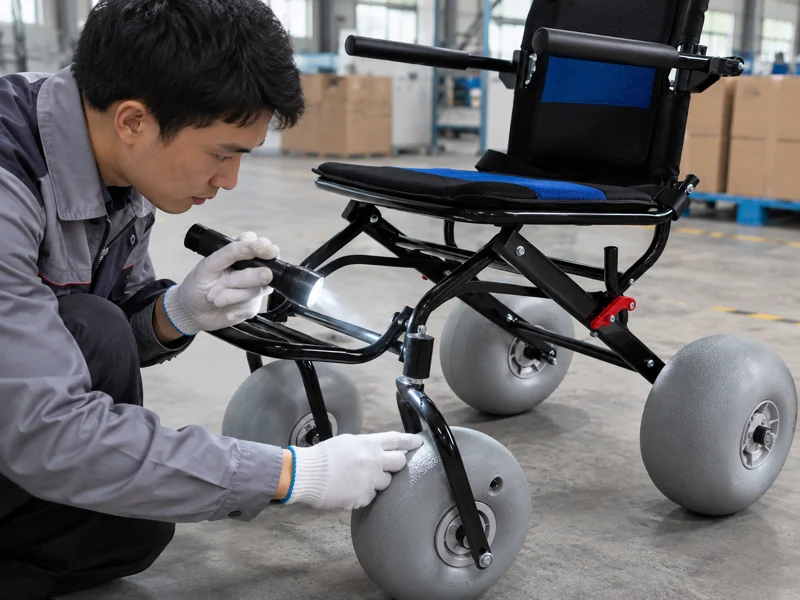
Inspect accessible frame surfaces, joints, brackets, and folding components before setup. Look for distortion, cracks, damage from contact during shipping, and interference between parts. Record condition in useful terms rather than writing “quality good.”
Follow the documented assembly and folding sequence. Do not force a joint or modify a bracket to close a receiving finding. After unfolding, confirm that the relevant lock engages.
- Inspect frame alignment on firm, level ground.
- Photograph dents, cracks, or bent brackets.
- Check closing joints for trapped fabric.
- Confirm folding-lock engagement as instructed.
Transit damage should be recorded before adjustment hides it. Keep a suspect unit on hold and ask for an approved response. If your site uses other beach mobility equipment, avoid transferring its folding procedure to this model.
Frame findings and disposition
| Finding | Receiving classification | Next step |
|---|---|---|
| Cosmetic mark | Compare with agreed finish criteria | Record disposition |
| Bent structural part | Mechanical concern | Hold unit |
| Folding interference | Assembly or damage question | Stop and clarify |
| Lock cannot engage | Functional failure | Correct under approved procedure, then recheck |
5. How should wheels and attachment hardware be checked?
Match each wheel assembly with its intended position, then inspect tyre surfaces, valves, hubs, axles, and retention parts. Confirm that installed parts agree with the assembly sequence. A wheel resting in place is not evidence that its retaining hardware has engaged.
Use applicable V3.0 inflation instructions for the supplied wheels. Record actual readings where required, with a suitable gauge. Do not copy a value from another model or a broad beach wheel product listing.
- Check each wheel’s identity and condition.
- Confirm attachment and retention.
- Observe free movement and clearance.
- Record unexplained drag or side movement.
Wheel condition and assembly completion require separate entries. Keep a missing clip distinct from a damaged tyre in the discrepancy record. This helps your supplier provide the right correction. It also prevents receiving staff from treating an unresolved assembly issue as normal setup.
Wheel-related receiving findings
| Finding | Specific record | Release requirement |
|---|---|---|
| Missing retainer | Unit and wheel position | Correct part fitted and checked |
| Damaged tyre or valve | Photo and location | Approved repair or replacement |
| Wheel rubbing | Position and movement affected | Cause resolved |
| Incorrect assembly supplied | Reference compared with order | Accepted disposition or correct supply |
6. What seating, armrest, and foot-support checks are needed?
Examine seat and back fabric, seams, attachment points, armrest movement, and foot-support operation. Check accessible edges where a user or attendant may make contact. Record whether all supplied adjustment parts are present.
Test only the movements described in current instructions. A mechanically functioning support does not establish an individual’s seating fit. Keep receiving acceptance focused on condition and ordered configuration; user assessment comes later.
- Look for tears and damaged seams.
- Confirm seating attachment completeness.
- Check armrest movement without forcing.
- Inspect foot supports and their connections.
A clean appearance cannot clear a loose support. Verify engagement and condition around each moving part. Relevant beach-access project contexts may shape future operation, but they do not change receiving criteria for a delivered chair. Record unexpected cushions or accessories as configuration questions.
Seating-area acceptance points
| Area | Inspect | Hold condition |
|---|---|---|
| Seat and back | Fabric, seams, attachments | Load-bearing damage or missing fitting |
| Armrests | Movement and attachment | Unintended looseness or interference |
| Foot supports | Condition and operation | Damaged or incomplete connection |
| Supplied belt | Webbing, buckle, mounting | Damage or incomplete assembly |
7. How should missing parts and instruction gaps be handled?
Prepare a unit-linked shortage list with component description, photograph, expected quantity, and received quantity. Include the relevant assembly step when a part cannot be identified. Avoid ordering a generic substitute before compatibility is confirmed.
Document gaps also affect release. Missing assembly guidance or contradictory component labels can prevent receiving staff from checking a unit properly. The Ary manual library provides a starting point. Supplier clarification should identify your exact delivered version.
- List shortages separately from damaged parts.
- Record the unit affected by each item.
- Identify the instruction page requiring clarification.
- Keep hold status visible during correspondence.
A reply must resolve the specific shortage or ambiguity. “Parts sent” does not close a record until received items match the request. Confirm quantity and identity on arrival, then complete installation and recheck before releasing equipment.
Shortage and document follow-up
| Open item | Ask for | Close when |
|---|---|---|
| Missing component | Compatible reference and quantity | Correct item received and fitted |
| Unidentified fitting | Annotated assembly explanation | Intended location confirmed |
| Wrong manual | Matching version | Assembly can be checked |
| Conflicting instruction | Written correction | Affected check completed |
8. Which functional checks complete unit inspection?
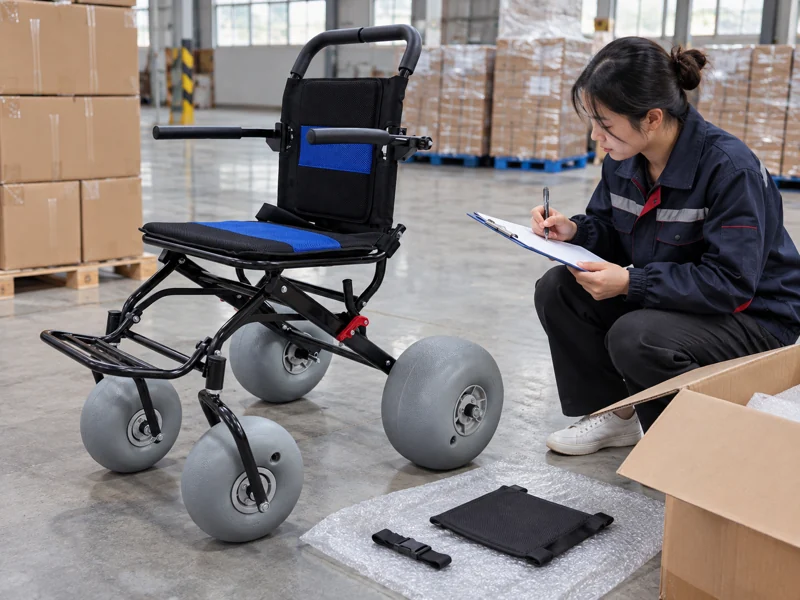
After identity, condition, and assembly checks pass, move the empty chair on firm, level ground. Observe rolling, turning, wheel clearance, and relevant adjustment or locking functions. Apply only checks supported by current instructions and the agreed acceptance procedure.
Stop at unexplained drag, noise, looseness, or failed engagement. Record the exact function and condition under which it occurs. Do not conduct an improvised overload test or use a person as a convenient test load.
- Check straight movement and turns.
- Recheck relevant locks after adjustment.
- Observe wheel and frame interference.
- Record each result against the unit ID.
A functional fault needs a documented recheck after correction. Send clear findings through Ary Beach support, including model and component location. A photograph may identify a part; a short movement description often explains the symptom more clearly.
Functional test record
| Function | Observation | Result handling |
|---|---|---|
| Straight rolling | Drag, rubbing, unusual noise | Hold unexplained fault |
| Turning | Wheel clearance and interference | Record direction and position |
| Folding lock | Engagement after setup | Hold failed engagement |
| Approved adjustments | Movement and selected-position security | Recheck after correction |
9. How should a delivery deviation be resolved?
Create one discrepancy record per issue, linked to all affected units. State the requested requirement, delivered condition, proposed correction, responsible person, and due point. Keep photographs and supplier responses with that record.
Distinguish acceptance of a commercial difference from permission to use faulty equipment. A price allowance does not repair a mechanical problem. Any proposed alternative part or configuration needs review before affected units are released.
- Identify every unit covered by the issue.
- Record correction, replacement, or return decision.
- Define what must be checked afterward.
- Preserve both original and corrected conditions.
The disposition must say what happens to each affected unit. If part of a delivery passes, record its separate release where your procedure permits. Keep held equipment physically identifiable so warehouse movement cannot accidentally change its status.
Disposition options
| Decision | Suitable situation | Required closure |
|---|---|---|
| Accept as ordered | Checks meet agreed requirements | Release record |
| Correct and reinspect | Approved repair or missing-part completion | Successful recheck |
| Accept documented deviation | Authorized, suitable difference | Written approval and revised reference |
| Replace or return | Difference cannot be accepted | Agreed logistics and reconciliation |
10. What should the final receiving record contain?
Issue a receiving summary that distinguishes ordered, received, accepted, and held quantities. Link each unit with its inspection result and any discrepancy record. State whether accessories and documentation are complete.
Transfer accepted units into the asset register with current instructions and maintenance records. Keep route authorization and user suitability separate from receipt. Equipment can meet an order while a local operating plan still needs work.
- Reconcile package, unit, and accessory quantities.
- List accepted and held unit IDs.
- Attach completed corrections and rechecks.
- Hand over manuals and asset records.
Release should make stock status unambiguous. Label available equipment only after its required checks are complete. Send the supplier a consolidated list of remaining delivery actions and keep those units unavailable until their disposition is closed.
Q1: Does an approved pre-order sample eliminate receiving checks?
Receiving checks confirm that delivered units match the approved configuration and arrived complete and undamaged.
Q2: Can one complete chair be assembled from parts across several cartons?
Keep parts linked to their delivery records. Any reallocation should be recorded so shortages and affected units remain traceable.
Q3: Should receiving staff repair a bent bracket immediately?
Record the original condition and obtain an approved disposition. Do not modify structural parts to make an inspection pass.
Q4: Can a payment discount close a mechanical defect?
A commercial adjustment does not establish equipment fitness. Mechanical issues still require a suitable correction or other approved disposition.
Q5: May accepted units be released while others remain held?
Where your receiving procedure permits, release clearly identified passing units separately. Preserve unit-level traceability and hold status for the rest.